Stanford CS229: Machine Learning | Summer 2019 | Lecture 23 - Course Recap and Wrap Up
TL;DR
In this lecture, Professor covers topics like logistic regression, perceptron algorithm, exponential family, generative models, kernel methods, neural networks, bias-variance trade-off, regularization, and reinforcement learning.
Transcript
this is lecture 23 of cs229 um so uh today we're going to just continue the the uh finals review that we started last class and uh we'll finish up the final review and ah that's going to be it so uh we we might finish a little early today all right um continuing the the uh the final reviews so in the last class we started off with supervised learni... Read More
Key Insights
- 🎏 The perceptron algorithm is a streaming algorithm used for classification that updates parameter vectors based on misclassifications.
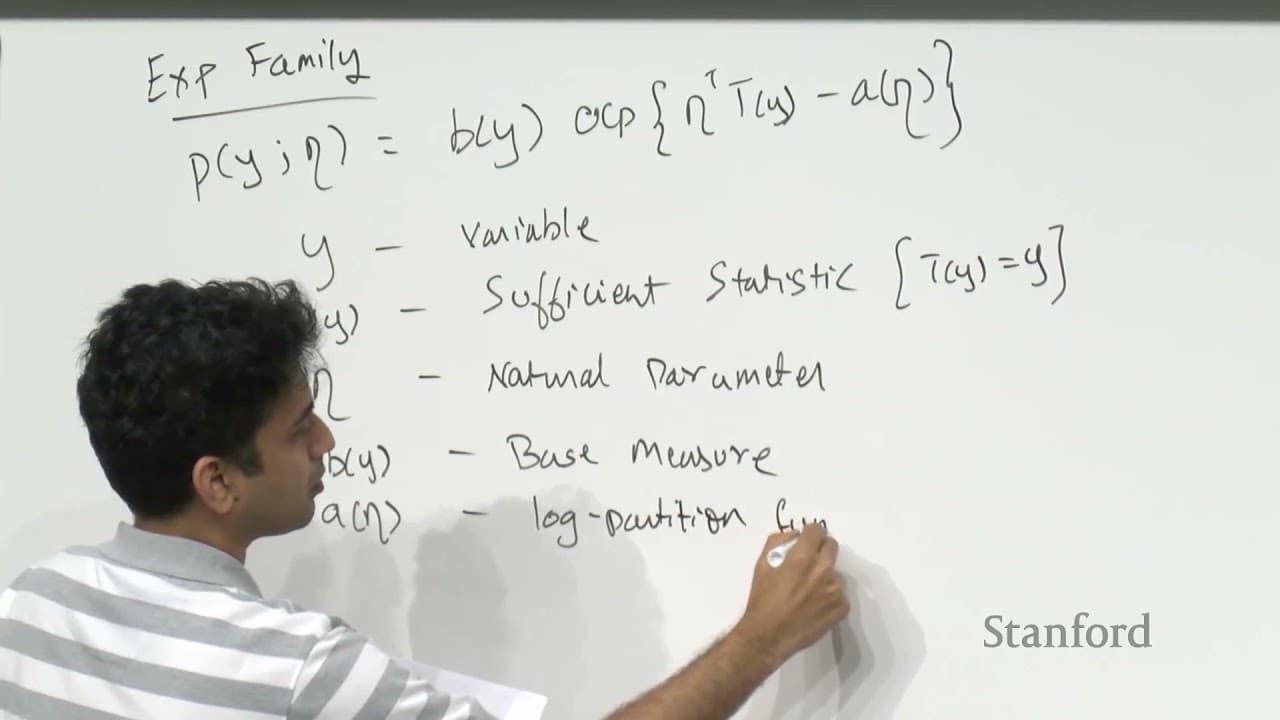
- 👪 The exponential family is a family of probability distributions with a specific form, and generalized linear models (GLMs) extend this by connecting inputs and outputs using linear models.
- 🌥️ Regularization adds a penalty for large parameter values to control model complexity and prevent overfitting.
- 🎰 The bias-variance trade-off is a fundamental concept in machine learning, balancing the ability of a model to fit the training data with its ability to generalize to unseen data.
- 🍉 Reinforcement learning involves sequential decision-making based on rewards and penalties, and it differs from other machine learning approaches in its focus on optimizing long-term cumulative rewards.
- 👻 Gaussian processes provide a framework for modeling complex patterns in regression problems, and the backpropagation algorithm allows for the calculation of gradients for neural networks.
- 💨 Kernel methods are a way to efficiently introduce non-linear features using a kernel function, which calculates the inner products of feature maps.
Install to Summarize YouTube Videos and Get Transcripts
Explore YouTube Video Summarizer or Get YouTube Transcript Extractor
Questions & Answers
Q: What is the perceptron algorithm and how does it update the parameter vector?
The perceptron algorithm is a streaming algorithm used for classification. It updates the parameter vector, theta, based on misclassifications. If the correct answer is 1 and the predicted answer is 0, the algorithm adds a small scalar times the input vector, x, to the parameter vector. This updates the decision boundary, improving classification.
Q: What is the difference between the exponential family and generalized linear models?
The exponential family is a family of probability distributions that have a specific form, while generalized linear models (GLMs) are an extension that connects inputs and outputs using linear models. GLMs introduce a linear model by re-parameterizing the natural parameter, eta, with the inputs, x.
Q: How does regularization help in machine learning models?
Regularization adds a penalty for large values of the parameters in a model to reduce complexity. It can be achieved by adding a term to the loss function that encourages smaller parameter values. Regularization helps control overfitting, as it discourages the model from learning complex patterns that may not generalize well to unseen data.
Q: What is the bias-variance trade-off in machine learning?
The bias-variance trade-off refers to the relationship between the model's ability to fit the training data (bias) and its ability to generalize to unseen data (variance). A model with high bias may not capture complex patterns in the data, while a model with high variance may overfit and fail to generalize. Balancing bias and variance is crucial for building effective machine learning models.
Summary & Key Takeaways
-
The lecture continues the review of supervised learning topics, including linear regression, logistic regression, Newton's method, and the perceptron algorithm.
-
The concept of the exponential family is introduced, which is a family of probability distributions that have a specific form.
-
The perceptron algorithm is explained as a streaming algorithm that updates the parameters based on misclassifications.
-
The lecture covers the use of kernel methods to introduce non-linear features efficiently.
-
Gaussian processes and their use in regression are discussed, along with the concept of bias-variance trade-off and regularization.
-
Finally, reinforcement learning and its application in sequential decision-making are introduced.
Read in Other Languages (beta)
Share This Summary 📚
Summarize YouTube Videos and Get Video Transcripts with 1-Click
Try YouTube Summary with ChatGPT & Claude or YouTube Transcript Generator
Explore More Summaries from Stanford Online 📚
Summarize YouTube Videos and Get Video Transcripts with 1-Click
Try YouTube Summary with ChatGPT & Claude or YouTube Transcript Generator