Gradient and graphs
TL;DR
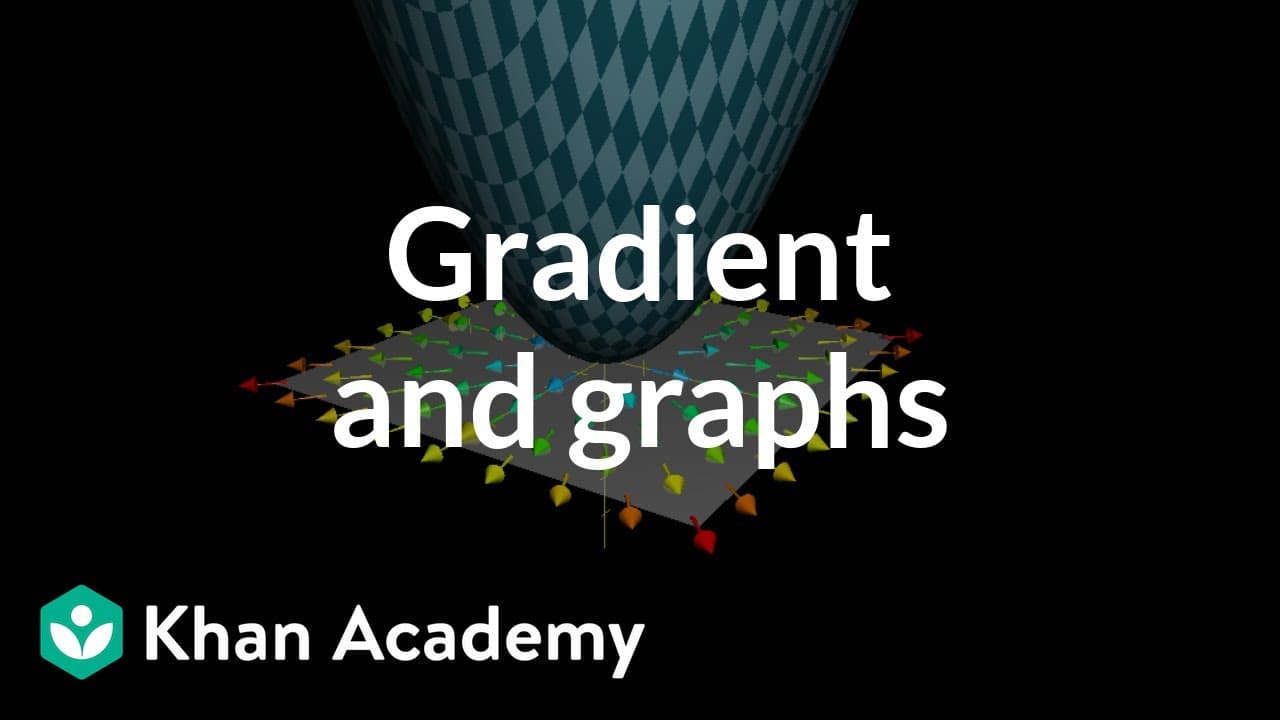
The gradient of a function on a graph can be visualized as a vector field, where the direction of the vectors indicates the direction of steepest ascent and the length represents the steepness of the ascent.
Transcript
- [Voiceover] So here I'd like to talk about what the gradient means in the context of the graph of a function. So in the last video, I defined the gradient, but let me just take a function here. And the one that I had graphed is x-squared plus y-squared, f of x, y, equals x-squared plus y-squared. So two-dimensional input, which we think about as ... Read More
Key Insights
- 🏑 The gradient of a function on a graph can be understood as a vector field, where the vectors indicate the direction and steepness of the steepest ascent.
- 🥺 Walking in the direction of the gradient at a specific point on the graph leads to the fastest increase in altitude.
- ❓ The length of the gradient vector represents the steepness of the ascent.
- 😥 The gradient vector points away from the origin, which is the steepest direction of ascent.
Install to Summarize YouTube Videos and Get Transcripts
Explore YouTube Video Summarizer or Get YouTube Transcript Extractor
Questions & Answers
Q: What is the gradient of a function on a graph?
The gradient of a function on a graph is an operator that outputs a vector with partial derivatives as its components, representing the slope or rate of change of the function.
Q: What does the vector field representation of the gradient show?
The vector field representation of the gradient shows vectors pointing away from the origin, indicating the direction of steepest ascent on the graph.
Q: How does the direction of the gradient vector relate to walking on the graph?
The direction of the gradient vector at a specific point on the graph represents the direction to walk in order to increase altitude the fastest. It points directly away from the origin, which is the steepest direction of ascent.
Q: What does the length of the gradient vector indicate?
The length of the gradient vector indicates the steepness of the direction of steepest ascent. Longer vectors represent steeper slopes, while shorter vectors represent shallower slopes.
Summary & Key Takeaways
-
The gradient of a function on a graph is an operator that takes a function with two-dimensional input and one-dimensional output, and outputs a vector with partial derivatives as its components.
-
The vector field representation of the gradient shows vectors pointing away from the origin, representing the direction of steepest ascent.
-
Walking along the graph, the direction of the vector at a specific point on the graph tells you the direction to walk to increase altitude the fastest.
Read in Other Languages (beta)
Share This Summary 📚
Summarize YouTube Videos and Get Video Transcripts with 1-Click
Try YouTube Summary with ChatGPT & Claude or YouTube Transcript Generator
Explore More Summaries from Khan Academy 📚



Summarize YouTube Videos and Get Video Transcripts with 1-Click
Try YouTube Summary with ChatGPT & Claude or YouTube Transcript Generator