What Is Surface Texture Measurement and Its Terminology?
TL;DR
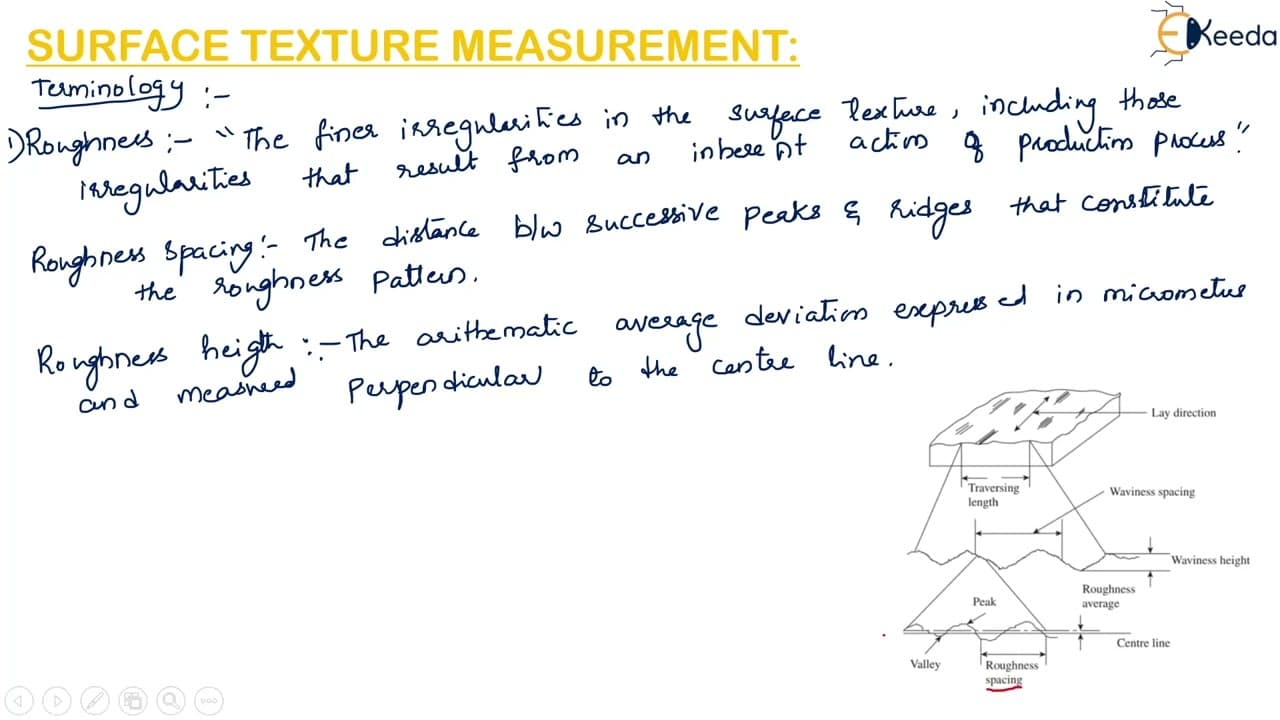
Surface texture measurement involves assessing surface irregularities like roughness and waviness, influenced by factors such as machining processes and tool geometry. Key terms include roughness, which refers to finer surface irregularities, and waviness, a broader texture component caused by incorrect tool geometry. Understanding these concepts is crucial for quantifying and improving surface quality in manufacturing.
Transcript
hello students today let us discuss the topic surface texture measurement so here we are going to learn the concept and the terminology of surface texture so if we take a look at the topology of a surface we can notice that there are surface irregularities which are superimposed on a widely spaced component of surface texture and it is called as th... Read More
Key Insights
- ❓ Surface irregularities, known as waviness, are a component of surface texture.
- 💋 Common factors causing surface irregularities include feed marks, chatter marks, rupture of workpiece material, surface vibrations, and irregularities in the machine tool.
- ❓ Surface roughness, influenced by machining processes, can be measured using parameters such as height and spacing of surface irregularities.
- 🔨 Waviness is caused by errors in the geometry of the tool producing the surface.
- ❓ Lay refers to the direction of the predominant surface pattern, determined by the manufacturing process.
- 🍘 Flaws are occasional irregularities like scratches, cracks, and blemishes on the surface.
- 🖐️ Surface texture encompasses roughness, waviness, lay, and flaws.
Install to Summarize YouTube Videos and Get Transcripts
Explore YouTube Video Summarizer or Get YouTube Transcript Extractor
Questions & Answers
Q: What are some factors that cause surface irregularities?
Surface irregularities can be caused by feed marks of cutting tools, chatter marks, rupture of workpiece material, surface vibrations, and irregularities in the machine tool itself.
Q: How is surface roughness quantified?
Surface roughness is quantified by parameters such as height and spacing of surface irregularities. It is important to distinguish one surface from another and is influenced by the machining process in mechanical engineering.
Q: What is waviness in surface texture measurement?
Waviness is a more widely spaced component of surface texture, with roughness being considered superimposed on a wavy surface. It is caused by errors in the geometry of the tool producing the surface.
Q: What is surface texture?
Surface texture refers to the repetitive or random deviations from the nominal surface that form a pattern. It includes roughness, waviness, lay, and flaws.
Summary & Key Takeaways
-
Surface irregularities, called waviness, are superimposed on a widely spaced component of surface texture.
-
Factors that cause surface irregularities include feed marks of cutting tools, chatter marks, rupture of workpiece material, surface vibrations, and irregularities in the machine tool.
-
Surface roughness is quantified by parameters such as height and spacing of surface irregularities, and it is influenced by the machining process in mechanical engineering.
Read in Other Languages (beta)
Share This Summary 📚
Summarize YouTube Videos and Get Video Transcripts with 1-Click
Try YouTube Summary with ChatGPT & Claude or YouTube Transcript Generator
Explore More Summaries from Ekeeda 📚





Summarize YouTube Videos and Get Video Transcripts with 1-Click
Try YouTube Summary with ChatGPT & Claude or YouTube Transcript Generator