What Is the Relationship Between Density and Specific Gravity?
TL;DR
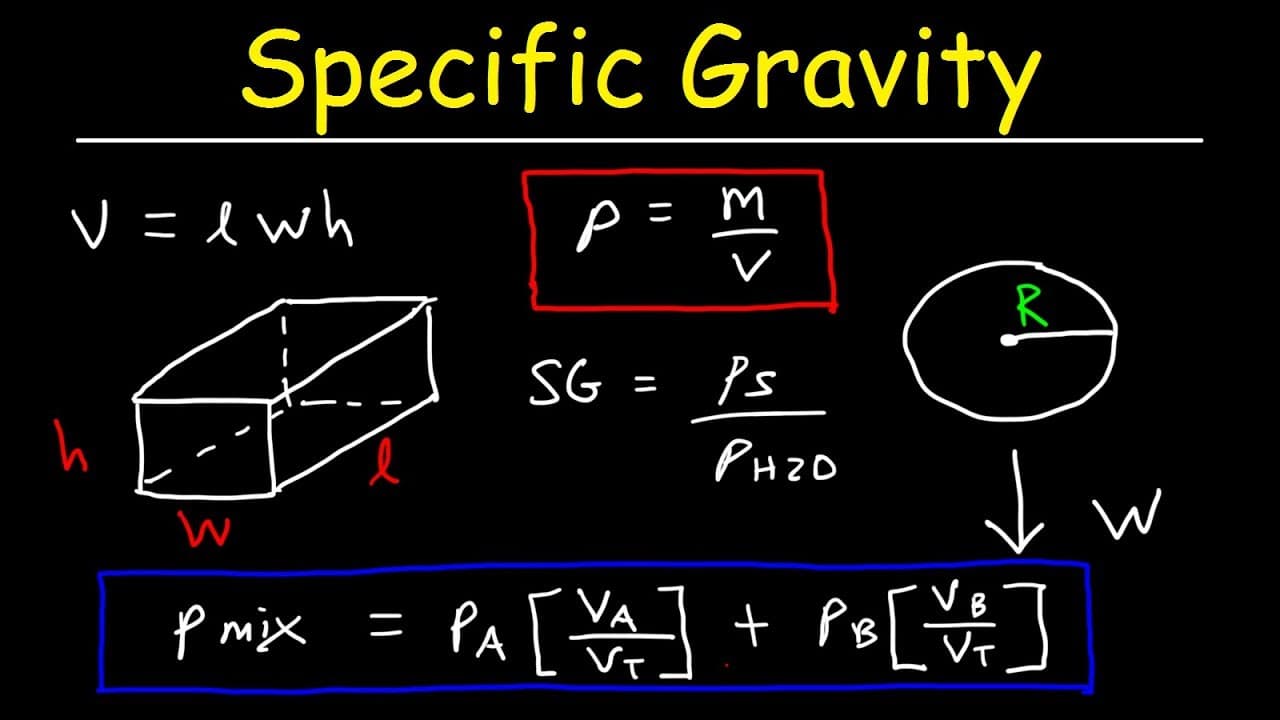
Density is defined as mass divided by volume, measured in kilograms per cubic meter. Specific gravity compares a substance's density to that of water, with no units. For example, aluminum has a density of 2,700 kg/m³ and a specific gravity of 2.7, while air has a density of 1.29 kg/m³ and a specific gravity of 0.00129.
Transcript
so in this video we're going to talk about density and specific gravity density in physics you'll see the symbol rho is mass divided by volume the density of water is 1 000 kilograms per cubic meter in physics this is the value that you want to use in chemistry you'll see this value the density of what is one gram per cubic centimeter the density o... Read More
Key Insights
- 🤒 Density is a fundamental concept in physics and is measured in kilograms per cubic meter.
- 💦 Specific gravity compares the density of a substance to that of water.
- 💦 The specific gravity of a substance can be determined by dividing its density by the density of water.
- 💆 In practice problems, the mass of a substance can be found by multiplying its density by its volume.
- 💆 The weight of an object can be calculated by multiplying its mass by the gravitational acceleration.
- 🥡 The density of a mixture can be determined by taking a weighted average of the densities of the individual components.
- 😚 The density of a mixture will be closer to the density of the component with a larger volume.
Install to Summarize YouTube Videos and Get Transcripts
Explore YouTube Video Summarizer or Get YouTube Transcript Extractor
Questions & Answers
Q: What is density and how is it calculated?
Density is the measurement of how much mass is packed into a given volume. It is calculated by dividing the mass of an object or substance by its volume.
Q: How is specific gravity different from density?
Specific gravity is a ratio that compares the density of a substance to the density of water. It is unitless and helps determine how dense a substance is relative to water.
Q: How do you calculate the mass of air in a room with given dimensions and density?
To calculate the mass of air in a room, you need to multiply the density of air by the volume of the room. The volume can be obtained by multiplying the length, width, and height of the room.
Q: How can the weight of a balloon filled with air be determined?
The weight of a balloon filled with air can be calculated by adding the mass of the air inside the balloon to the mass of the balloon itself, and then multiplying it by the gravitational acceleration.
Summary & Key Takeaways
-
Density is the ratio of mass to volume, commonly measured in kilograms per cubic meter.
-
The density of water is 1,000 kilograms per cubic meter, while the density of aluminum is 2.7 grams per cubic centimeter.
-
Specific gravity is the ratio of a substance's density to the density of water.
-
The specific gravity of aluminum is 2.7, while the specific gravity of air is 0.00129.
Read in Other Languages (beta)
Share This Summary 📚
Summarize YouTube Videos and Get Video Transcripts with 1-Click
Try YouTube Summary with ChatGPT & Claude or YouTube Transcript Generator
Explore More Summaries from The Organic Chemistry Tutor 📚




Summarize YouTube Videos and Get Video Transcripts with 1-Click
Try YouTube Summary with ChatGPT & Claude or YouTube Transcript Generator