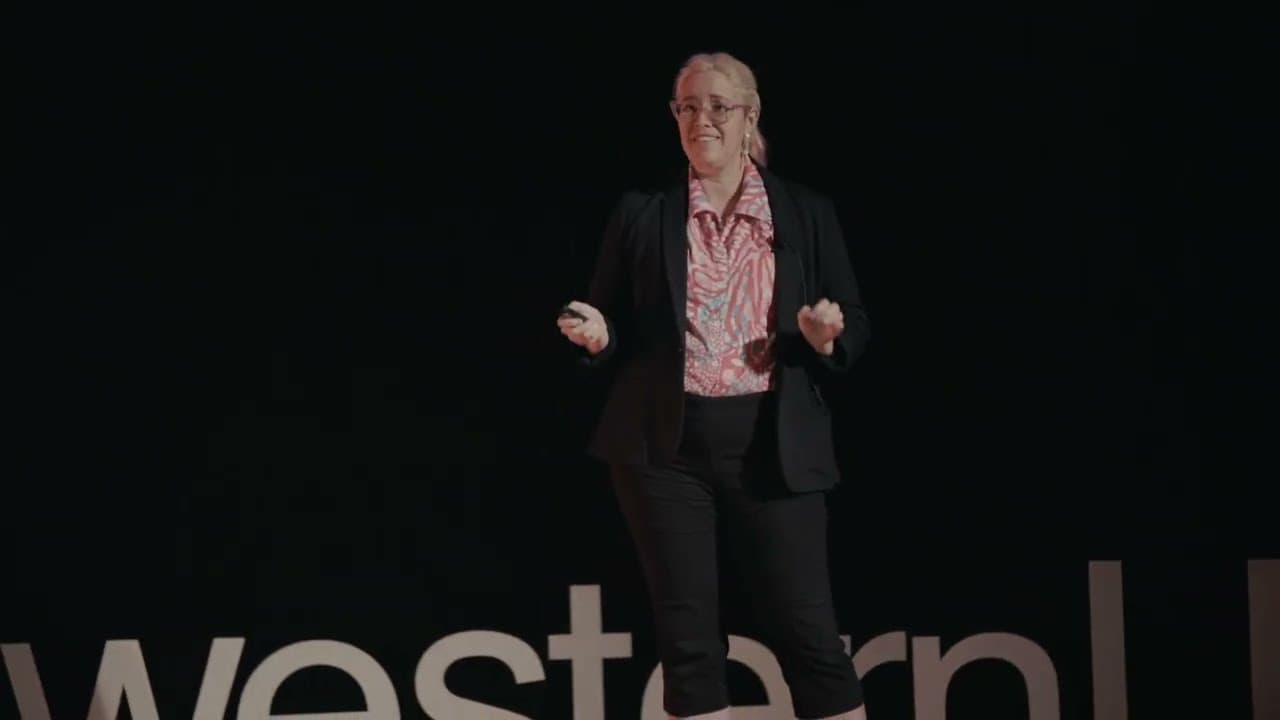
Liquid Art - A Different Perspective on Generative Art | Kate Compton | TEDxNorthwesternU
TL;DR
AI-generated art challenges traditional boundaries, creating a liquid art space with vast possibilities to explore socially and individually.
Transcript
all right we've all heard a lot about generative art it's in all the headlines so today I'm going to talk to you about AI generated art but I'm not going to be talking to you about how much better the models have gotten over the past six months or even what it's going to do to society which I know we're all really concerned about I'm actually going... Read More
Key Insights
- 🛰️ AI-generated art challenges traditional art forms by creating a liquid art space with infinite possibilities.
- 🥰 The interaction with AI art shifts from competition to coexistence, leading to the exploration of a different state of art.
- 🛰️ Designing for a liquid art space requires understanding geometric spaces and communal activities.
- 🥰 Seekers and Surfers approach exploring AI-generated art differently, with the former seeking specific pieces and the latter engaging in autotelic exploration.
- 🛰️ The shift from solid to liquid art spaces offers new dimensions for artistic expression and interaction.
- 🥰 Collaborative efforts in exploring AI-generated art create a dynamic environment for shared discovery and artistic interpretation.
- 🛰️ Naming and annotating landmarks in the art space form a social structure that enhances community engagement and exploration.
Install to Summarize YouTube Videos and Get Transcripts
Explore YouTube Video Summarizer or Get YouTube Transcript Extractor
Questions & Answers
Q: How does AI-generated art challenge traditional art forms?
AI-generated art creates a vast liquid art space with infinite possibilities, shifting the perception of art from solid to fluid, opening new avenues for exploration and interaction.
Q: What is the significance of the shift from solid to liquid art space in the context of AI-generated art?
The shift signifies a move from individual creation to a communal exploration of art, transforming how we perceive and engage with artistic creations, leading to new modes of expression and interpretation.
Q: How does one navigate the geometric spaces of AI-generated art?
Navigating these spaces involves understanding the possibility space, using collages to visualize the generator's range, mapping dimensional cubes for exploration, and utilizing natural language encoding for direct jumps in creativity.
Q: What are the differences between Seekers and Surfers in exploring AI-generated art?
Seekers focus on finding specific pieces in the space, using sliders, text encoding, and breeding techniques to navigate, while Surfers engage in a fluid conversation with the space, embracing autotelic exploration for the pleasure of moving.
Summary & Key Takeaways
-
AI-generated art challenges traditional solid art forms by creating a liquid art space with infinite possibilities.
-
The interaction with AI art shifts from competition to coexistence, leading to the exploration of a different state of art.
-
Designing for a liquid art space requires navigating geometric spaces, exploring communal activities, and understanding individual surfing and seeking approaches.
Read in Other Languages (beta)
Share This Summary 📚
Summarize YouTube Videos and Get Video Transcripts with 1-Click
Try YouTube Summary with ChatGPT & Claude or YouTube Transcript Generator
Explore More Summaries from TEDx Talks 📚
Summarize YouTube Videos and Get Video Transcripts with 1-Click
Try YouTube Summary with ChatGPT & Claude or YouTube Transcript Generator