Strategy in finding limits | Limits and continuity | AP Calculus AB | Khan Academy
TL;DR
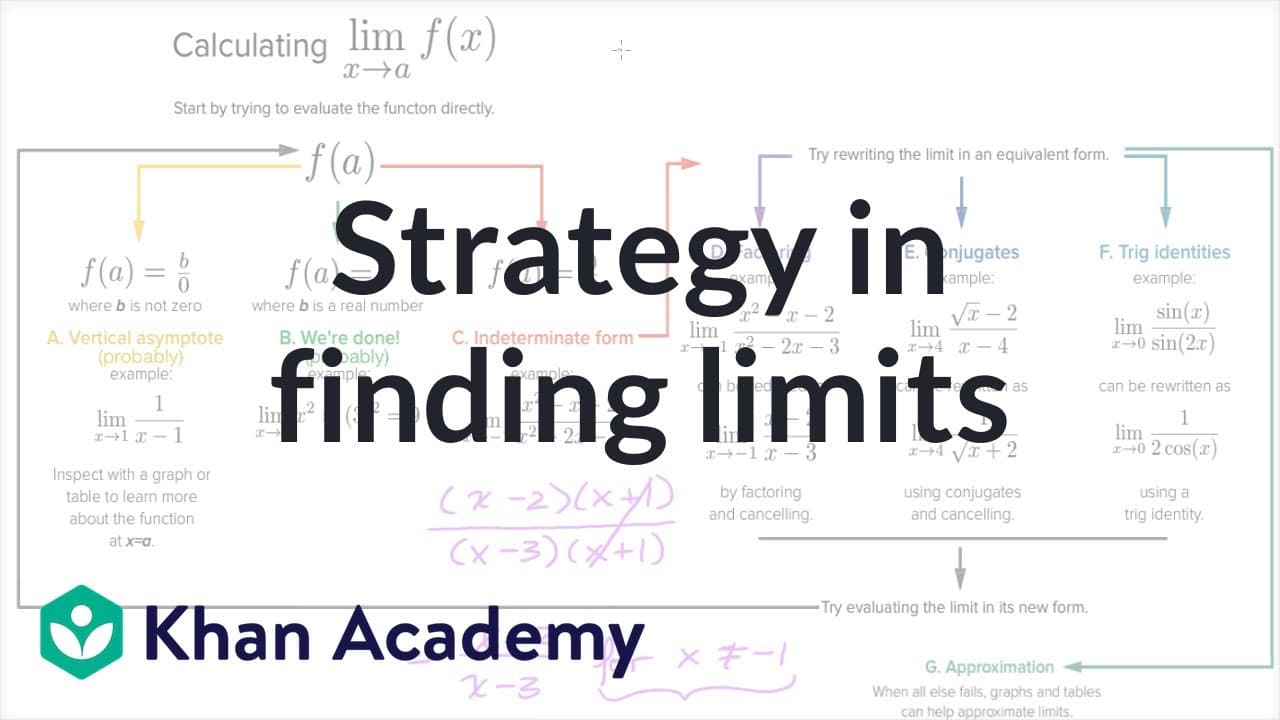
This video explains various techniques for finding limits, including substitution, vertical asymptotes, indeterminate forms, factoring, multiplying by conjugates, and using trig identities.
Transcript
- [Instructor] Multiple videos and exercises we cover the various techniques for finding limits. But sometimes, it's helpful to think about strategies for determining which technique to use. And that's what we're going to cover in this video. What you see here is a flowchart developed by the team at Khan Academy, and I'm essentially going to work t... Read More
Key Insights
- 😥 Evaluating the function at the given point is usually sufficient to find the limit for plain vanilla functions.
- 🚦 Vertical asymptotes occur when a function has a number divided by zero, indicating a sharp change in behavior.
- 💁 Indeterminate forms require additional techniques to simplify and find the limit.
- 😑 Factoring and multiplying by conjugates can help simplify expressions and determine the limit.
- 😑 Trig identities can be used to simplify trigonometric expressions and find the limit.
Install to Summarize YouTube Videos and Get Transcripts
Explore YouTube Video Summarizer or Get YouTube Transcript Extractor
Questions & Answers
Q: How can you determine the limit if f(a) is a real number?
If f(a) is a real number, evaluating the function at that point will give the limit, assuming no point discontinuity or jump discontinuity is present.
Q: What is a vertical asymptote?
A vertical asymptote occurs when evaluating a function at a certain point results in a number divided by zero. It represents a vertical line where the function approaches infinity or negative infinity.
Q: What should you do if you encounter an indeterminate form?
Indeterminate forms, such as zero over zero, require additional techniques like factoring or multiplying by conjugates to simplify the expression and find the limit.
Q: How can trig identities be used to find limits?
Trig identities can be used to simplify trigonometric expressions and find the limit. By applying the appropriate identities, the expression can be rewritten in a form that allows for direct evaluation.
Summary & Key Takeaways
-
The video introduces a flowchart that helps determine which technique to use when finding limits.
-
For plain vanilla functions that are continuous, evaluating the function at the given point usually gives the limit.
-
Vertical asymptotes occur when evaluating the function at the given point results in a number divided by zero.
-
Indeterminate forms, such as zero over zero, require additional techniques like factoring or multiplying by conjugates.
-
Trig identities can be used to simplify and find the limit of trigonometric expressions.
Read in Other Languages (beta)
Share This Summary 📚
Summarize YouTube Videos and Get Video Transcripts with 1-Click
Try YouTube Summary with ChatGPT & Claude or YouTube Transcript Generator
Explore More Summaries from Khan Academy 📚



Summarize YouTube Videos and Get Video Transcripts with 1-Click
Try YouTube Summary with ChatGPT & Claude or YouTube Transcript Generator