Invariant | Continuous and Discrete Time Systems | Signals and Systems
TL;DR
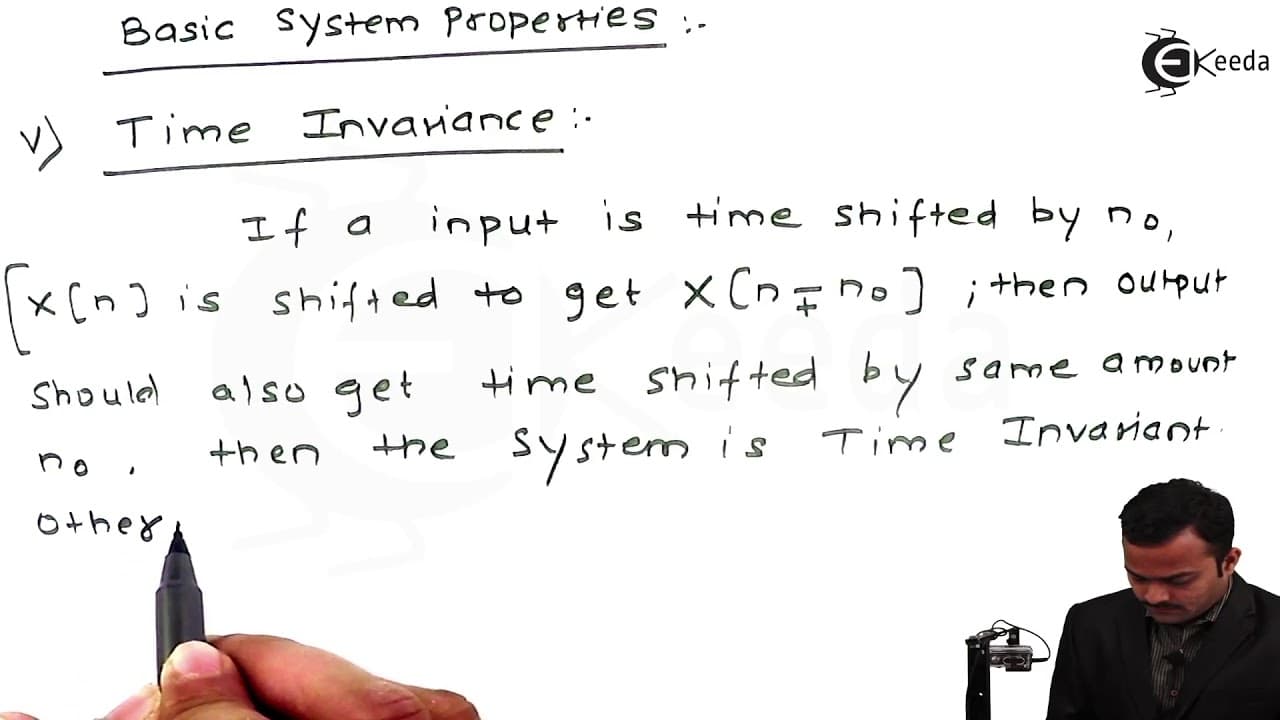
Time invariance refers to the property of a system where shifting the input signal results in a corresponding shift in the output signal.
Transcript
hi students in this video we are going to see basic system properties which is very important and called as time invariance so time invariance states if i am shifting the input signal and that signal if i pass through system whether the system is giving same shift at the output side or not based on that we can classify the system as time invariant ... Read More
Key Insights
- ❓ Time invariance is a crucial property in system analysis and classification.
- 📡 Shifting the input signal results in a corresponding shift in the output signal in time invariant systems.
- ⌛ Time invariance has both discrete time and continuous time representations.
- 👻 The property of time invariance allows for predictable and consistent system behavior.
- ⌛ Time invariance simplifies system analysis and design by enabling the use of time shifting operations.
- 🎮 Time invariance is a fundamental concept in signal processing and control system engineering.
- ⌛ The mathematical representation of time invariance involves comparing input and output signals after shifting.
Install to Summarize YouTube Videos and Get Transcripts
Explore YouTube Video Summarizer or Get YouTube Transcript Extractor
Questions & Answers
Q: What is time invariance in systems?
Time invariance in systems refers to the property where shifting the input signal by an amount n0 results in a corresponding shift of the output signal by the same amount. It determines whether a system is time invariant or time varying.
Q: What are the implications of a time invariant system?
In a time invariant system, any change in the input signal's timing will result in a corresponding change in the timing of the output signal. This property allows for predictable behavior and analysis of systems.
Q: How can time invariance be mathematically represented?
Mathematically, time invariance can be represented as follows: if a system has an input signal x(t) and the corresponding output signal is y(t), any shift in the input signal x(t), denoted as x(t - t0), should produce a corresponding shift in the output signal y(t - t0).
Q: Why is time invariance an important property of systems?
Time invariance is an important property because it enables analysis and understanding of how systems respond to changes in input timing. It allows for predictable behavior and makes it easier to design and analyze systems.
Summary & Key Takeaways
-
Time invariance determines whether a system will produce the same shift in the output signal when the input signal is shifted.
-
If the input signal is shifted by an amount n0, the output signal should also be shifted by the same amount for a system to be considered time invariant.
-
Time invariance is a fundamental property of systems and has both discrete time and continuous time representations.
Read in Other Languages (beta)
Share This Summary 📚
Summarize YouTube Videos and Get Video Transcripts with 1-Click
Try YouTube Summary with ChatGPT & Claude or YouTube Transcript Generator
Explore More Summaries from Ekeeda 📚





Summarize YouTube Videos and Get Video Transcripts with 1-Click
Try YouTube Summary with ChatGPT & Claude or YouTube Transcript Generator