Centripetal Force Physics Problems - Calculate Tension & Maximum Speed - Uniform Circular Motion
TL;DR
Centripetal force is the force that keeps an object moving in a circular path, and it can be provided by tension, gravity, static friction, or magnetic force.
Transcript
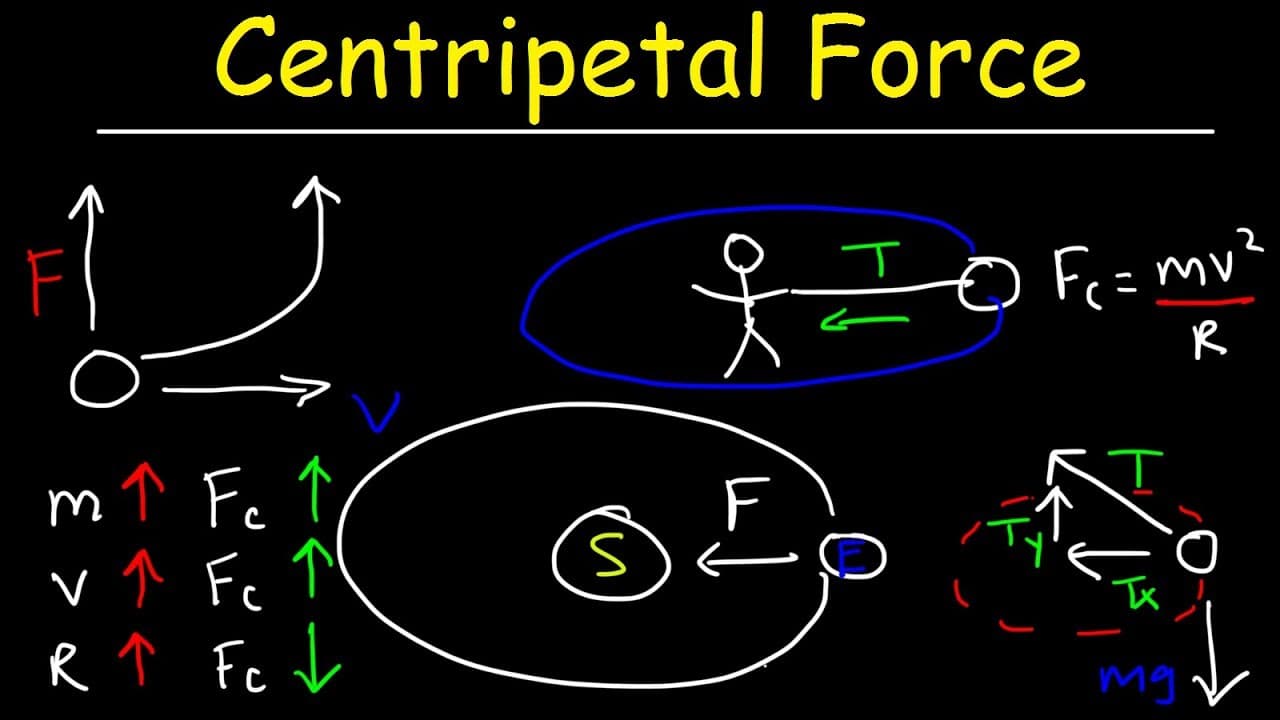
so let's say if you have a ball and the ball is moving to the right and there's a force that's acting on the ball and it's parallel to the velocity vector what's going to happen to the ball if the force and velocity vectors are parallel the ball is going to speed up now what if the force and the velocity vectors are anti-parallel if they're opposit... Read More
Key Insights
- 🐎 Centripetal force causes objects to move in a circular path and can result in speeding up, slowing down, or changing direction.
- ❓ Four common examples of centripetal forces are tension, gravity, static friction, and magnetic force.
- 💆 The centripetal force equation, Fc = mv^2/r, relates the force to the mass, speed, and radius of the circular path.
- 💆 Increasing mass or speed will increase the centripetal force, while increasing the radius will decrease it.
- 😨 Decreasing speed and increasing the radius can help reduce the sensation of being pushed outward during car turns.
Install to Summarize YouTube Videos and Get Transcripts
Explore YouTube Video Summarizer or Get YouTube Transcript Extractor
Questions & Answers
Q: What is centripetal force?
Centripetal force is the force that keeps an object moving in a circular path. It can cause the object to speed up, slow down, or change direction.
Q: What are some examples of centripetal forces?
Some examples of centripetal forces include tension in a rope, gravity in planetary orbits, static friction in car turns, and magnetic force in moving charges in a magnetic field.
Q: How does the centripetal force equation work?
The centripetal force equation, Fc = mv^2/r, relates the centripetal force (Fc) to the mass (m), speed (v), and radius (r) of the circular path. It shows that an increase in mass or speed will increase the centripetal force, while an increase in radius will decrease it.
Q: How does centripetal force affect car turns?
When making a sharp turn at high speed, the centripetal force is large, causing the sensation of being pushed outward. Slowing down and making wider turns can decrease this sensation.
Summary & Key Takeaways
-
Centripetal force causes an object to speed up when the force and velocity vectors are parallel, slow down when they are antiparallel, and change direction at constant speed when they are perpendicular.
-
Centripetal force is not a new force, but rather a force provided by another force, such as tension, gravity, static friction, or magnetic force.
-
The centripetal force equation is Fc = mv^2/r, where Fc is the centripetal force, m is the mass of the object, v is the speed, and r is the radius of the circular path.
Read in Other Languages (beta)
Share This Summary 📚
Summarize YouTube Videos and Get Video Transcripts with 1-Click
Try YouTube Summary with ChatGPT & Claude or YouTube Transcript Generator
Explore More Summaries from The Organic Chemistry Tutor 📚
Summarize YouTube Videos and Get Video Transcripts with 1-Click
Try YouTube Summary with ChatGPT & Claude or YouTube Transcript Generator