Conference on Diversity & Inclusion in Economics, Finance, & Central Banking: Panel
TL;DR
Central banks play a role in addressing inequality through monetary policy, but it is not their primary tool. They should consider the distributional consequences of their policies and work towards diversity and inclusion within their institutions.
Transcript
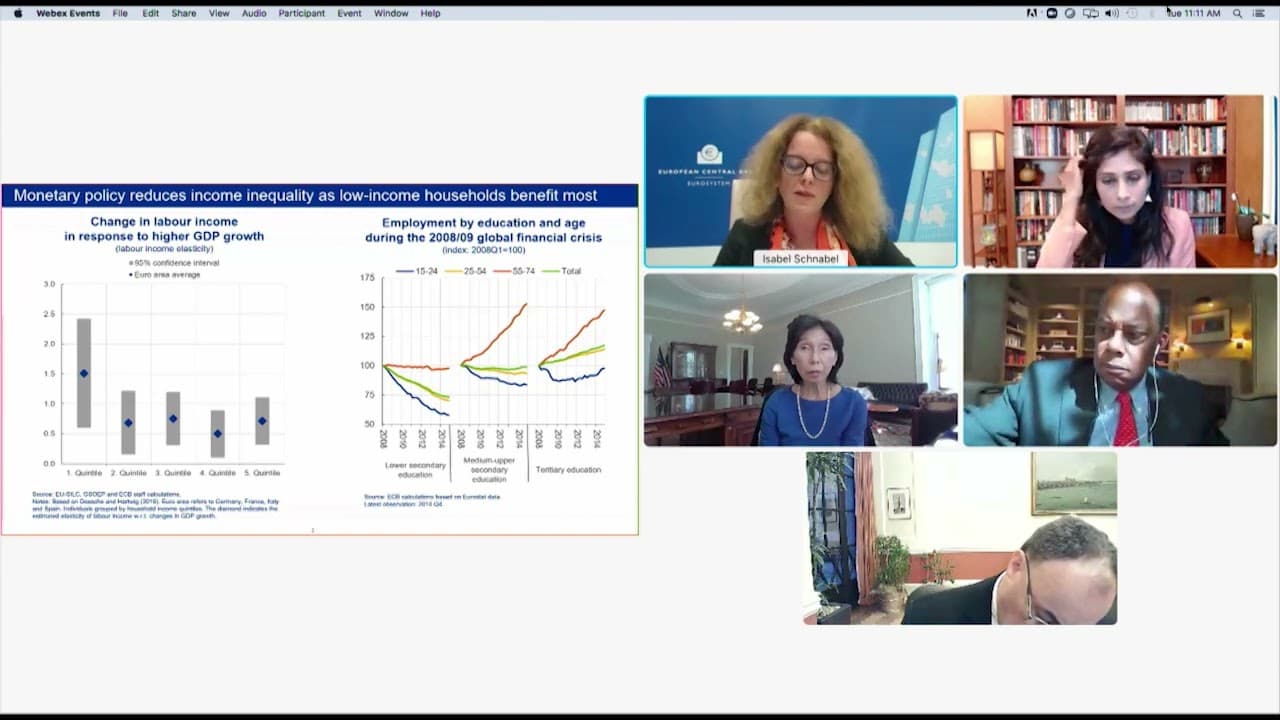
welcome everyone to this uh panel discussion on central banks and inequality we're going to base this discussion around two big questions one is on monetary policy and inequality and then a second topic around the role of central banks in addressing diversity and inclusion not just in the prof in their institutions but also more widely in the econo... Read More
Key Insights
- 🔨 Monetary policy has distributional consequences, but it is not the primary tool for addressing inequality.
- 🏦 Central banks have a responsibility to consider the social impacts of their policies and promote diversity and inclusion within their institutions.
- 🖤 The economics profession lacks diversity and central banks can play a role in addressing this issue through targeted hiring, training, and support programs.
Install to Summarize YouTube Videos and Get Transcripts
Explore YouTube Video Summarizer or Get YouTube Transcript Extractor
Questions & Answers
Q: How does monetary policy affect inequality?
Monetary policy can have distributional consequences, as changes in interest rates and asset prices can impact different income groups. However, the overall effect on inequality is dependent on various factors and other policy measures are needed to address structural inequality.
Q: What is the role of central banks in promoting diversity and inclusion?
Central banks can promote diversity and inclusion within their institutions by implementing targeted hiring and recruitment procedures, providing training programs, and encouraging mentorship and support for underrepresented groups. They can also use their influence in the economics profession to advocate for greater diversity.
Q: How can central banks balance their primary mandate with addressing inequality?
Central banks should prioritize their primary mandate of maintaining price stability while also considering the distributional impacts of their policies. They can communicate openly about their trade-offs and work towards policies that minimize negative side effects and promote inclusive growth.
Q: What actions can central banks take to address inequality and diversity in the economics profession?
Central banks should actively promote diversity in hiring and recruitment practices, provide support and mentorship programs for underrepresented groups, and collaborate with universities and academia to encourage diversity in the economics profession.
Summary & Key Takeaways
-
Lower interest rates associated with monetary policy can lead to increases in asset prices, benefiting the wealthy and raising concerns about inequality.
-
However, monetary policy also has benefits for low-income workers, such as creating more employment opportunities and lowering borrowing costs.
-
While monetary policy alone cannot solve inequality, central banks should consider the social impacts of their policies and be proactive in promoting diversity and inclusion.
Read in Other Languages (beta)
Share This Summary 📚
Summarize YouTube Videos and Get Video Transcripts with 1-Click
Try YouTube Summary with ChatGPT & Claude or YouTube Transcript Generator
Explore More Summaries from Federal Reserve 📚





Summarize YouTube Videos and Get Video Transcripts with 1-Click
Try YouTube Summary with ChatGPT & Claude or YouTube Transcript Generator