Bayesian Networks 3 - Probabilistic Programming | Stanford CS221: AI (Autumn 2021)
TL;DR
Probabilistic programming is a new way to define Bayesian networks through writing programs, highlighting the generative process aspect of Bayesian networks.
Transcript
hi in this module i'm going to talk about probabilistic programming new way to think about defining bayesian networks through the lens of writing programs and this really is going to highlight the generative process aspect of bayesian networks so recall in bayesian networks is defined by a set of variables there are directed edges between the rando... Read More
Key Insights
- 👶 Probabilistic programming offers a new approach to defining Bayesian networks by writing programs.
- 👻 It allows for the modeling of various scenarios, such as object tracking, language modeling, document classification, and disease diagnosis.
- 🎰 Probabilistic programming reverses the traditional machine learning paradigm by focusing on how quantities of interest generate observed data.
- 💨 It provides a flexible and intuitive way to define joint distributions and perform probabilistic inference.
- ❓ Different probabilistic programming models, such as hidden Markov models and factorial hidden Markov models, can be used to capture different dependencies and generate joint distributions.
- ❓ Naive Bayes and Latent Dirichlet Allocation are popular models in text analysis, and they can be defined using probabilistic programming.
- 💁 Probabilistic programming can handle missing information naturally in the modeling process.
Install to Summarize YouTube Videos and Get Transcripts
Explore YouTube Video Summarizer or Get YouTube Transcript Extractor
Questions & Answers
Q: What is the key idea behind probabilistic programming?
The key idea behind probabilistic programming is to define Bayesian networks through writing programs, where the program itself serves as a mathematical construct to define the joint distribution over random variables.
Q: How can probabilistic programming be used in object tracking?
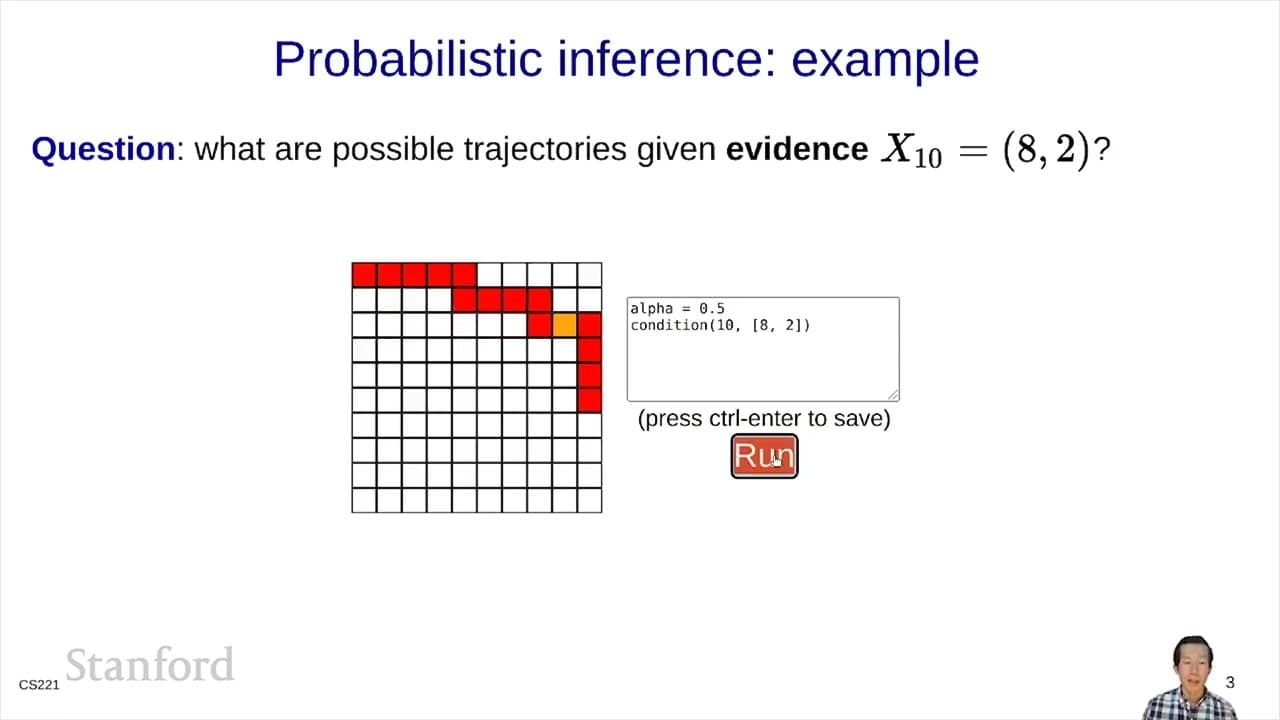
In object tracking, probabilistic programming can be used to generate the locations of objects at different time steps, along with sensor readings. By running the program, trajectories of the objects can be simulated and visualized.
Q: What is the difference between naive Bayes and Latent Dirichlet Allocation (LDA)?
Naive Bayes is a fast classification model, where a document's class or label is generated along with individual words in the document. LDA is an extension of naive Bayes, allowing for multiple topics in a document, generating a distribution over topics and words for each position in the document.
Q: How can probabilistic programming be used in disease diagnosis?
In disease diagnosis, probabilistic programming can model the activities of diseases and symptoms. By specifying dependencies between diseases and symptoms, the program can be used to infer possible diseases given observed symptoms.
Summary & Key Takeaways
-
Probabilistic programming allows for the writing of programs that are equivalent to defining the joint distribution in a Bayesian network.
-
Probabilistic programs can be used to model various scenarios, such as object tracking, language modeling, document classification, and disease diagnosis.
-
The paradigm in probabilistic programming is to think about how quantities of interest generate the observed data, rather than starting with inputs and defining operations to produce outputs.
Read in Other Languages (beta)
Share This Summary 📚
Summarize YouTube Videos and Get Video Transcripts with 1-Click
Try YouTube Summary with ChatGPT & Claude or YouTube Transcript Generator
Explore More Summaries from Stanford Online 📚

Summarize YouTube Videos and Get Video Transcripts with 1-Click
Try YouTube Summary with ChatGPT & Claude or YouTube Transcript Generator