How Can Claude Code Re-Create a Markov Model Quant Trading Strategy?
TL;DR
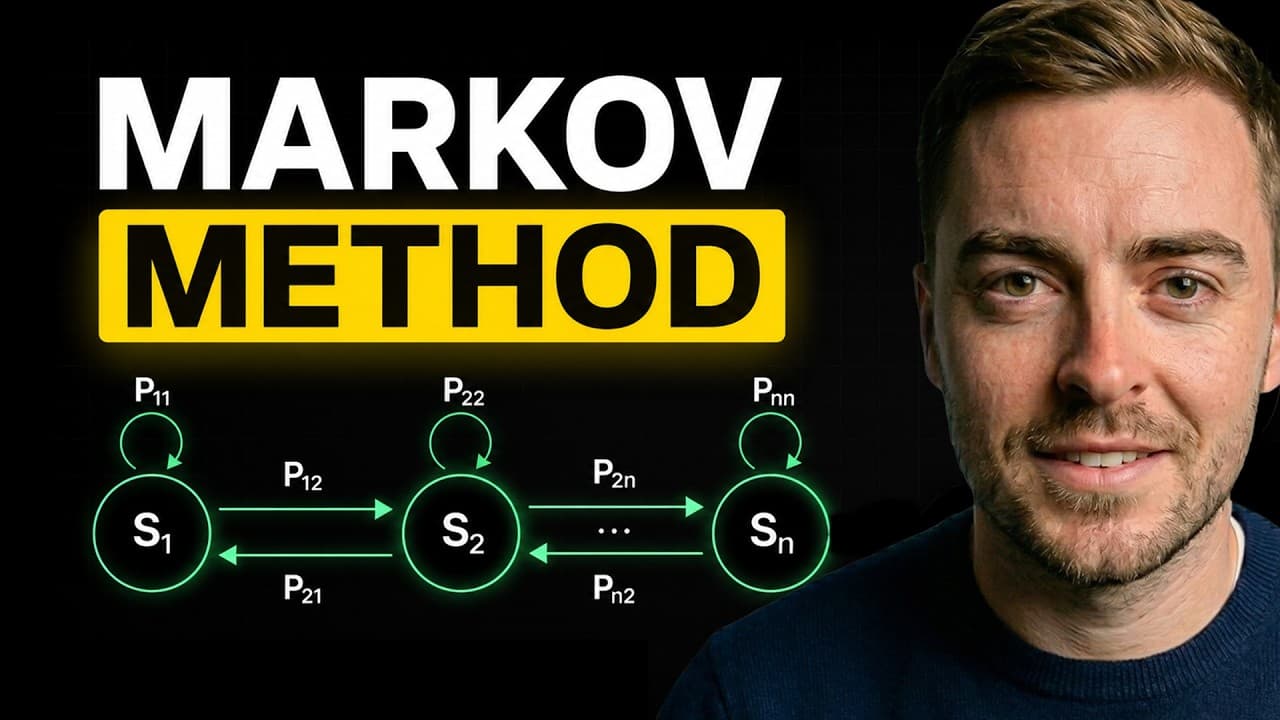
Claude Code or another LLM can help apply a quant trading strategy that classifies markets as bull, sideways, or bear using 20-day returns and models transitions with a 3x3 matrix. The method also uses probability-based trade signals, walk-forward backtesting, and hidden Markov models to reduce subjective decisions. Read on to understand the core calculations and how each element supports the strategy.
Transcript
I've realized something about trading. Average people who are trying to do day trading, even all the way up to professionals doing trading, they do it completely different than how hedge funds do it. Now, I want to tell you something that I've learned recently that completely shattered my view of trading. And that is that quants are not using trend... Read More
Key Insights
- Quant trading uses Markov models to classify market states into bull, bear, and sideways based on 20-day returns.
- The Markov property emphasizes that only the current state influences future market conditions, not historical data.
- A 3x3 transition matrix calculates the probability of market state transitions, aiding in prediction and strategy formulation.
- The concept of 'stickiness' describes the likelihood of a market state persisting into the next day, guiding trade decisions.
- Multi-day forecasts are generated by squaring the transition matrix, but long-term predictions tend to lose significance.
- Trade signals are generated by subtracting bear probability from bull probability, indicating the strength and direction of trades.
- Walk-forward backtesting prevents strategies from being biased by future data, ensuring more reliable backtesting results.
- The hidden Markov model removes subjective state labels, instead relying on pattern recognition to define market states.
Install to Summarize YouTube Videos and Get Transcripts
Explore YouTube Video Summarizer or Get YouTube Transcript Extractor
Questions & Answers
Q: How can Claude Code re-create a Markov model quant trading strategy?
The hedge fund method can be converted into instructions that Claude Code or another LLM can apply to trading strategies. The workflow classifies market states, calculates transition probabilities, generates trade signals, and uses walk-forward backtesting; the described prompts can also be installed as a Claude Code skill.
Q: How are bull, bear, and sideways market states defined?
Each state is based on the asset’s cumulative return over the last 20 days. A return of 5% or more is a bull state, a return of negative 5% or lower is a bear state, and anything between those thresholds is sideways.
Q: What is the Markov property in this trading method?
The Markov property assumes that the market’s next state depends on its current state rather than the full path it took to get there. The strategy therefore uses today’s bull, bear, or sideways classification to estimate what may happen next.
Q: How is a 3x3 transition matrix used in quant trading?
The 3x3 matrix records transition probabilities among the bull, bear, and sideways states. Each row represents the current state, while the columns represent the possible next states, allowing the strategy to estimate the most likely condition for the following day.
Q: What does “stickiness” mean for a market state?
Stickiness is the probability that the market remains in its current state on the next day. For example, bull-state stickiness measures how likely a bull state is to be followed by another bull state.
Q: How does the strategy create a trading signal from state probabilities?
The signal is calculated by subtracting the bear probability from the bull probability. The resulting value indicates the proposed trade’s direction and strength.
Q: How are multi-day Markov forecasts calculated?
Multi-day forecasts are produced by multiplying the transition matrix by itself, including squaring it for a further-ahead forecast. As the forecast horizon grows, the probabilities tend to lose significance, limiting the value of long-term projections.
Q: Why use walk-forward backtesting and a hidden Markov model?
Walk-forward backtesting recalculates the strategy daily so future data does not influence earlier decisions. A hidden Markov model further reduces subjectivity by identifying patterns in price history instead of relying on manually assigned market-state labels.
Q: Do hedge fund quants use trend lines and chart indicators?
According to the video, quants do not use trend lines and chart indicators to make decisions in the same way ordinary traders do. They quantify market conditions with numerical values, states, transition counts, and probabilities instead of relying on feelings or “vibes.”
Q: How do you label historical Bitcoin data with bull, bear, and sideways states?
Run an algorithm across Bitcoin’s price history and assign a state to each day based on the returns from the previous 20 days. Labeling begins on the 20th day because that is the first point with a complete 20-day lookback period.
Q: Where can I get the Claude Code prompt for the hedge fund trading method?
The video says the free copy-and-paste prompts are available through the GitHub link in the top line of the video description. One prompt installs the method into Claude Code or another LLM, while another creates a TradingView visualization using Pine Script.
Summary & Key Takeaways
-
Quant trading strategies utilize Markov models to define market conditions into bull, bear, and sideways states. This method relies on historical data and probabilities, differing from traditional trading by focusing on the current state rather than past trends. By leveraging AI, traders can automate these strategies, ensuring more accurate and consistent decision-making.
-
The Markov property in quant trading emphasizes the importance of the current market state over historical data. A 3x3 transition matrix is used to calculate the probability of state transitions, assisting in predicting future market conditions. This approach enhances the precision of trading strategies by focusing on calculated probabilities rather than trends.
-
Trade signals in quant trading are derived by subtracting bear probability from bull probability, indicating the strength and direction of trades. Multi-day forecasts are created by squaring the transition matrix, although long-term predictions may lose significance. The hidden Markov model further refines these strategies by removing subjective state labels.
Read in Other Languages (beta)
Share This Summary 📚
Summarize YouTube Videos and Get Video Transcripts with 1-Click
Try YouTube Summary with ChatGPT & Claude or YouTube Transcript Generator
Explore More Summaries from Lewis Jackson 📚
Summarize YouTube Videos and Get Video Transcripts with 1-Click
Try YouTube Summary with ChatGPT & Claude or YouTube Transcript Generator