What Is XGBoost and How Does It Use Loss Functions?
TL;DR
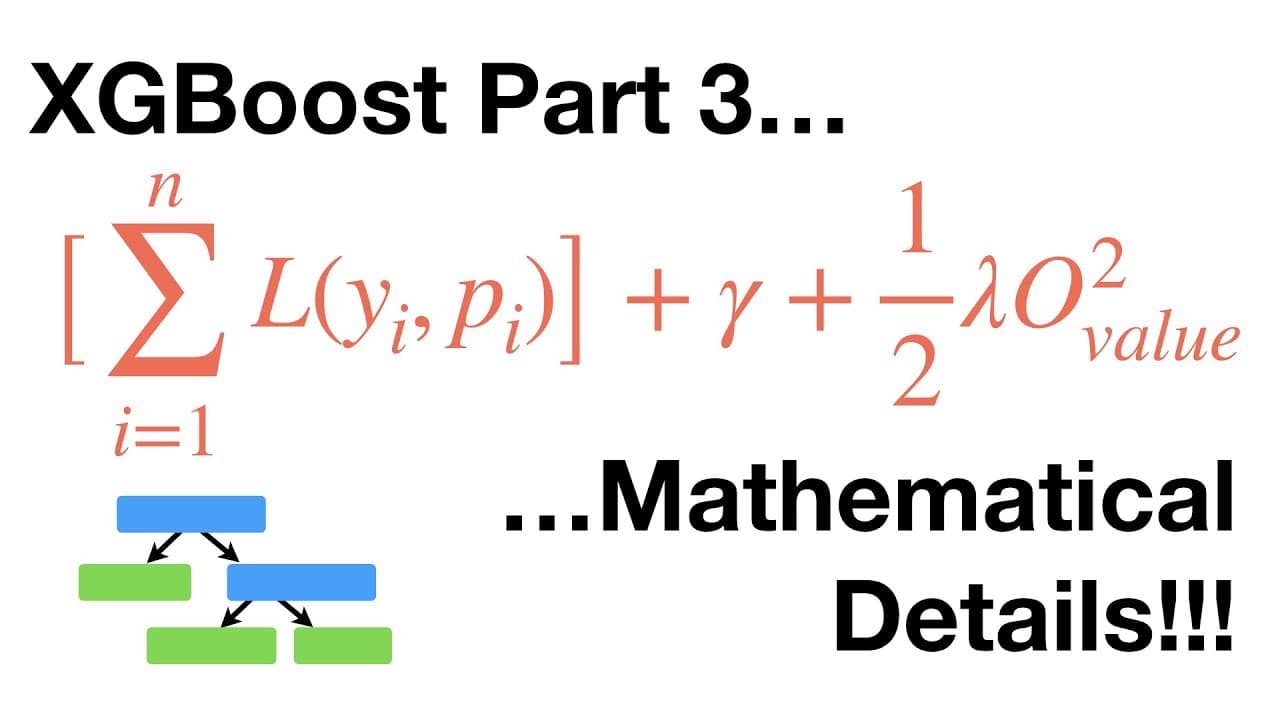
XGBoost builds decision trees by minimizing loss functions alongside regularization terms for both regression and classification tasks. The optimal output value for a leaf is found through this minimization process, while similarity scores are calculated using simplified equations that adjust for the specific scenario being addressed.
Transcript
XG boost math details there's a lot of them watch out staffed quest hello I'm Josh stormer and welcome to stat quest today we're gonna talk about XG boost part 3 mathematical details this stat quest assumes that you already have a general idea of how XG boost builds trees if not check out the quests the links are in the description below this stat ... Read More
Key Insights
- 🌸 XG Boost utilizes loss functions and regularization for optimal output value calculation.
- 💯 The similarity scores in XG Boost are derived by simplifying the output value equation.
- 🦻 Regularization in XG Boost aids in controlling overfitting and model complexity.
- 😒 The use of gradients and Hessians in XG Boost helps in optimizing output values and similarity scores.
- 🌸 The process of tree building in XG Boost involves iterative adjustments to minimize the loss function.
- 💯 Cover, related to the Hessians, plays a role in determining the similarity scores for regression and classification.
- 🤮 XG Boost balances computational efficiency with accuracy through simplifying equations and omitting non-essential terms.
Install to Summarize YouTube Videos and Get Transcripts
Explore YouTube Video Summarizer or Get YouTube Transcript Extractor
Questions & Answers
Q: How does XG Boost utilize loss functions and regularization in tree building?
XG Boost uses a combination of loss functions and regularization terms to find the optimal output values for leaves, minimizing the overall equation for regression or classification.
Q: What is the significance of similarity scores in XG Boost?
Similarity scores are calculated to measure the relative similarity of data points, aiding in decision-making for tree construction in XG Boost for regression and classification tasks.
Q: How does XG Boost handle the complexity of calculating the optimal output value?
XG Boost simplifies the process by approximating the equation with a second-order Taylor polynomial, allowing for efficient computation and optimization of the output values for tree nodes.
Q: What role does regularization play in determining the output values in XG Boost?
Regularization in the form of a penalty term helps prevent overfitting by adjusting the output values to balance prediction accuracy and model complexity, similar to Ridge regression.
Summary & Key Takeaways
-
XG Boost utilizes loss functions and regularization to build trees for regression and classification.
-
The optimal output value for a leaf is determined by minimizing the loss function with a regularization term.
-
Similarity scores are derived by simplifying the equation and adjusting for regression or classification scenarios.
Read in Other Languages (beta)
Share This Summary 📚
Summarize YouTube Videos and Get Video Transcripts with 1-Click
Try YouTube Summary with ChatGPT & Claude or YouTube Transcript Generator
Explore More Summaries from StatQuest with Josh Starmer 📚

Summarize YouTube Videos and Get Video Transcripts with 1-Click
Try YouTube Summary with ChatGPT & Claude or YouTube Transcript Generator