Bailout 1: Liquidity vs. Solvency
TL;DR
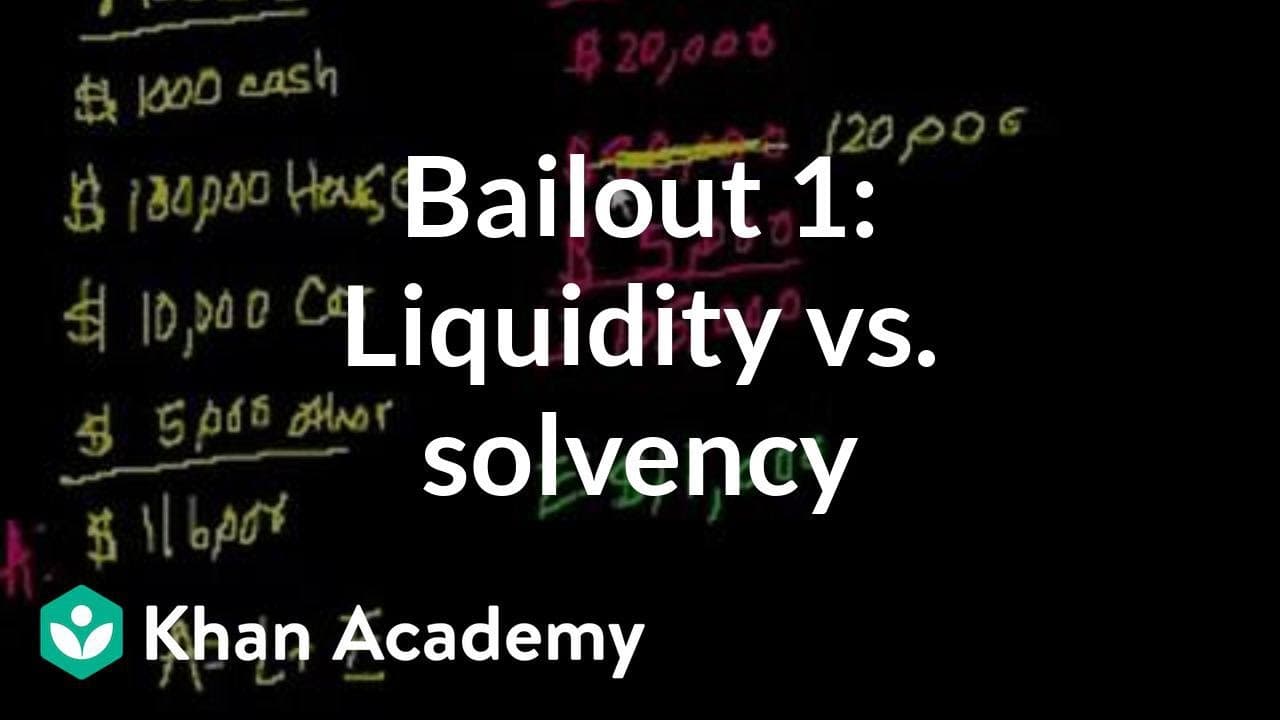
This video explains the concept of balance sheets and their relevance in understanding the financial crisis and bailout in simple terms.
Transcript
In the next series of videos, I'm going to give my best attempt at trying to get a handle on the bailout and the financial crisis. So I'm going to try to explain different concepts in more than one way. Then I think hopefully it'll all sink in. But the big picture really is that there's a lot of fancy terminology being thrown around, but the underl... Read More
Key Insights
- ⚖️ Understanding balance sheets is crucial in comprehending the financial crisis and bailout.
- 🪐 Net worth or equity is the difference between total assets and total liabilities.
- 🍧 Insolvency occurs when liabilities are greater than assets, while illiquidity refers to having positive equity but insufficient immediate cash.
- 💼 Bankruptcy protection provides legal protection in cases of insolvency, helping individuals and entities reorganize their financial affairs.
- 🌉 Illiquidity can be resolved through bridge loans or temporary financial support.
- 📼 Assets are always equal to liabilities plus equity, as per the balance sheet equation.
- 🙃 Net worth reflects the true financial standing, rather than merely the value of assets owned.
Install to Summarize YouTube Videos and Get Transcripts
Explore YouTube Video Summarizer or Get YouTube Transcript Extractor
Questions & Answers
Q: What is a balance sheet?
A balance sheet is a financial statement that shows an individual or entity's assets, liabilities, and equity, providing an overview of their financial position.
Q: How does insolvency differ from illiquidity?
Insolvency occurs when liabilities exceed assets, indicating an inability to repay debt. Illiquidity, on the other hand, refers to having positive equity but lacking immediate cash flow to meet financial obligations.
Q: When is bankruptcy protection sought?
Bankruptcy protection is sought when an individual or entity is insolvent and cannot repay their debts, allowing them to have their financial assets and liabilities redistributed by the court.
Q: How can illiquidity be resolved?
Illiquidity can be resolved by obtaining bridge loans or temporary financial support to bridge the gap between the available cash and immediate obligations.
Summary & Key Takeaways
-
A balance sheet is a snapshot of what an individual or entity owns (assets) and owes (liabilities), with the difference being their net worth or equity.
-
If liabilities are greater than assets, it indicates insolvency, where bankruptcy protection may be sought to address the financial situation.
-
Illiquidity, on the other hand, refers to having positive equity but insufficient cash to meet immediate obligations, which can be resolved with bridge loans or temporary financial support.
Read in Other Languages (beta)
Share This Summary 📚
Summarize YouTube Videos and Get Video Transcripts with 1-Click
Try YouTube Summary with ChatGPT & Claude or YouTube Transcript Generator
Explore More Summaries from Khan Academy 📚



Summarize YouTube Videos and Get Video Transcripts with 1-Click
Try YouTube Summary with ChatGPT & Claude or YouTube Transcript Generator