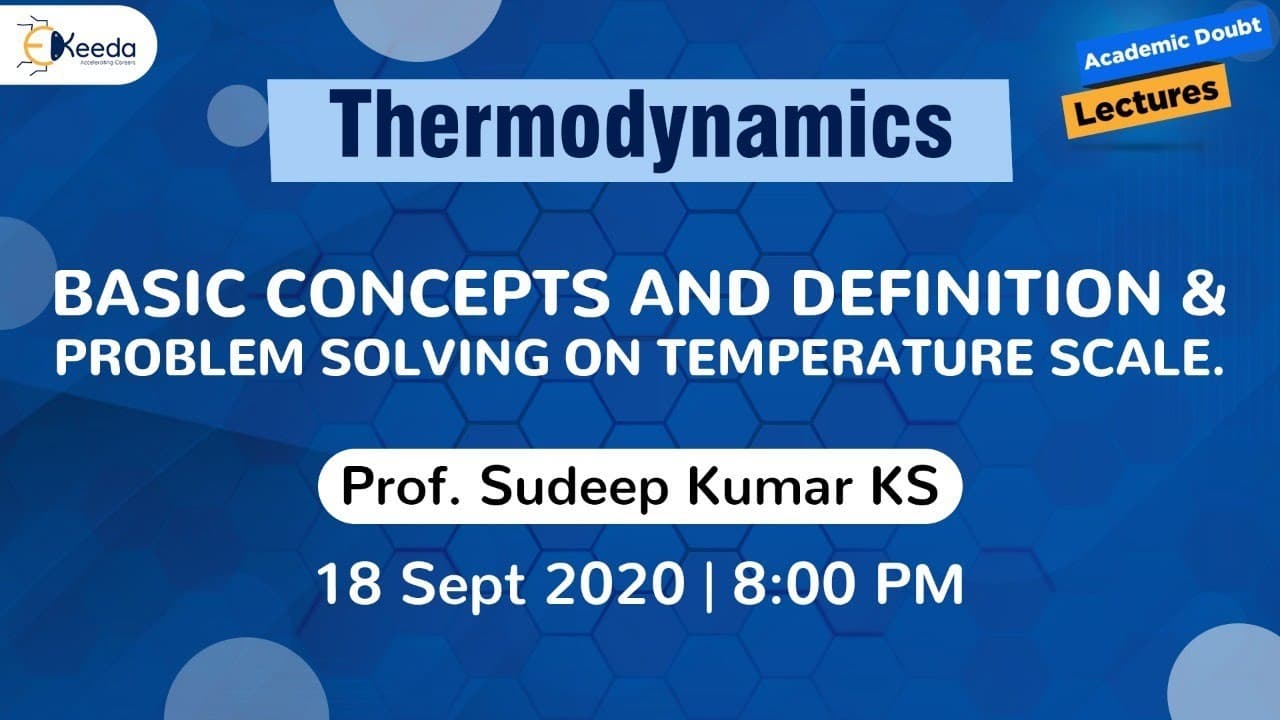
Thermodynamics - Basic Concepts, Definition & Problem Solving on Temperature Scale | 18 Sept | 8 PM
TL;DR
Thermodynamics is the study of energy transfer and its effect on the properties of a system, involving work and heat transfer.
Transcript
do uh good evening everyone in the previous live session i discussed the basic concepts about uh discussed about basic concepts and definition of thermodynamics in that i discussed the basic of significance of thermodynamic approach and then after that uh i discussed the system type of system uh open closed and i selected systems and after that uh ... Read More
Key Insights
- 🥵 Thermodynamics deals with energy transfer through work and heat transfer, causing changes in the properties of a system.
- 💦 Different forms of work include electrical, shaft, paddle wheel, and fluid flow work.
- 🥵 Heat transfer occurs due to temperature differences and can happen through conduction, convection, and radiation.
- 🥵 Both work and heat are path functions and inexact differentials.
- 🫢 Ideal gas behavior is described by equations of state, such as pv = mrt or pv = nrt.
- 🫢 Specific and universal gas constants are used to relate temperature, pressure, volume, and properties.
- 🥵 Adiabatic processes have no heat interaction with the surroundings.
Install to Summarize YouTube Videos and Get Transcripts
Explore YouTube Video Summarizer or Get YouTube Transcript Extractor
Questions & Answers
Q: What is thermodynamics and what does it study?
Thermodynamics is the study of energy transfer and its effect on the properties of a system. It focuses on changes in properties due to work and heat transfer.
Q: What are the different forms of work in thermodynamics?
Thermodynamics involves electrical work, shaft work, paddle wheel work, and work produced by the flow of fluid.
Q: How does heat transfer occur?
Heat transfer occurs due to temperature differences, with heat always flowing from regions of higher temperature to lower temperature. It can happen through conduction, convection, and radiation.
Q: What are adiabatic processes?
Adiabatic processes are those in which no heat interaction takes place between the system and its surroundings. They are often observed in compressions and expansions, such as in IC engines.
Summary & Key Takeaways
-
Thermodynamics deals with changes in the properties of a system due to energy transfer through work and heat transfer.
-
Work transfer involves the interaction between a system and its surroundings, where work is done by or on the system.
-
Different forms of work include electrical work, shaft work, paddle wheel work, and work produced by the flow of fluid.
-
Heat transfer occurs due to temperature differences, with heat always transferring from higher to lower temperature regions.
-
Heat can be transferred through conduction, convection, and radiation.
-
Both work and heat are path functions and inexact differentials.
-
Adiabatic processes have no heat interaction with the surroundings.
-
Ideal gas behavior is described by the equation of state, such as pv = mrt or pv = nrt, where m and n are mass and number of moles of gas, respectively.
-
Specific and universal gas constants are used to relate temperature, pressure, volume, and properties of an ideal gas.
-
A temperature scale can be defined using a property that changes with temperature, allowing for temperature measurement.
Read in Other Languages (beta)
Share This Summary 📚
Summarize YouTube Videos and Get Video Transcripts with 1-Click
Try YouTube Summary with ChatGPT & Claude or YouTube Transcript Generator
Explore More Summaries from Ekeeda 📚


Summarize YouTube Videos and Get Video Transcripts with 1-Click
Try YouTube Summary with ChatGPT & Claude or YouTube Transcript Generator