Multiplying a vector by a scalar | Vectors and spaces | Linear Algebra | Khan Academy
TL;DR
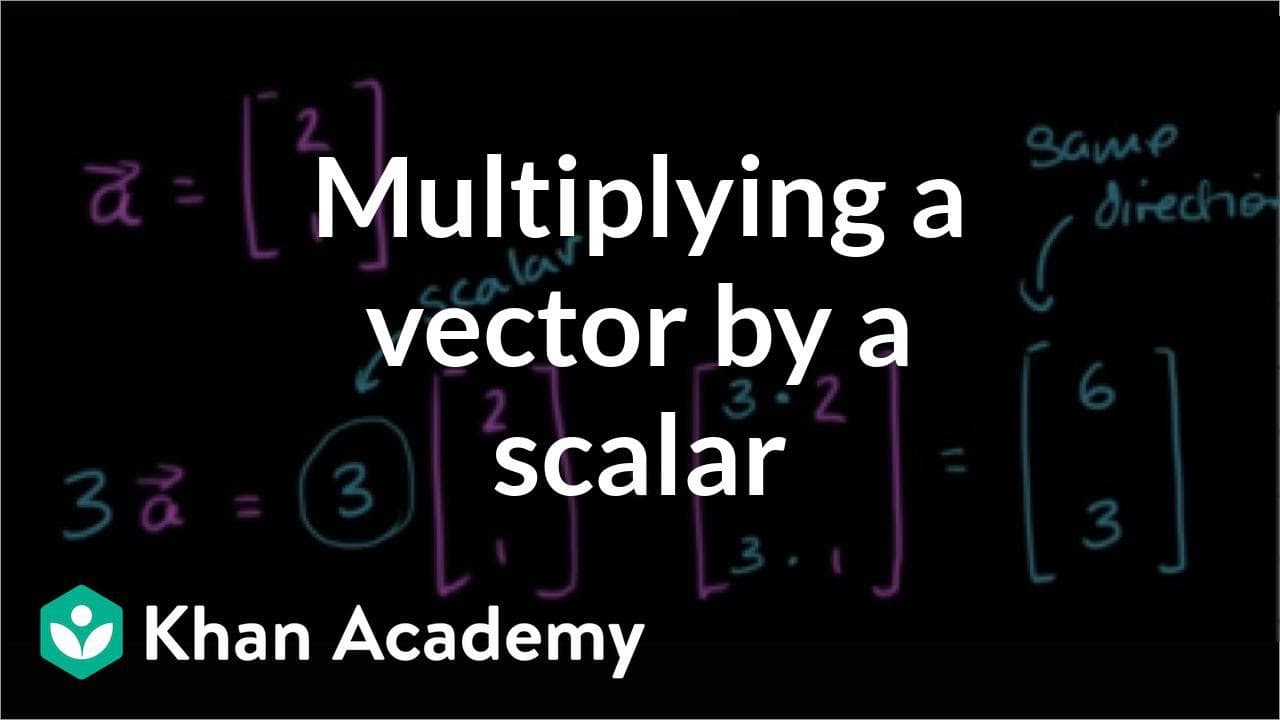
Multiplying a vector by a scalar results in a new vector with the same direction but a different magnitude.
Transcript
Let's say that I have the vector a, and let's say that it's equal to (2,1) So we could draw it right over here, So it's equal to (2,1), so if we were to start at the origin and we would move 2 in the horizontal direction, and 1 in the vertical direction so we would end up right over here. Now what I want to do is think about, how we can define mult... Read More
Key Insights
- ✖️ Scalar multiplication of a vector involves multiplying each component of the vector by the scalar.
- ⚖️ Multiplying a vector by a positive scalar scales up the vector without changing its direction.
- 🐬 A negative scalar multiplication flips the direction of the vector without changing its magnitude.
- ✖️ Scalar multiplication applies to vectors of any dimensionality.
- 📈 Scalar multiplication can be visualized on a graph to understand its effects.
- 👈 The scalar multiplication of a vector by -1 results in the vector pointing in the exact opposite direction.
- ✖️ Scalar multiplication is a fundamental operation in linear algebra.
Install to Summarize YouTube Videos and Get Transcripts
Explore YouTube Video Summarizer or Get YouTube Transcript Extractor
Questions & Answers
Q: How do you define vector scalar multiplication?
Vector scalar multiplication involves multiplying each component of the vector by the scalar. For example, multiplying a vector (2, 1) by 3 results in the vector (6, 3).
Q: What happens when you multiply a vector by a positive scalar?
Multiplying a vector by a positive scalar scales up the vector, increasing its magnitude without changing its direction. This can be visualized by plotting the resulting vector on a graph.
Q: How does multiplying a vector by a negative scalar affect the vector?
Multiplying a vector by a negative scalar flips its direction, pointing it in the exact opposite direction. The magnitude of the vector remains the same.
Q: Can the scalar multiplication be applied to vectors of higher dimensions?
Yes, the concept of scalar multiplication applies to vectors of any dimensionality. Each component of the vector is multiplied by the scalar.
Summary & Key Takeaways
-
Vector scalar multiplication involves multiplying each component of the vector by the scalar.
-
Multiplying a vector by a positive scalar scales up the vector, increasing its magnitude.
-
Multiplying a vector by a negative scalar flips its direction, while its magnitude remains the same.
Read in Other Languages (beta)
Share This Summary 📚
Summarize YouTube Videos and Get Video Transcripts with 1-Click
Try YouTube Summary with ChatGPT & Claude or YouTube Transcript Generator
Explore More Summaries from Khan Academy 📚



Summarize YouTube Videos and Get Video Transcripts with 1-Click
Try YouTube Summary with ChatGPT & Claude or YouTube Transcript Generator