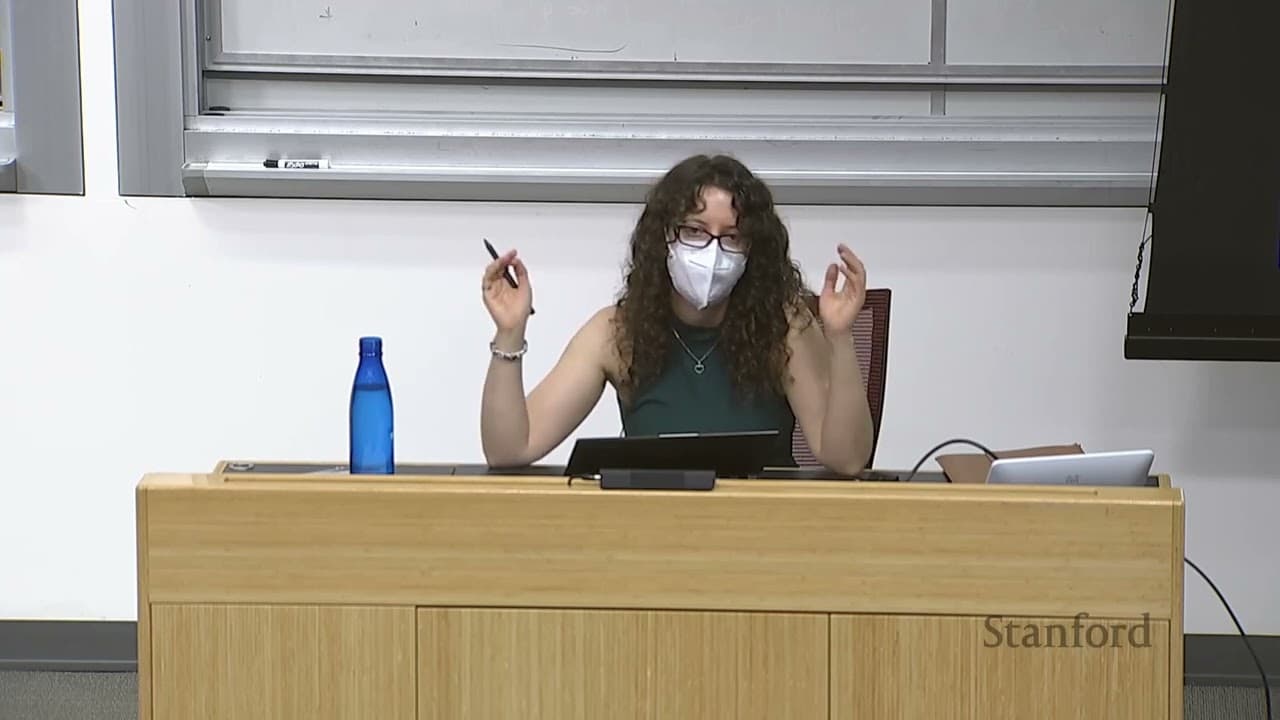
Stanford CS229 Machine Learning I Neural Networks 1 I 2022 I Lecture 8
TL;DR
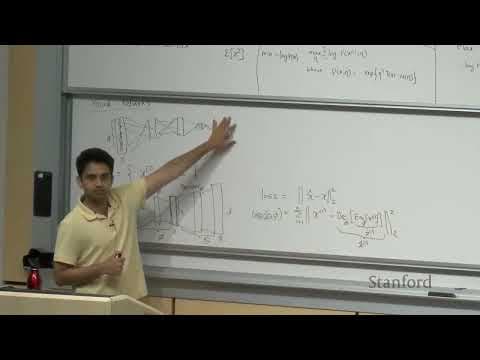
This lecture introduces the concepts of neural networks and deep learning, highlighting their potential for creative applications and their ability to handle non-linear models.
Transcript
hello everybody hi my name is Masha um some of you may have met me already as part of office hours and seen me post on Ed and things like that I'm really excited to be giving the lectures today it's going to be in a slightly different format than tenu's or Chris's so feel free to give me feedback on that afterwards on Ed or by email whatever you li... Read More
Key Insights
- 🙇 Neural networks have the potential to achieve impressive results in various domains, thanks to their ability to handle non-linear relationships between inputs and outputs.
- 🖐️ Activation functions, such as ReLU, play a crucial role in introducing non-linearities to neural networks, making them more expressive and capable of capturing complex patterns in the data.
- 👻 Vectorization allows for more efficient computation in neural networks and enables parallelization on hardware like GPUs.
- ❓ The connection between neural networks and kernel methods highlights the flexibility and learning potential of neural networks, as opposed to the more fixed structure imposed by kernel methods.
Install to Summarize YouTube Videos and Get Transcripts
Explore YouTube Video Summarizer or Get YouTube Transcript Extractor
Questions & Answers
Q: What are some potential applications of deep learning models?
Deep learning models have the potential to be applied in various fields, such as creative writing, medicine, education, and autonomous driving. They can be used to create expressive models that generate creative content and improve decision-making processes in these domains.
Q: How do neural networks differ from linear regression and kernel models?
Neural networks introduce non-linearities through the use of activation functions, allowing them to handle non-linear relationships between inputs and outputs. Linear regression and kernel models, on the other hand, are limited to linear or non-linear relationships respectively, without the flexibility of neural networks.
Q: What is the significance of the ReLU activation function in neural networks?
The ReLU activation function introduces non-linearities to neural networks, making them capable of handling non-linear relationships between inputs and outputs. It allows for more expressive models that can capture complex patterns and representations in the data.
Q: How do neural networks optimize their weights and biases?
Neural networks optimize their weights and biases through a process called backpropagation. This involves computing the gradients of the cost function with respect to the parameters and using techniques like stochastic gradient descent to update the weights and biases iteratively.
Summary & Key Takeaways
-
The lecture begins by discussing the motivation behind neural networks and their potential to achieve impressive results in various fields, such as creative writing and autonomous driving.
-
Linear regression and kernel models are introduced as examples of linear and non-linear models, respectively.
-
The lecture then delves into the definition and structure of neural networks, explaining how intermediate variables and hidden layers are used to make predictions.
-
The concept of vectorization is introduced to represent neural networks more concisely and enable faster computation.
-
The importance of activation functions, specifically ReLU, in introducing non-linearities to neural networks is emphasized.
-
The lecture concludes by discussing the connection between neural networks and kernel methods, highlighting the flexibility and learning potential of neural networks.
Read in Other Languages (beta)
Share This Summary 📚
Summarize YouTube Videos and Get Video Transcripts with 1-Click
Try YouTube Summary with ChatGPT & Claude or YouTube Transcript Generator
Explore More Summaries from Stanford Online 📚
Summarize YouTube Videos and Get Video Transcripts with 1-Click
Try YouTube Summary with ChatGPT & Claude or YouTube Transcript Generator