How Buildings Can Improve Life — Inside and Out | Doris Sung | TED
TL;DR
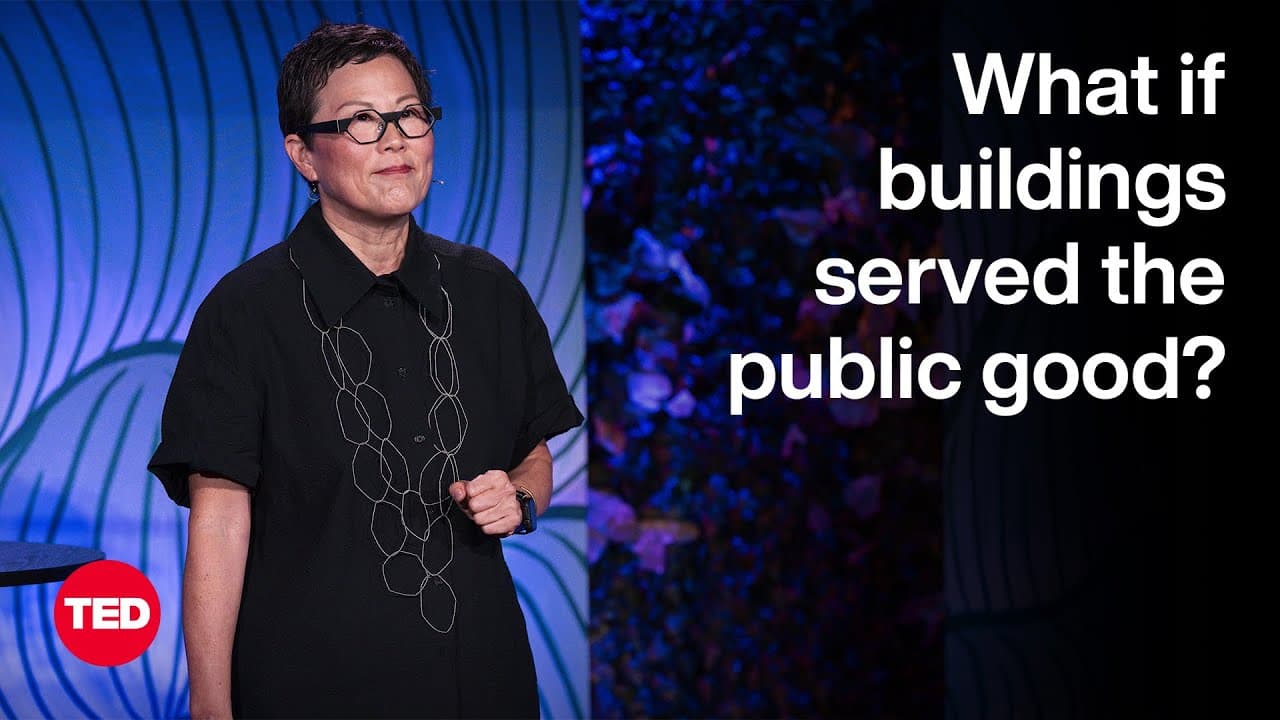
Buildings can be designed to benefit both the people on the inside and those on the outside by incorporating technologies that improve sustainability, equity, and wellness.
Transcript
So have you ever walked in front of a glass facade and see yourself in the reflection and try to check yourself out? Oh wait, wait, I forgot -- the glass facade is there not for you, but it's for the people on the inside to get a great view out. And they're probably looking at you picking the spinach from your teeth. (Laughter) Have you ever walked... Read More
Key Insights
- 🏛️ Building facades have historically been designed solely for the interior comfort, but they can be transformed to benefit the public.
- 👻 New technologies allow for the creation of habitats for animals, water collection and purification, noise pollution reduction, and improved air quality.
- 😅 The smog-eating panel and self-shading window system are two specific examples of how building facades can be improved for public benefit.
Install to Summarize YouTube Videos and Get Transcripts
Explore YouTube Video Summarizer or Get YouTube Transcript Extractor
Questions & Answers
Q: How can building facades benefit people on the outside?
Building facades can be transformed to create habitats for animals, collect and purify water, and reduce noise pollution, improving the overall well-being of the public. This means that building exteriors can be more than just aesthetically pleasing; they can serve a greater purpose.
Q: How does the smog-eating panel work?
In urban-canyon areas, where air movement is predictable, the smog-eating panel modulates the surface to allow prevailing winds to flow into tubes and filter out smog and particulate matter. This creates a continuous flow of fresh air and helps improve air quality in heavily polluted areas.
Q: How does the self-shading window system work?
The self-shading window system utilizes thermo bimetal material that curls when heated. This material is placed in the cavity of a double-glazed window system and responds to outdoor temperature changes, automatically shading the interior of the building. This reduces the need for excessive air conditioning and conserves energy.
Q: How can these technologies be implemented on a larger scale?
Three suggestions are offered: changing policy to require construction investment in public-centric facade technologies, allowing owners to rent or lease their facades for infrastructure purposes, and advocating for change by demanding more magnanimous building facades as renters.
Summary & Key Takeaways
-
Traditional building facades were designed solely for the interior, but now there is an opportunity to use the exterior surface area for the public good.
-
New technologies can transform building facades into habitats for animals, collect and purify water, reduce noise pollution, and improve air quality.
-
Two specific technologies include a smog-eating panel that filters out particulate matter and a self-shading window system that automatically adjusts to the outdoor environment.
Read in Other Languages (beta)
Share This Summary 📚
Summarize YouTube Videos and Get Video Transcripts with 1-Click
Try YouTube Summary with ChatGPT & Claude or YouTube Transcript Generator
Explore More Summaries from TED 📚






Summarize YouTube Videos and Get Video Transcripts with 1-Click
Try YouTube Summary with ChatGPT & Claude or YouTube Transcript Generator