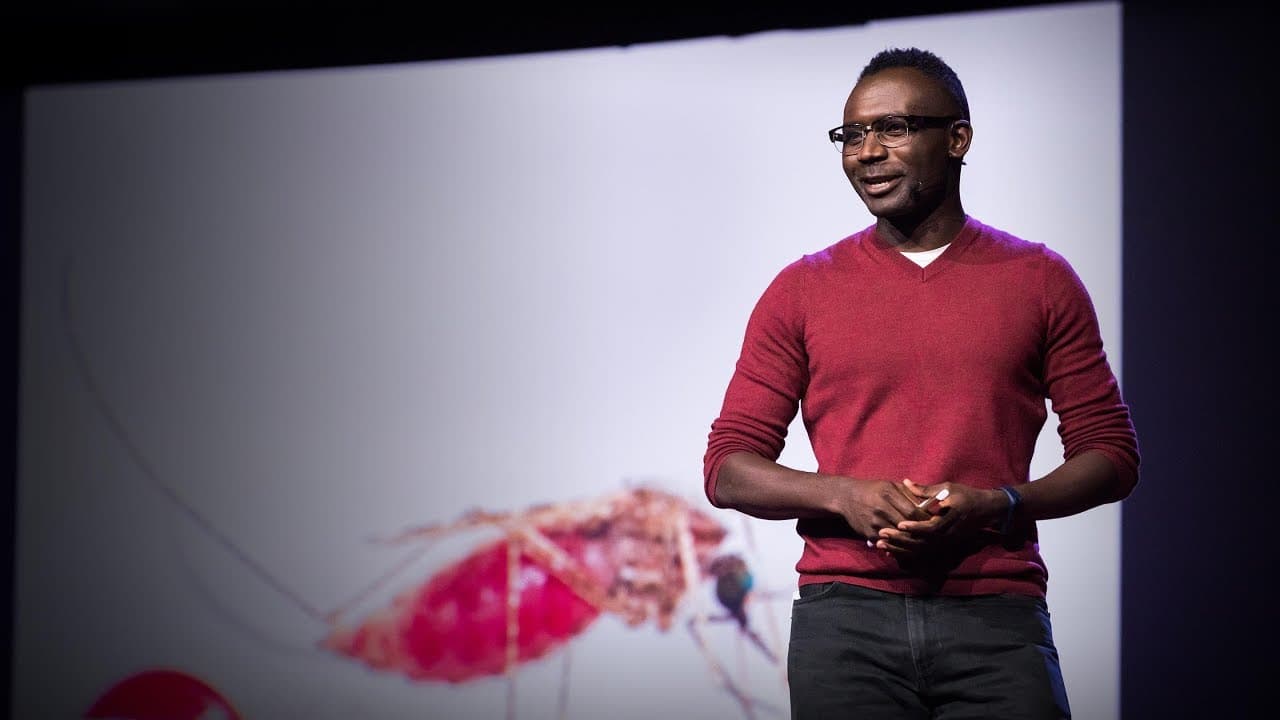
Why I study the most dangerous animal on earth -- mosquitoes | Fredros Okumu
TL;DR
Fredros Okumu, a scientist from Tanzania, shares his experiences with malaria and reveals innovative strategies, such as using mosquitoes themselves and synthetic attractants, that could help eliminate malaria-transmitting mosquitoes.
Transcript
I guess because I'm from Tanzania I have a responsibility to welcome all of you once again. Thank you for coming. So, first of all, before we start, how many of you in the audience have been in the past a victim of this bug here? We apologize on behalf of all the mosquito catchers. (Laughter) Ladies and gentlemen, imagine getting seven infectious m... Read More
Key Insights
- 🦟 Malaria is a significant health issue in Tanzania, with high transmission rates and severe symptoms, including seizures.
- 🌍 Ifakara Health Institute was established to address the health needs of local communities, particularly malaria.
- 🔬 Researchers at Ifakara Health Institute focus on studying mosquito biology to find new ways to control malaria transmission.
- 💧 One strategy involves using mosquitoes themselves to carry insecticides to their breeding habitats, effectively eliminating their offspring.
- 🦟 Ifakara also has the largest mosquito farm in the world for malaria research, allowing for the testing of new tools and techniques.
- 💥 The use of mosquito swarms as a target for population control has shown promise, with swarm locations remaining consistent over time.
- 👃 Mosquitoes have highly developed sensory organs and can detect substances produced by humans from a distance. Ifakara has created synthetic blends to attract and trap mosquitoes. ⏰ Targeting malaria-transmitting mosquitoes could lead to the elimination of malaria and other mosquito-borne diseases like dengue and Zika.
Install to Summarize YouTube Videos and Get Transcripts
Explore YouTube Video Summarizer or Get YouTube Transcript Extractor
Questions & Answers
Q: How many mosquito bites can a person receive in a year?
According to the speaker, an individual can receive 2,555 infectious mosquito bites per year, which equates to an average of seven bites every day.
Q: What was the purpose of the speaker's work in the Kilombero River valley?
The speaker's primary role in the Kilombero River valley was to estimate the level of malaria transmission across the villages and identify the mosquitoes responsible for transmitting the disease.
Q: What are the current practices for combating malaria?
The current best practice for combating malaria is the use of insecticide-treated bednets. However, it has been discovered that these bednets offer minimal protection against mosquito bites and are ineffective at killing the mosquitoes.
Q: How do the speaker and his colleagues propose to control mosquito populations?
The speaker and his colleagues have developed various methods to control mosquito populations. These include using mosquitoes themselves to distribute insecticides to their breeding sites and using the mosquitoes' mating behavior to target and eliminate entire populations.
Q: What is the speaker's opinion on using CRISPR to kill off mosquitoes?
The speaker believes that the use of gene-editing techniques, such as CRISPR, to kill off mosquitoes offers real opportunities to have high-impact interventions in the fight against malaria. He acknowledges the need for responsible regulation and independent risk assessments to ensure the correct and safe implementation of these techniques.
Summary & Key Takeaways
-
The speaker welcomes the audience and apologizes on behalf of mosquito catchers for any past harm caused by mosquitoes.
-
The speaker discusses the prevalence of malaria in Tanzania and the importance of studying mosquitoes to combat the disease.
-
The speaker presents different methods being used to control mosquito populations, including using mosquitoes to carry insecticides, mapping swarm locations, and creating synthetic substances to lure and kill mosquitoes.
Read in Other Languages (beta)
Share This Summary 📚
Summarize YouTube Videos and Get Video Transcripts with 1-Click
Try YouTube Summary with ChatGPT & Claude or YouTube Transcript Generator
Explore More Summaries from TED 📚





Summarize YouTube Videos and Get Video Transcripts with 1-Click
Try YouTube Summary with ChatGPT & Claude or YouTube Transcript Generator