Stanford XCS224U: NLU I Contextual Word Representations, Part 6: RoBERTa I Spring 2023
TL;DR
The Roberta team explored the design space of contextual representation and made improvements over the Bert model.
Transcript
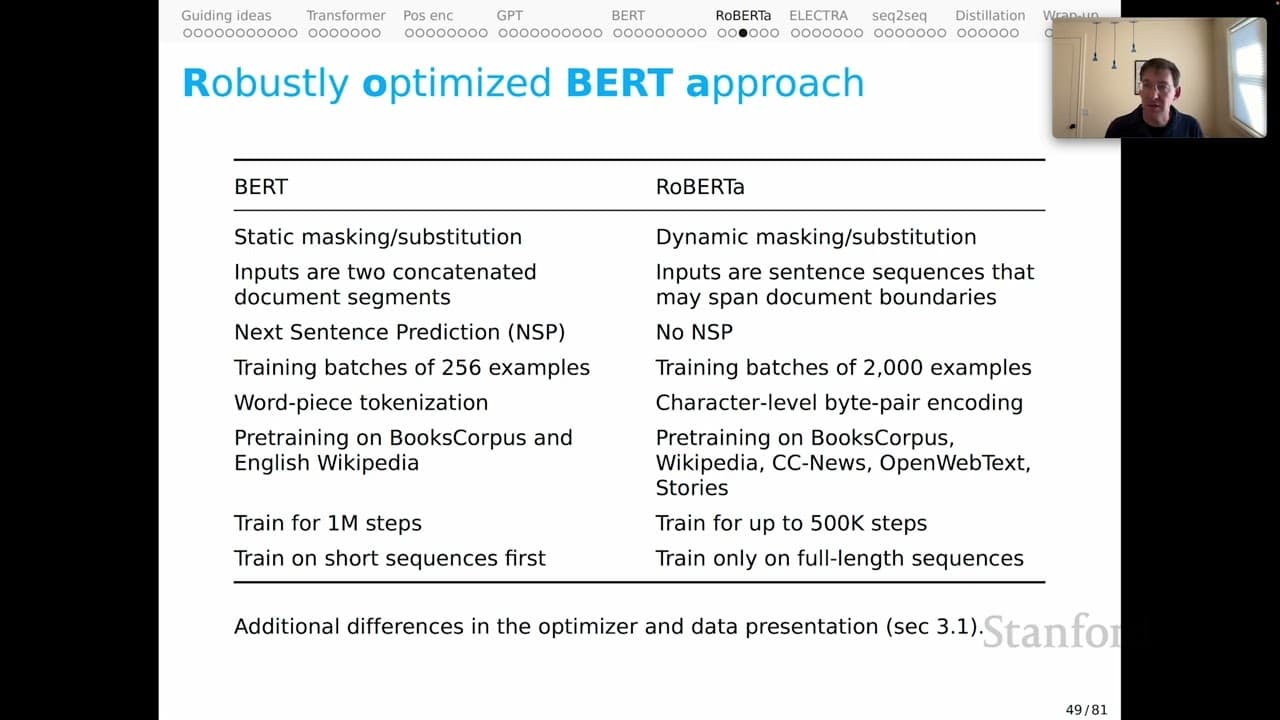
welcome back everyone this is part six in our series on contextual representation we're going to focus on Roberta Roberta stands for robustly optimized Bert approach you might recall that I finished the Bert screencast by listing out some key known limitations of the Bert model and the top item on that list was just an observation that the Bert tea... Read More
Key Insights
- 😤 The Roberta team conducted a more thorough exploration of the design space than the Bert team.
- 🌥️ Dynamic masking, full sentences, and larger batch sizes improved performance in various benchmarks.
- 🪘 Training on more data and for a longer duration resulted in better results for Roberta.
- 🖐️ Efficiency and resource considerations played a role in decision-making.
- 😤 The release of base and large models by the Roberta team allows for comparison with the corresponding Bert models.
Install to Summarize YouTube Videos and Get Transcripts
Explore YouTube Video Summarizer or Get YouTube Transcript Extractor
Questions & Answers
Q: What are some key differences between Bert and Roberta?
Some key differences include the use of dynamic masking in Roberta, which introduces diversity in training examples. Roberta uses sentence sequences instead of concatenated document segments, has larger batch sizes, utilizes character-level byte pair encoding, and is trained on more data and for a longer duration compared to Bert.
Q: Why did the Roberta team choose to use dynamic masking?
Dynamic masking was chosen because it introduces more diversity into the training regime. Even though it did not show significant improvements in benchmarks, the intuition behind dynamic masking suggests its usefulness in training.
Q: What approach did Bert and Roberta take in presenting examples to the models?
Bert evaluated full sentences and doc sentences (pairs of sentences from the same document). Roberta chose full sentences as it allows for more efficient batch creation, even though doc sentences had a slight advantage in terms of discourse coherence.
Q: How did the Roberta team decide on the batch size for training?
The team experimented with different batch sizes and found that larger batch sizes, specifically 2000 examples per batch, resulted in better performance based on metrics like perplexity, accuracy, and efficiency.
Summary & Key Takeaways
-
The Roberta team conducted a more thorough exploration of the design space and made improvements over the Bert model.
-
Key differences between Bert and Roberta include dynamic masking, using sentence sequences instead of concatenated document segments, larger batch sizes, character-level byte pair encoding, and training on more data for a longer duration.
-
Evidence from benchmarks showed that dynamic masking, full sentences, larger batch sizes, and more training data resulted in better performance for Roberta.
Read in Other Languages (beta)
Share This Summary 📚
Summarize YouTube Videos and Get Video Transcripts with 1-Click
Try YouTube Summary with ChatGPT & Claude or YouTube Transcript Generator
Explore More Summaries from Stanford Online 📚

Summarize YouTube Videos and Get Video Transcripts with 1-Click
Try YouTube Summary with ChatGPT & Claude or YouTube Transcript Generator