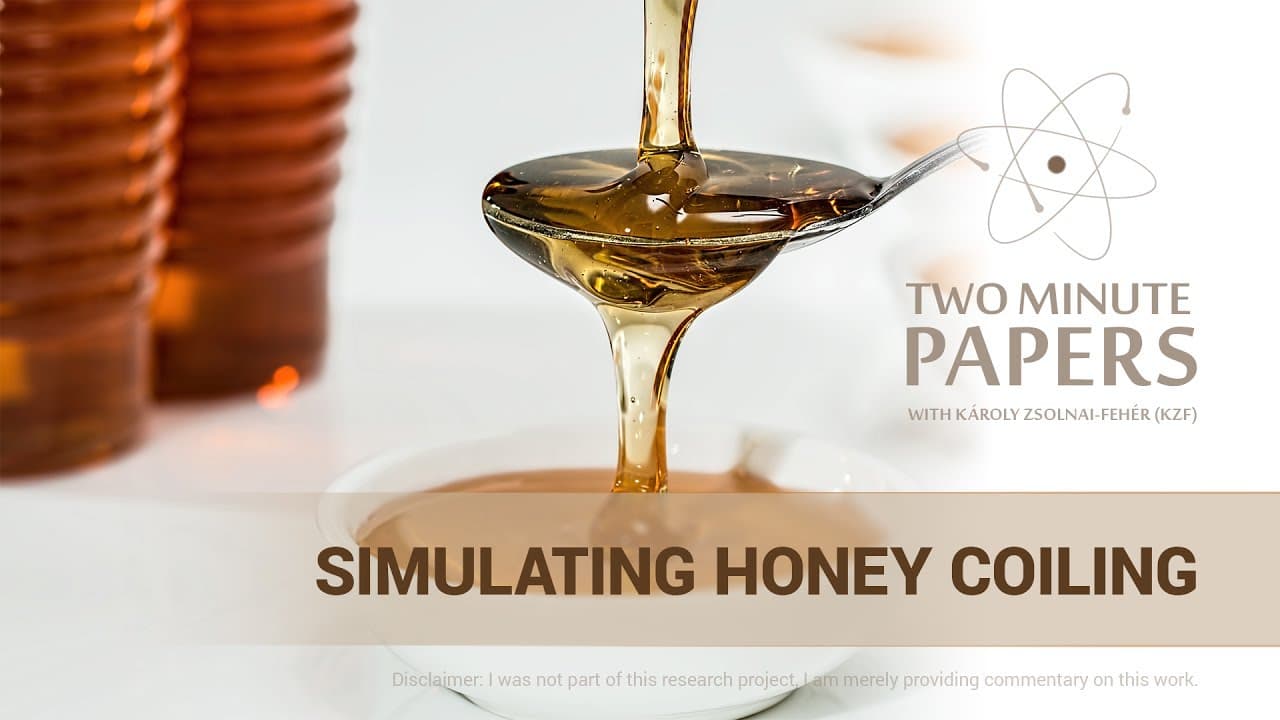
Simulating Honey Coiling | Two Minute Papers #158
TL;DR
This video discusses a new simulation technique for modeling the buckling and coiling effect of honey by efficiently solving fluid equations and retaining coupling effects, making it a valuable tool for fluid simulations in movies.
Transcript
Dear Fellow Scholars, this is Two Minute Papers with Károly Zsolnai-Fehér. This episode is about simulating a beautiful phenomenon in nature, the buckling and coiling effect of honey. Mmm! This effect is due to the high viscosity of materials like honey, which means that they are highly resistant against deformation. Water, however, is much less vi... Read More
Key Insights
- 💦 The buckling and coiling effect of honey is due to its high viscosity compared to water.
- 😒 The Eulerian approach in simulation eliminates the need for individual particles and instead uses a grid-based system.
- 🌸 Traditional grid-based simulations suffer from inaccuracies and loss of detail in buckling effects.
- 💥 The proposed simulation technique efficiently solves fluid equations together, retaining coupling effects and accurately simulating collisions.
- 👨🔬 The paper is well-written and digestible, with tight paragraphs that effectively communicate the research findings.
- 🫵 Authors of featured papers in Two Minute Papers benefit from increased recognition and views.
- 🈶 Writing research papers featured in the series requires significant hard work and is made available free of charge.
Install to Summarize YouTube Videos and Get Transcripts
Explore YouTube Video Summarizer or Get YouTube Transcript Extractor
Questions & Answers
Q: What is the difference between the Lagrangian and Eulerian approaches for simulating the buckling effect of honey?
The Lagrangian approach involves computing velocities and pressure for individual particles, while the Eulerian approach uses a grid-based system to compute these quantities only at specific points in space.
Q: How do grid-based simulations typically handle buckling effects?
Traditional grid-based simulators use an operator splitting technique, solving fluid equations separately for advection, pressure, and viscosity. However, this leads to loss of detail in buckling effects due to introduced inaccuracies.
Q: What is the key innovation of the new simulation technique proposed in the paper?
The paper introduces an efficient method that solves the fluid equations together, retaining coupling effects and accurately simulating buckling effects and collisions with solid objects.
Q: Why is the paper praised for its writing and readability?
The paper is commended for its clear and concise writing, with tight paragraphs that effectively communicate the ideas without unnecessary words.
Summary & Key Takeaways
-
The video introduces the buckling and coiling effect of honey, which occurs due to its high viscosity.
-
It compares the Lagrangian approach (particle-based simulation) with the new Eulerian approach (grid-based simulation) for simulating this effect.
-
The paper proposes a method that efficiently solves the fluid equations together, retaining coupling effects and accurately simulating collisions with solid objects.
Read in Other Languages (beta)
Share This Summary 📚
Summarize YouTube Videos and Get Video Transcripts with 1-Click
Try YouTube Summary with ChatGPT & Claude or YouTube Transcript Generator
Explore More Summaries from Two Minute Papers 📚



Summarize YouTube Videos and Get Video Transcripts with 1-Click
Try YouTube Summary with ChatGPT & Claude or YouTube Transcript Generator