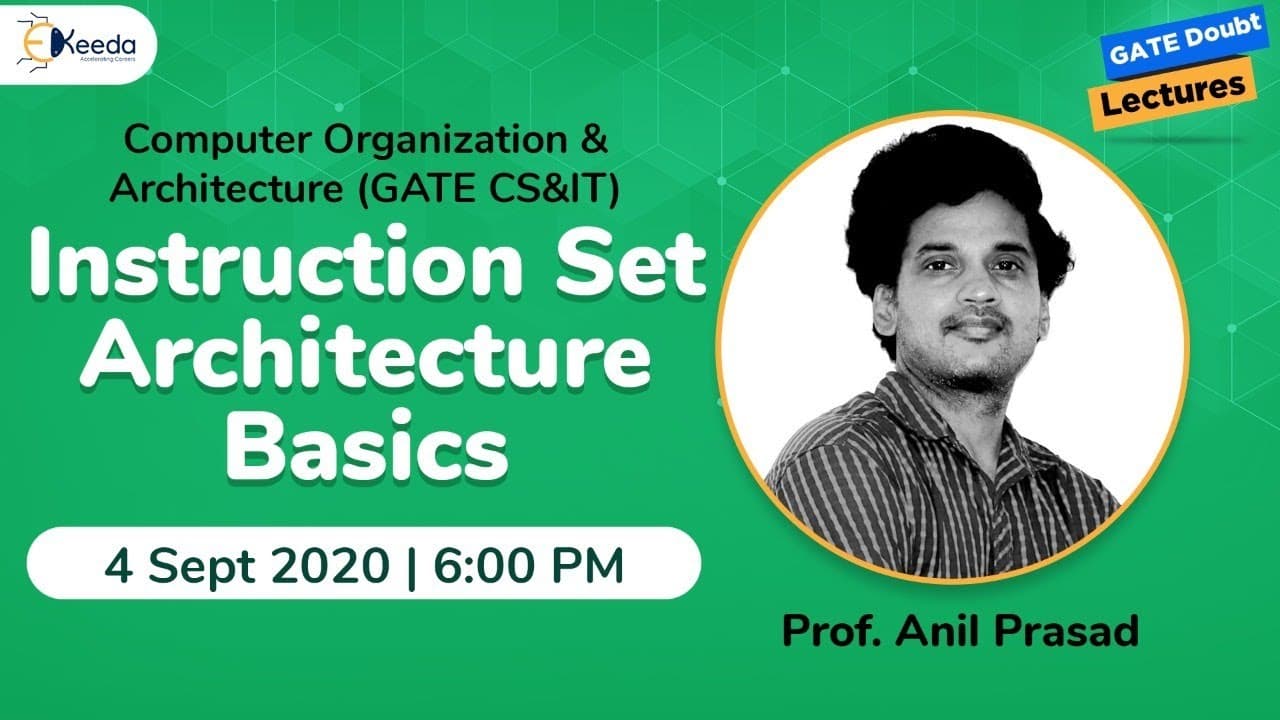
Computer Organization & Architecture (GATE CSE) - Instruction Set Architecture Basics - 4 Sep, 6 PM
TL;DR
This content provides an introduction to computer architecture and focuses on the design and purpose of register sets in a single accumulator organization.
Transcript
hi um am i audible um send me messages because taking it for first time just i wanted to know if my picture and voice is completely added i'd like to know um yeah of course it is audible people are saying that it is idle fine okay fine yeah um now this is daniel i'm gonna take computer architecture for you guys when it comes to my profile i finishe... Read More
Key Insights
- 🧑🎓 The speaker introduces themselves and Ekeda, highlighting their qualifications and experience in computer architecture and the platform's initiative for GATE students.
- 💻 Computer architecture involves designing the structure and organization of a computer system, including the CPU, main memory, and control unit.
- 🍉 Main memory is crucial for program execution, and secondary memory provides long-term storage for data.
Install to Summarize YouTube Videos and Get Transcripts
Explore YouTube Video Summarizer or Get YouTube Transcript Extractor
Questions & Answers
Q: What is the purpose of computer architecture?
Computer architecture involves designing the structure and organization of a computer system, focusing on components such as the CPU, main memory, and control unit.
Q: How does Ekeda support GATE students?
Ekeda offers online training for GATE students, providing recorded content and live lectures totaling around 500 hours. This additional content helps students prepare for the exam.
Q: What is the difference between main memory and secondary memory?
Main memory, also known as RAM, is directly accessible by the CPU and holds programs and data currently being executed. Secondary memory, such as hard drives or solid-state drives, provides long-term storage but is not directly accessible by the CPU.
Q: What is the purpose of a register set in a computer system?
Register sets store temporary data and instructions within the CPU. They include registers such as the program counter, which holds the address of the next instruction, and the accumulator, which holds the output of each instruction.
Summary & Key Takeaways
-
The video introduces the speaker and discusses their qualifications and experience in the field of computer architecture.
-
It explains Ekeda, the largest online platform for technical courses, and its initiative to provide online training for GATE (Graduate Aptitude Test in Engineering) students.
-
The content then delves into the basics of computer architecture, including the history of computer systems, program execution, and the importance of main memory.
Read in Other Languages (beta)
Share This Summary 📚
Summarize YouTube Videos and Get Video Transcripts with 1-Click
Try YouTube Summary with ChatGPT & Claude or YouTube Transcript Generator
Explore More Summaries from Ekeeda 📚





Summarize YouTube Videos and Get Video Transcripts with 1-Click
Try YouTube Summary with ChatGPT & Claude or YouTube Transcript Generator