Acid–base indicators | Acids and bases | AP Chemistry | Khan Academy
TL;DR
Acid-base indicators help determine the equivalence point in titrations by changing color based on pH levels.
Transcript
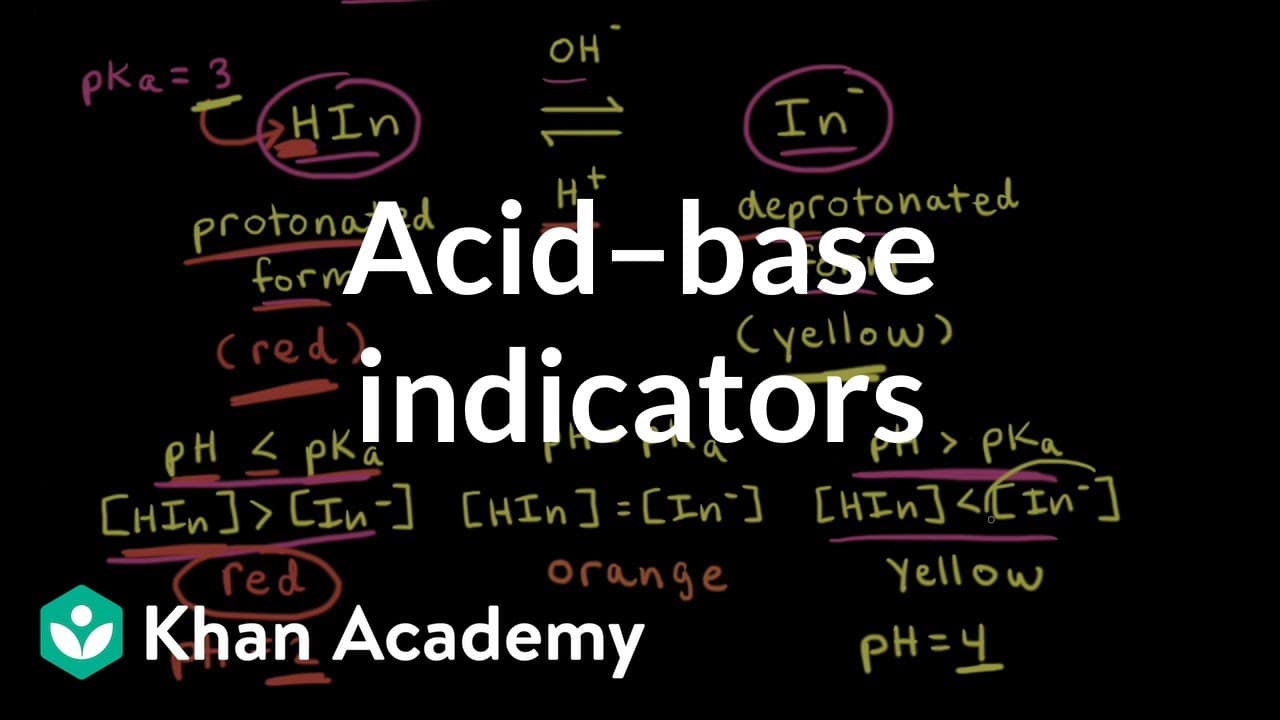
- [Instructor] Acid-base indicators are used in titrations to determine when the equivalence point is reached. Let's look at a hypothetical indicator. In the protonated form, the indicator has the formula HIn. So this would be the acidic proton on this protonated form. When base is added, the protonated form is converted into the deprotonated form.... Read More
Key Insights
- ⚾ Acid-base indicators change color based on the ratio of protonated and deprotonated forms, which is influenced by pH.
- 😥 The pH range over which an indicator changes color is approximately equal to the pKa value plus or minus one.
- 😥 Choosing the right indicator for a titration involves matching the indicator's color change range or pKa value with the pH at the equivalence point.
- 💪 Methyl red is suitable for weak acid-strong base titrations, while phenolphthalein is suitable for weak base-strong acid titrations.
- 😥 The choice of indicator depends on the pH range of the equivalence point and the pH range or pKa value of the indicator.
- 😥 Acid-base indicators help ensure accurate and precise titrations by visually indicating when the equivalence point is reached.
- 😥 To accurately determine the equivalence point, it is essential to choose an indicator that undergoes a color change within close proximity to the pH of the equivalence point.
Install to Summarize YouTube Videos and Get Transcripts
Explore YouTube Video Summarizer or Get YouTube Transcript Extractor
Questions & Answers
Q: How do acid-base indicators work in titrations?
Acid-base indicators change color based on changes in the ratio of protonated and deprotonated forms, which are influenced by pH. This allows us to visually determine when the equivalence point is reached in a titration.
Q: How do protonated and deprotonated forms of an acid-base indicator differ?
The protonated form of an acid-base indicator has an acidic proton and a positive charge, while the deprotonated form lacks the proton and carries a negative charge. Their ratio determines the color of the solution.
Q: How does pH affect the concentration of protonated and deprotonated forms?
When the pH is lower than the pKa value of a conjugate acid-base pair, the concentration of the weak acid (protonated form) is greater than the concentration of the conjugate base (deprotonated form). As the pH increases, the concentration of the conjugate base becomes greater than the weak acid.
Q: How can we choose the right acid-base indicator for a titration?
The goal is to choose an indicator whose color change occurs close to the pH of the equivalence point. This can be determined by considering the pH range and/or the pKa value of the indicator.
Summary & Key Takeaways
-
Acid-base indicators are used in titrations to determine when the equivalence point is reached.
-
The color of an acid-base indicator solution changes based on the ratio of protonated and deprotonated forms, which are influenced by pH.
-
The pH range over which an indicator changes color is approximately equal to the pKa value plus or minus one.
Read in Other Languages (beta)
Share This Summary 📚
Summarize YouTube Videos and Get Video Transcripts with 1-Click
Try YouTube Summary with ChatGPT & Claude or YouTube Transcript Generator
Explore More Summaries from Khan Academy 📚



Summarize YouTube Videos and Get Video Transcripts with 1-Click
Try YouTube Summary with ChatGPT & Claude or YouTube Transcript Generator