Problem No 1 on Basic System Properties | Continuous and Discrete Time Systems | Signals and Systems
TL;DR
This video analyzes a system and determines its properties, concluding that it is memoryless, causal, linear, and not time-invariant.
Transcript
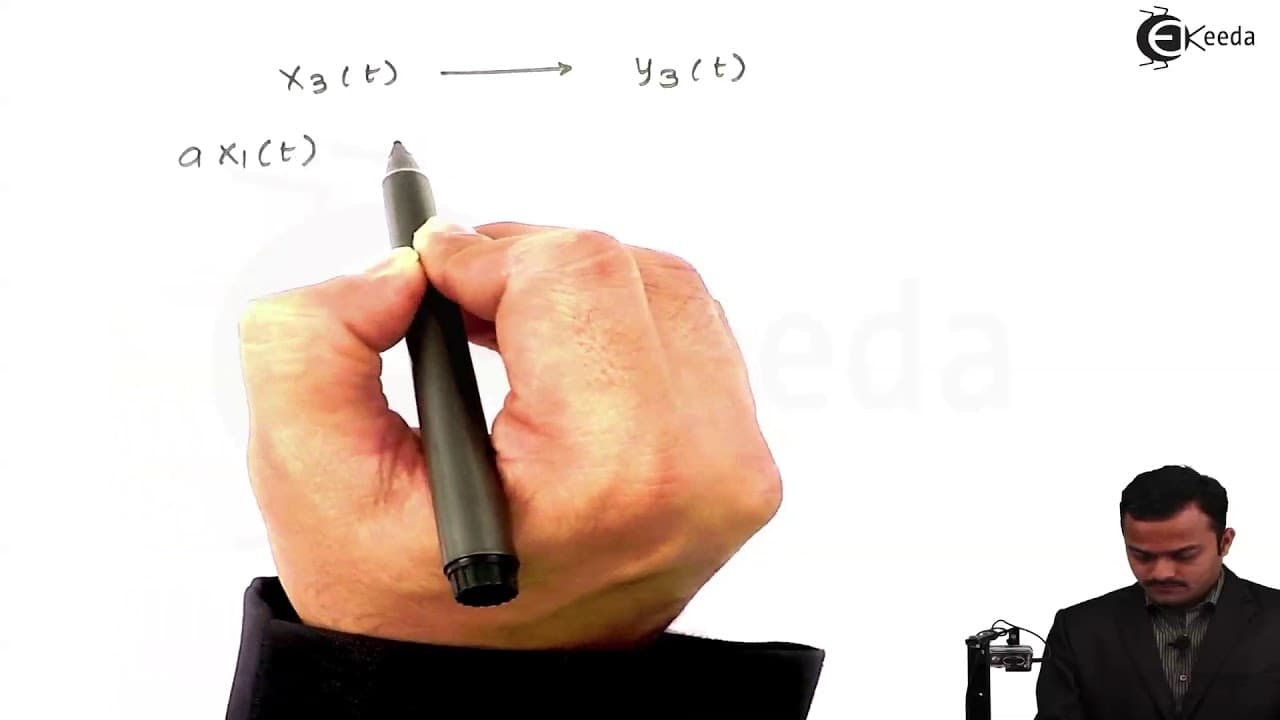
hello students in this video we are going to see a system and we will check its classification that is whether it is static or dynamic or it is causal non-causal or it is time invariant or varying with time or linear non-linear so system is given like this so for this system we need to check whether it is memoryless so check whether the system is m... Read More
Key Insights
- ⌛ A system requires memory if there are shifts in time, such as delays or advances, in the input.
- 🎁 Memoryless systems exhibit a present output that depends only on the present input.
- 🍝 Causal systems have outputs that depend on the present and past values of the input.
- ✅ Linearity in a system is determined by checking if it fulfills the properties of homogeneity and superposition.
Install to Summarize YouTube Videos and Get Transcripts
Explore YouTube Video Summarizer or Get YouTube Transcript Extractor
Questions & Answers
Q: What determines whether a system requires memory?
In this analysis, any shift in time, such as a delay or advance, indicates that the system requires memory to process the input.
Q: Is the system in the video memoryless?
Yes, based on the given expression y(t) = t*x(t), there are no time shifts in the input, indicating that the system does not require memory.
Q: What is a causal system?
A causal system is one in which the output depends on the present and past values of the input. In this case, the system in the video is causal, as the output depends only on the present values of the input.
Q: How is linearity determined in a system?
Linearity is determined by checking if the system fulfills the properties of homogeneity and superposition, where the multiplication and addition of inputs result in corresponding changes in the output. In this analysis, the system is found to be linear.
Summary & Key Takeaways
-
The system in focus is determined to be memoryless as it does not require any time delays or advances.
-
The system is found to be a causal system, as the output depends only on the present values of the input.
-
The system exhibits linearity, fulfilling properties of homogeneity and superposition.
-
However, the system is not time-invariant, as a shift in the input does not result in a corresponding shift in the output.
Read in Other Languages (beta)
Share This Summary 📚
Summarize YouTube Videos and Get Video Transcripts with 1-Click
Try YouTube Summary with ChatGPT & Claude or YouTube Transcript Generator
Explore More Summaries from Ekeeda 📚





Summarize YouTube Videos and Get Video Transcripts with 1-Click
Try YouTube Summary with ChatGPT & Claude or YouTube Transcript Generator