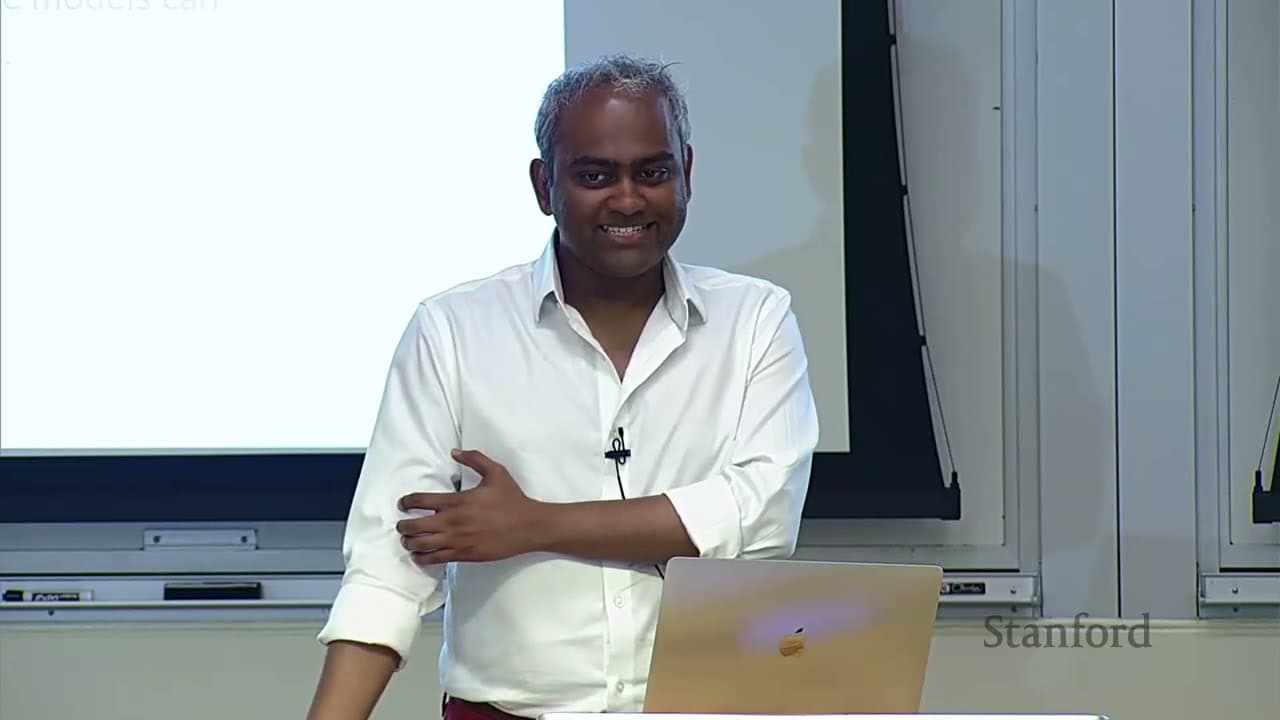
Stanford Seminar - A Picture of the Prediction Space of Deep Networks
TL;DR
Neural networks are capable of learning well due to the specific patterns in the data they are trained on, and their efficacy provides insights into the nature of data.
Transcript
thank you for coming I'll tell you about a few new results on understanding neural networks so I'm interested in understanding learning what properties of the physical world allow us to learn well and allow us to learn efficiently so uh and and and in a sense if you are any good at saying what good learning means then this kind of theory or this ki... Read More
Key Insights
- 👻 The energy landscape of neural networks is non-convex but still allows for effective training, resembling the Grand Canyon with areas where the network can get stuck.
- 🚂 Neural networks can fit complex functions with a large number of parameters due to the specific patterns present in the data they are trained on.
- ❓ The success of deep learning provides insights into the nature of data and the patterns that can be effectively learned.
- 🚂 Sloppiness, which refers to the redundancy and insensitivity to changes in certain dimensions, is a property of trained models and can explain their efficacy.
- ❓ Different architectures and optimization algorithms can result in different training trajectories, but all architectures have similar trajectories within their respective clusters.
- 😘 The manifold of probability distributions learned by neural networks is low-dimensional, and tasks can be learned on this low-dimensional manifold.
- 😄 The specific patterns in the data determine the ease of learning for neural networks, and the choice of learning problem also affects the learning process.
Install to Summarize YouTube Videos and Get Transcripts
Explore YouTube Video Summarizer or Get YouTube Transcript Extractor
Questions & Answers
Q: Why are neural networks able to be well-trained despite being non-convex optimization problems?
Neural networks have an energy landscape that is not convex, but still allows for effective training. The landscape is like the Grand Canyon, with certain areas where the network can get stuck, but tricks can be used to navigate and escape these areas.
Q: How can neural networks fit complex functions with a high degree of parameters even with limited data?
Neural networks can fit complex functions due to the specific patterns present in the data they are trained on. These patterns allow for effective learning even with a large number of parameters. The remaining parameters that are not constrained do not impact the network's predictions significantly.
Q: Why are neural networks considered efficient learners compared to other machine learning models?
Neural networks are considered efficient learners because they are able to capture and model specific patterns in the data they are trained on. The specific patterns in the data make it possible for neural networks to achieve high accuracy without overfitting.
Q: Are there limitations to the current understanding of neural networks?
While significant progress has been made in understanding neural networks, there are still aspects that remain unknown. The understanding of the specific properties and behaviors of neural networks is an active area of research.
Summary & Key Takeaways
-
The talk focuses on understanding artificial neural networks and their ability to learn efficiently, with the eventual goal of understanding why biological systems learn better than artificial systems.
-
The first key question explored is why neural networks can be well-trained despite being non-convex optimization problems. The energy landscape of neural networks is not convex but still allows for effective training.
-
The second key question addresses why neural networks can fit highly complex functions with a large number of parameters, even with limited data. The data used in training neural networks contains specific patterns that make this possible.
Read in Other Languages (beta)
Share This Summary 📚
Summarize YouTube Videos and Get Video Transcripts with 1-Click
Try YouTube Summary with ChatGPT & Claude or YouTube Transcript Generator
Explore More Summaries from Stanford Online 📚
Summarize YouTube Videos and Get Video Transcripts with 1-Click
Try YouTube Summary with ChatGPT & Claude or YouTube Transcript Generator