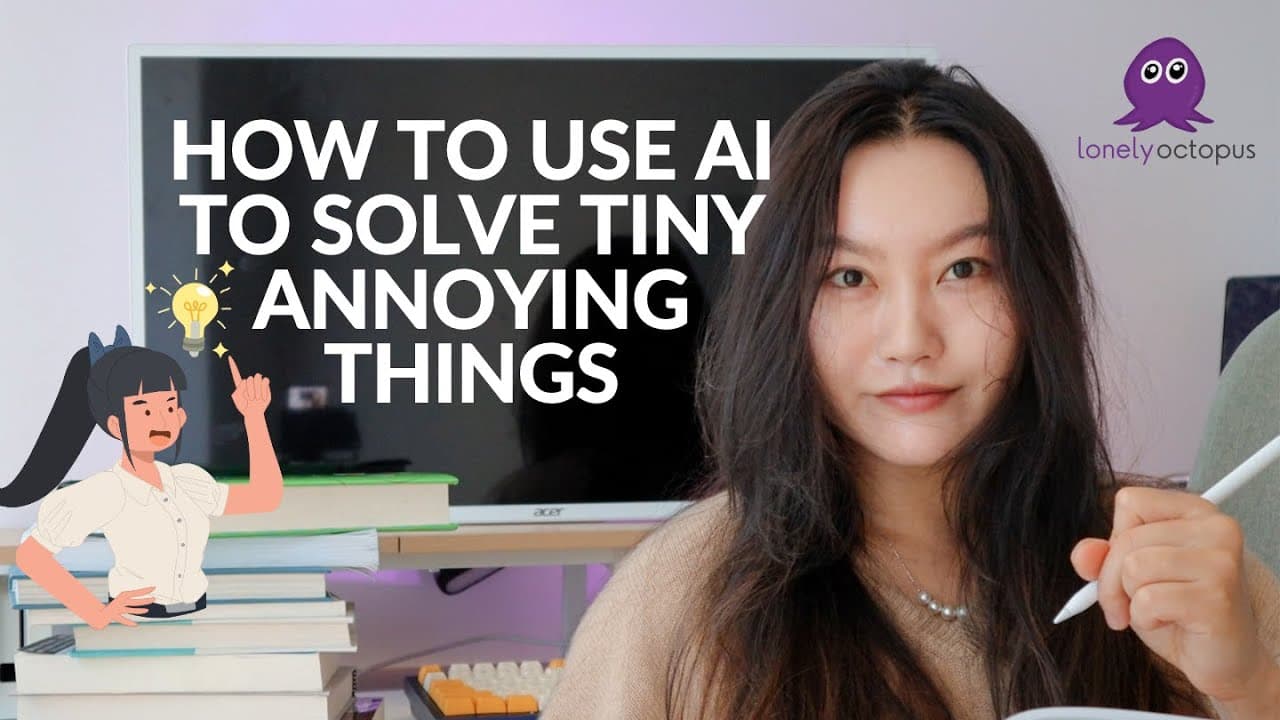
🐙 Lunch & Learn: How to use AI to Solve Tiny Annoying Things
TL;DR
Discussing AI solutions for everyday annoyances in a live stream.
Transcript
Hello friends my apologies the firewall has gotten me today and nothing would load but I am here now how are you doing all Hello friends de Fen hello hey Cipher quit playing box hello hey aan hi minina cult Penny hello hey spider the waiting is the hardest part is everyone here white what is white peas white pece hello hello Tina AI queen as in lik... Read More
Key Insights
- AI can be utilized to solve small daily annoyances, such as organizing notes, managing personal finances, and more through tools like chatbots and automation platforms.
- The host discusses the potential impact of AI advancements on creative fields, suggesting that AI might lower the barrier to entry but also increase competition.
- Live brainstorming with viewers on how AI can address specific annoyances, like writer's block or losing track while reading, shows the interactive and communal approach to learning AI.
- The host introduces the concept of 'cold start problems' in creative processes and suggests using AI to generate initial ideas or outlines.
- There is a concern about how creators might be affected by AI tools that automate tasks traditionally requiring human creativity and skill.
- The discussion emphasizes the importance of learning how to leverage AI tools rather than mastering all underlying skills, suggesting a shift in skill sets needed in the future.
- The host promotes the 'Lonely Octopus' program, which offers personalized AI learning and real-world project experience, highlighting its community-driven approach.
- The session includes practical tips for using AI in daily tasks, such as using speech-to-text for note-taking and automating emails with AI integrations.
Install to Summarize YouTube Videos and Get Transcripts
Explore YouTube Video Summarizer or Get YouTube Transcript Extractor
Questions & Answers
Q: How can AI help with writer's block?
AI can assist with writer's block by generating initial ideas or outlines. Using tools like GPT, one can input a topic and receive a structured outline or even a draft, which can serve as a starting point for further development. This helps overcome the 'cold start problem' and stimulates creativity.
Q: What concerns are there about AI in creative fields?
The main concern is that AI might replace certain creative jobs by automating tasks traditionally requiring human creativity and skill. However, AI also lowers the barrier to entry, allowing more people to express creativity. This could lead to increased competition as more people have access to creative tools.
Q: What is the 'Lonely Octopus' program?
The 'Lonely Octopus' program is an educational initiative that teaches AI skills through personalized study plans and real-world projects. Participants work on projects from reputable companies, gaining practical experience and network connections. The program is community-driven, offering mentorship and support throughout the learning process.
Q: How does AI impact the skill sets needed in the future?
AI is shifting the skill sets needed in the future by making it more important to understand how to leverage AI tools rather than mastering all underlying skills. As AI automates more tasks, the ability to effectively use AI tools becomes crucial, reducing the necessity for certain technical skills.
Q: How can AI be used to organize notes and manage personal tasks?
AI can organize notes and manage personal tasks through automation platforms like Zapier and AI chatbots. These tools can help categorize notes, automate reminders, and even suggest actions based on note content. AI can also convert speech to text for easier note-taking and summarization.
Q: What are some practical AI tools mentioned in the session?
The session mentions tools like GPT for generating content, Zapier for automating email and calendar tasks, and Harpa for summarizing YouTube videos. These tools can help streamline daily tasks, making processes more efficient and reducing the burden of repetitive activities.
Q: How does the host suggest overcoming 'cold start problems'?
The host suggests using AI to generate initial outlines or drafts to overcome 'cold start problems.' By inputting a topic into an AI tool like GPT, users can receive structured content that serves as a foundation for further development, helping to kickstart the creative process.
Q: What is the impact of AI on the barrier to entry in creative fields?
AI significantly lowers the barrier to entry in creative fields by providing tools that automate complex tasks, allowing more people to participate in creative processes. This democratization of creativity means that skills once required to produce high-quality content are now accessible to a broader audience, increasing diversity and competition.
Summary & Key Takeaways
-
In a live stream, the host discusses using AI to solve everyday annoyances, like organizing notes and managing personal tasks. The session is interactive, with viewers contributing their own 'tiny annoying things' and brainstorming AI solutions.
-
The host expresses excitement and concern about AI's impact on creative fields, noting that while it democratizes creative tools, it also raises competition. The discussion includes AI's role in lowering barriers to creative expression.
-
The 'Lonely Octopus' program is introduced as a way to learn AI skills and apply them in real-world projects. The program emphasizes personalized learning and community support, aiming to equip participants with practical AI knowledge.
Read in Other Languages (beta)
Share This Summary 📚
Summarize YouTube Videos and Get Video Transcripts with 1-Click
Try YouTube Summary with ChatGPT & Claude or YouTube Transcript Generator
Explore More Summaries from Tina Huang 📚



Summarize YouTube Videos and Get Video Transcripts with 1-Click
Try YouTube Summary with ChatGPT & Claude or YouTube Transcript Generator