Stanford engineers devise optical method for producing 3-D images of nanoscale objects
TL;DR
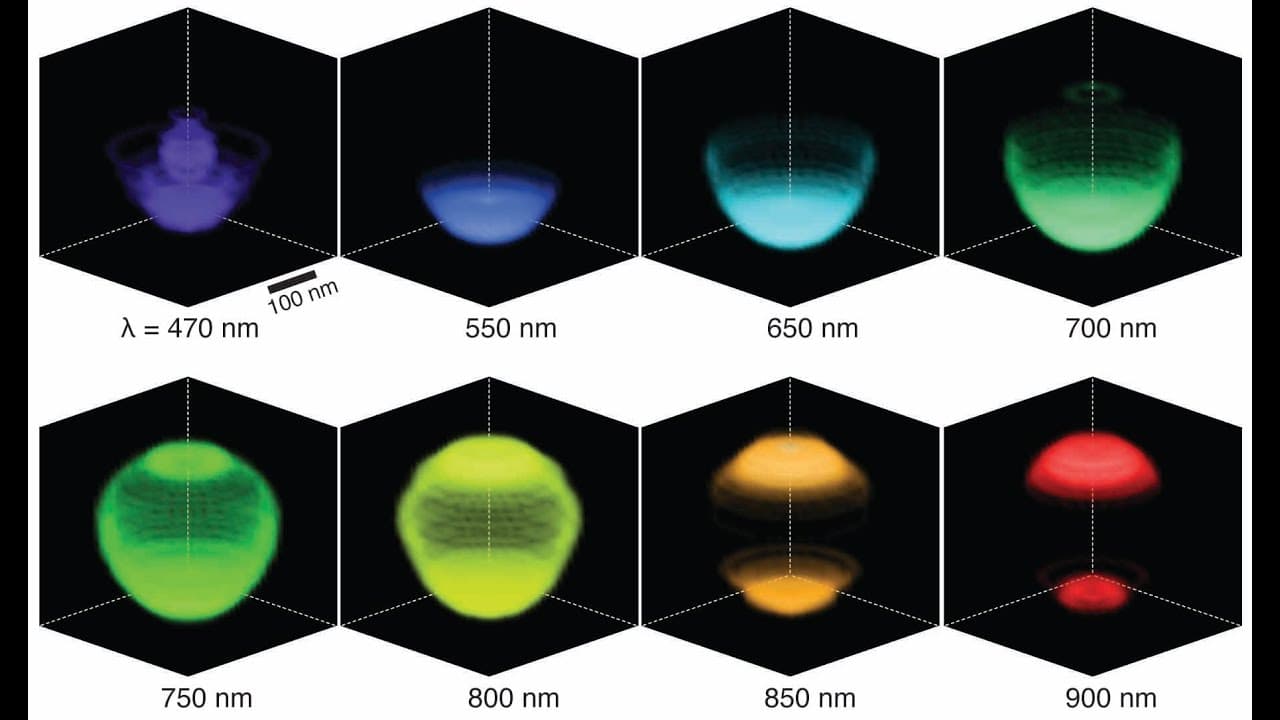
Stanford researchers have developed a technique called cathodoluminescence tomography, which combines cathodoluminescence and tomography to generate three-dimensional images of the radiative optical properties of nanostructures.
Transcript
Stanford University. Have you ever wondered how a CAT scan is able to generate a three-dimensional image of your organs? These images are made using a process called tomography. In this technique, two-dimensional images are taken at several angles. Each angle gives us new information about the object. Next, an algorithm can combine all of these 2D ... Read More
Key Insights
- 🥡 Tomography is a technique that can create three-dimensional images of objects by combining two-dimensional images taken at different angles.
- 😁 Cathodoluminescence is a phenomenon where objects emit light when excited by a beam of electrons, and it can be used to probe the optical properties of nanostructures.
- 🙂 By combining cathodoluminescence with tomography, researchers can visualize how light interacts with nanostructures at the nanometer scale.
- 👻 This cathodoluminescence tomography technique allows for the first three-dimensional imaging of the radiative optical properties of nanostructures.
- 🈸 It has the potential to provide valuable insights for designing and engineering nanostructures for various applications.
- 🙂 The technique can be used to study how light interacts with solar cells on the nanoscale, aiding in the design of more efficient cells.
- 🤗 Cathodoluminescence tomography opens up new possibilities for visualizing and understanding the behavior of nanostructures in various fields, including nanotechnology and materials science.
Install to Summarize YouTube Videos and Get Transcripts
Explore YouTube Video Summarizer or Get YouTube Transcript Extractor
Questions & Answers
Q: How does tomography work to create three-dimensional images?
Tomography involves taking two-dimensional images of an object at different angles, which are then combined using an algorithm to create a three-dimensional image of the object.
Q: What is cathodoluminescence?
Cathodoluminescence is a phenomenon where an object emits light when it is excited by a beam of electrons in an electron microscope.
Q: How can cathodoluminescence be used to probe optical properties of nanostructures?
By collecting the light emitted through cathodoluminescence, researchers can map out the optical properties of nanostructures with nanometer-scale resolution.
Q: What is cathodoluminescence tomography?
Cathodoluminescence tomography is a technique that combines cathodoluminescence with tomography to generate three-dimensional maps of how light interacts with nanostructures.
Summary & Key Takeaways
-
Tomography is a technique that uses two-dimensional images taken at different angles to create a three-dimensional image of an object.
-
Stanford researchers have applied tomography to tiny objects like nanoparticles, allowing them to see individual atoms in three dimensions.
-
By combining cathodoluminescence with tomography, researchers can now visualize how light interacts with nanostructures with nanometer-scale resolution.
Read in Other Languages (beta)
Share This Summary 📚
Summarize YouTube Videos and Get Video Transcripts with 1-Click
Try YouTube Summary with ChatGPT & Claude or YouTube Transcript Generator
Explore More Summaries from Stanford 📚



Summarize YouTube Videos and Get Video Transcripts with 1-Click
Try YouTube Summary with ChatGPT & Claude or YouTube Transcript Generator