Can AI Ever Match Human Intelligence?
TL;DR
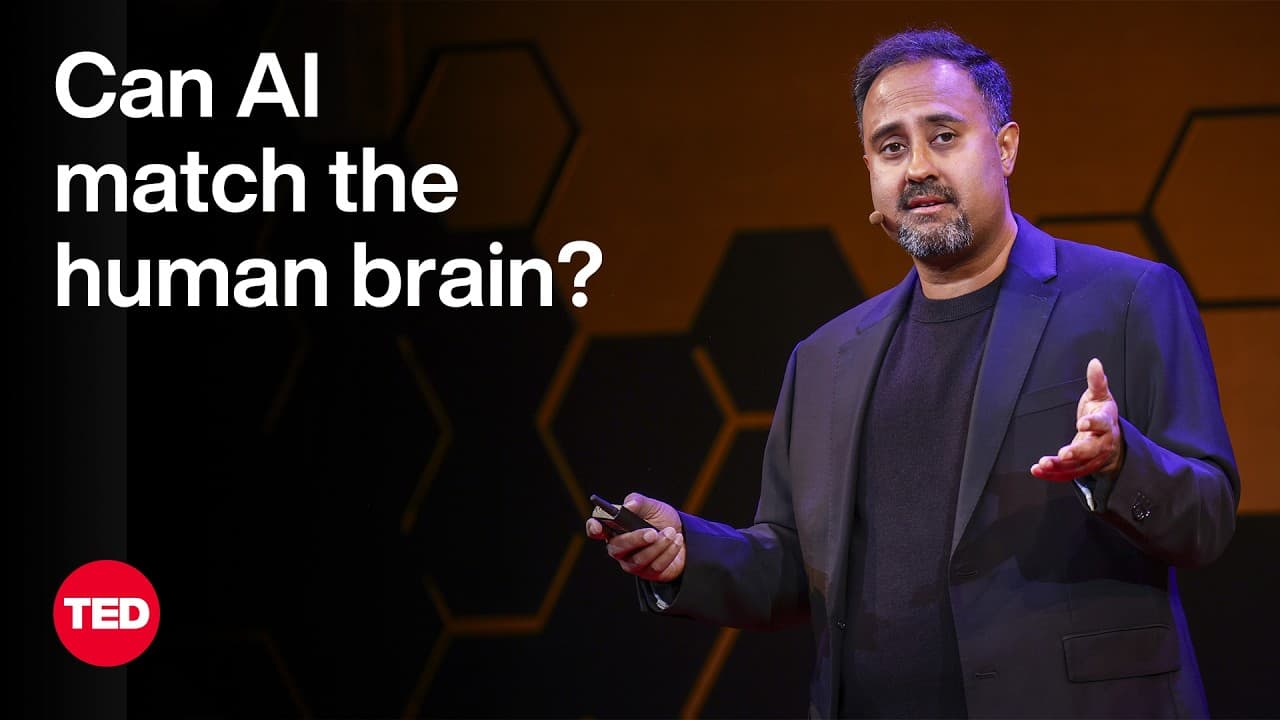
AI has advanced significantly but still fails to replicate human intelligence's nuances in reasoning and efficiency. Bridging the gap between AI and human cognition requires a multidisciplinary approach, exploring data efficiency, energy consumption, and explainability. A unified science of intelligence can enhance both artificial and biological understanding, pushing the boundaries of what's possible.
Transcript
so what the heck happened in the field of AI in the last decade it's like a strange new type of intelligence appeared in our planet but it's not like human intelligence it has remarkable capabilities but it also makes egregious errors that we never make and it doesn't yet do the Deep logical reasoning that we can do it has a very mysterious surface... Read More
Key Insights
- 🖤 Over the past decade, AI has drastically evolved but still lacks a comprehensive understanding of its fundamental principles.
- ❓ Employing a multidisciplinary approach that includes neuroscience, mathematics, and psychology is crucial for advancing both AI and our understanding of natural intelligence.
- 🪡 Data efficiency in AI remains a major challenge as models require massive datasets for minimal improvements, emphasizing the need for innovative learning approaches.
- 🧠 AI's significant energy consumption compared to human brains presents an opportunity to rethink technological designs for enhanced energy efficiency.
- 🧠 Explainable AI can bridge gaps in neuroscience by providing accurate models that replicate and elucidate brain functions.
- 🚨 Merging human cognitive processes with AI systems can enhance the understanding of neural functions and capabilities.
- 👻 The pursuit of intelligence science, especially in an academic context, allows for openness and collaboration that fosters genuine progress in understanding intelligence.
Install to Summarize YouTube Videos and Get Transcripts
Explore YouTube Video Summarizer or Get YouTube Transcript Extractor
Questions & Answers
Q: What are some key capabilities and flaws of AI compared to human intelligence?
While AI possesses remarkable capabilities, such as processing vast amounts of data quickly, it is prone to making significant errors that humans typically do not. AI lacks deep logical reasoning and can struggle with complex tasks that require understanding and contextual awareness. These flaws highlight the necessity for a deeper understanding of AI's mechanisms and limitations.
Q: How does the historical context of biological intelligence aid in understanding AI?
By comparing AI with the evolution of biological intelligence over millions of years, we can appreciate the complexities that physical and evolutionary processes have instilled in human cognition. This perspective helps inform efforts to refine AI systems, drawing on years of evolutionary optimization to enhance their efficiency and functionality.
Q: What is the significance of data efficiency in AI development?
Data efficiency refers to the ability of AI systems to learn from fewer data points compared to humans. The current models are excessively data-hungry, often requiring massive datasets for marginal improvements. Understanding and developing non-redundant datasets can significantly optimize AI learning processes, making them more sustainable and effective in real-world applications.
Q: How does energy efficiency impact AI compared to biological systems?
While human brains operate on approximately 20 watts of power, large AI models can consume millions of watts during training. This disparity underscores the need for AI systems to adopt energy-efficient strategies inspired by biological computations, which are inherently designed to minimize energy consumption while maximizing computational efficiency.
Q: What role does explainable AI play in neuroscience research?
Explainable AI enhances neuroscience by offering insights into how digital models of the brain function. By developing accurate models that can reproduce experimental findings, researchers can deconstruct specific neural mechanisms, leading to a better understanding of brain processes and potentially unlocking new avenues for neuroscience discoveries.
Q: How can merging minds and machines be achieved according to the content?
The merging of minds and machines involves creating digital twins of biological systems and facilitating bidirectional communication between them. By understanding neural patterns, researchers can influence brain activity and enhance cognitive processes, leading to breakthroughs in understanding and potentially augmenting human capabilities.
Q: Why is a long-term approach essential in the pursuit of a science of intelligence?
A long-term perspective is crucial as it allows researchers to explore foundational questions about intelligence without the constraints of immediate financial pressures or corporate secrecy. This freedom encourages interdisciplinary approaches and fosters an environment where knowledge can be shared openly, ultimately benefiting scientific progress and societal understanding.
Q: What future prospects does the pursuit of intelligence science hold?
The endeavor to explore the science of intelligence opens numerous possibilities for enhancing AI and biological understanding. It promises advancements in cognitive augmentation, problem-solving capabilities, and even deeper insights into human nature, making it one of the most significant intellectual pursuits of our time.
Summary & Key Takeaways
-
The content discusses the rapid advancements in AI over the past decade, emphasizing its capabilities and flaws compared to human intelligence.
-
It highlights the significant gaps in our understanding of AI, urging a multi-disciplinary approach to create a new science of intelligence that incorporates insights from various fields.
-
The pursuit of this unified science of intelligence has the potential to enhance both artificial and biological intelligence through improved efficiency, explainability, and innovative technologies.
Read in Other Languages (beta)
Share This Summary 📚
Summarize YouTube Videos and Get Video Transcripts with 1-Click
Try YouTube Summary with ChatGPT & Claude or YouTube Transcript Generator
Explore More Summaries from TED 📚



Summarize YouTube Videos and Get Video Transcripts with 1-Click
Try YouTube Summary with ChatGPT & Claude or YouTube Transcript Generator