First Order Partial Derivation of Composite Function Problem 7
TL;DR
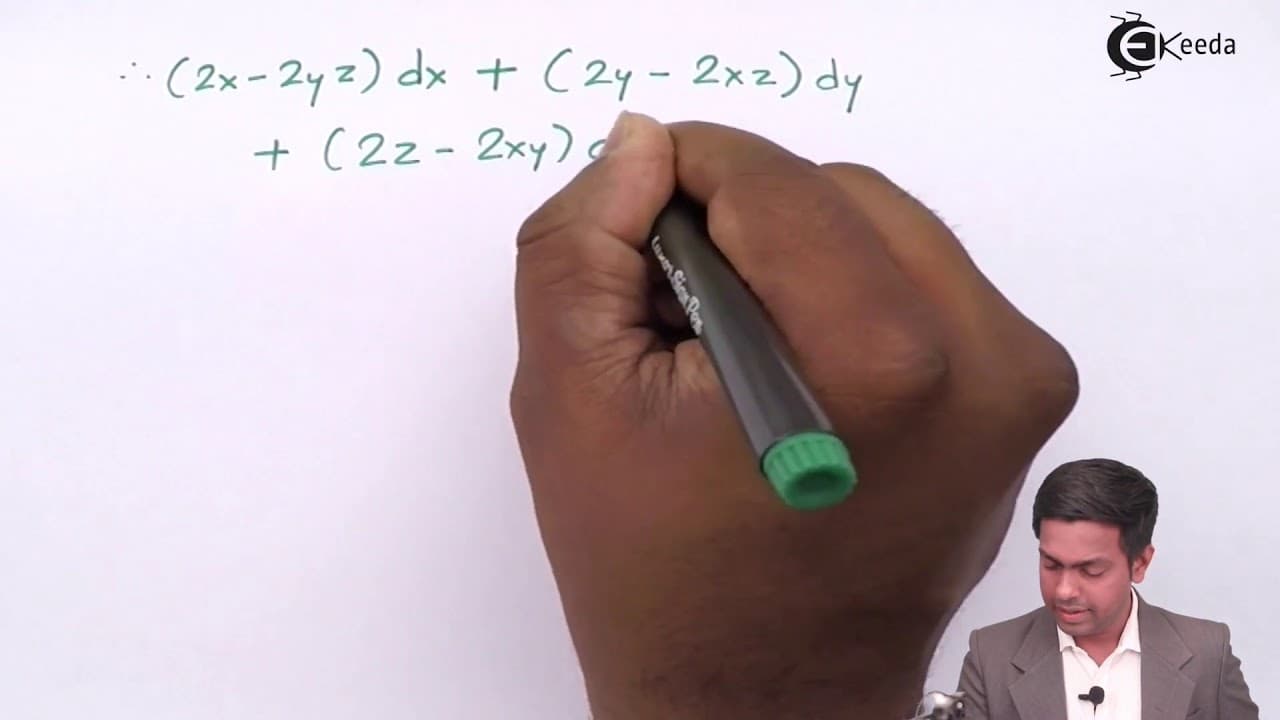
Derive a result using partial differentiation and the relationship between complete differentiation and partial differentiation.
Transcript
hello students so after completing six problems let's start with the next problem of composite function so here i have a function for which we have to derive the given result but this time guys it's not so easy to get the answer by just partial differentiation so here i'm gonna use one more property which will state the relationship between complet... Read More
Key Insights
- 😒 The problem involves a composite function that requires the use of partial differentiation.
- ❓ The relationship between complete differentiation and partial differentiation is crucial in solving the problem.
- 📏 The steps involved in deriving the result using partial differentiation and chain rule are explained in detail.
- 🇰🇬 Substitutions for the terms x - yz, y - xz, and z - xy are obtained using the concept of complete squares.
- 👻 Dividing all three terms by appropriate square roots allows for the derivation of the final result.
- ❓ Understanding the logic and strategy behind the solution is important for tackling similar problems.
- ♿ Subscribing to the ekeeda channel and sharing it with friends is recommended for access to helpful lectures.
Install to Summarize YouTube Videos and Get Transcripts
Explore YouTube Video Summarizer or Get YouTube Transcript Extractor
Questions & Answers
Q: How is the problem in the video different from previous problems that could be solved using partial differentiation?
The problem in the video involves terms like dx, dy, and dz, indicating the need for the relationship between complete differentiation and partial differentiation.
Q: How is the relationship between complete differentiation and partial differentiation used to solve the problem?
By taking all the terms of the function on the left-hand side and setting the right-hand side to zero, the function u is equated to zero, allowing for the use of partial differentiation.
Q: How is the formula for du derived using partial differentiation?
The formula for du, which represents the differentiation of u in terms of partial differentiation, is derived using the chain rule.
Q: How is the substitution for the terms x - yz, y - xz, and z - xy obtained?
By using the concept of complete squares and adding appropriate terms on both sides, the substitutions for the terms x - yz, y - xz, and z - xy can be obtained.
Summary & Key Takeaways
-
The video discusses a problem involving a composite function that cannot be solved using partial differentiation alone.
-
The relationship between complete differentiation and partial differentiation is used to solve the problem.
-
The steps involved in deriving the result using partial differentiation and chain rule are explained.
Read in Other Languages (beta)
Share This Summary 📚
Summarize YouTube Videos and Get Video Transcripts with 1-Click
Try YouTube Summary with ChatGPT & Claude or YouTube Transcript Generator
Explore More Summaries from Ekeeda 📚






Summarize YouTube Videos and Get Video Transcripts with 1-Click
Try YouTube Summary with ChatGPT & Claude or YouTube Transcript Generator