Nucleophilicity (Nucleophile Strength)
TL;DR
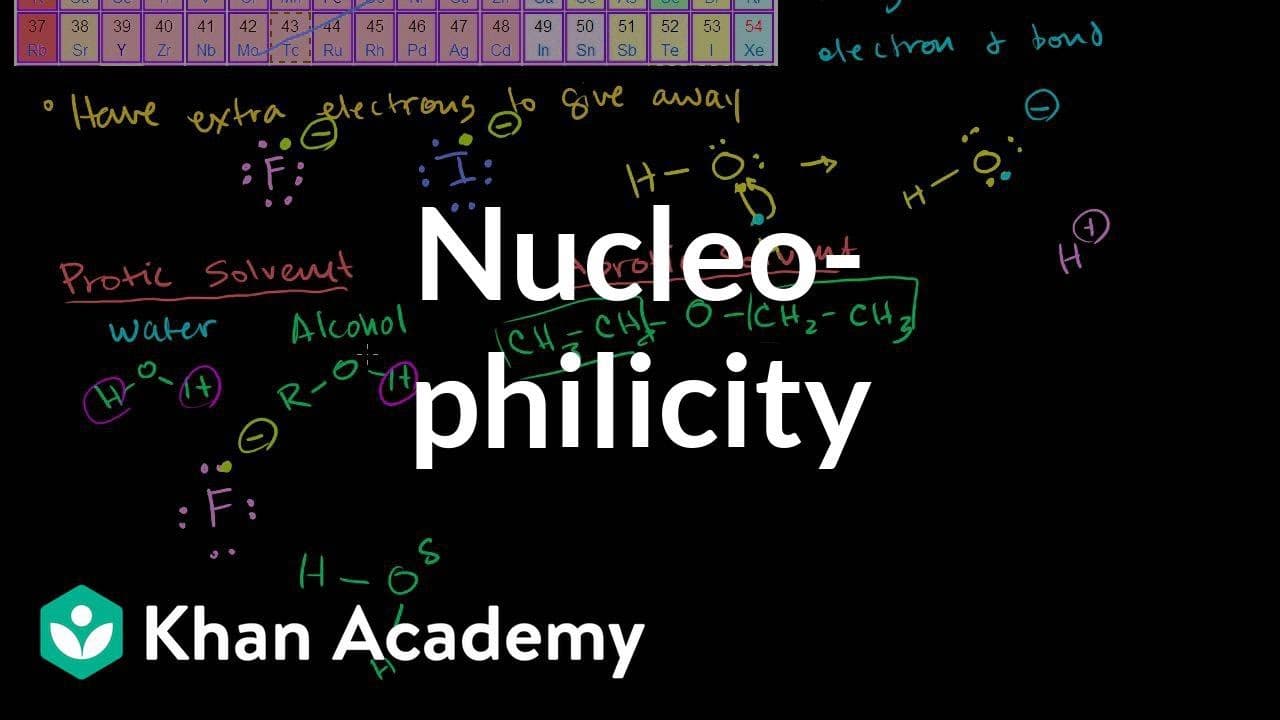
Nucleophilicity refers to the ability of an atom or molecule to give away extra electrons and bond with a nucleus or another atom. Factors such as extra electrons, lone pairs, and negative charge contribute to a substance's nucleophilicity.
Transcript
What I want to do with this video is talk about nucleophilicity. This is really just how good of a nucleophile something is. Or I'll just make up a definition right now: the ability for an atom slash ion slash molecule to act as a nucleophile, or to give away extra electrons and bond with a nucleus or with something else. I'll say with a nucleus. I... Read More
Key Insights
- 💁 Nucleophilicity refers to the ability of an atom, ion, or molecule to donate its lone pair of electrons and form new bonds.
- ❎ Negative ions or anions, including fluoride, chloride, bromide, and iodide, are typically good nucleophiles due to their extra electrons and negative charge.
- 💦 The hydroxide anion (OH), formed through the donation of an electron by water, is another example of a good nucleophile.
- 💦 In a protic solvent (such as water or alcohol), nucleophilicity is influenced by hydrogen bonding, resulting in smaller and more electronegative anions being less likely to react.
- 🤲 In an aprotic solvent (such as diethyl ether), nucleophilicity is less affected by hydrogen bonding, resulting in larger and more electronegative anions being more likely to react.
- 👋 Fluoride is the best nucleophile in an aprotic solvent, while iodide is the best nucleophile in a protic solvent.
- 🉑 Basicity and nucleophilicity are related concepts, but not the same. Basicity refers to the tendency of a substance to accept an electron pair, while nucleophilicity refers to the tendency to donate an electron pair.
Install to Summarize YouTube Videos and Get Transcripts
Explore YouTube Video Summarizer or Get YouTube Transcript Extractor
Questions & Answers
Q: What is nucleophilicity?
Nucleophilicity is a property that describes the ability of an atom, ion, or molecule to donate its lone pair of electrons and form a new bond with another atom or nucleus.
Q: What are some examples of good nucleophiles?
Good nucleophiles include negative ions or anions like fluoride (F-), chloride (Cl-), bromide (Br-), and iodide (I-), as well as the hydroxide anion (OH).
Q: Why are negative ions good nucleophiles?
Negative ions have extra electrons and a negative charge. These extra electrons can be donated to form new bonds with other atoms, making them good nucleophiles.
Q: How does the hydroxide anion serve as a nucleophile?
The hydroxide anion, derived from water, can donate its lone pair of electrons to form a bond with another atom or nucleus. This ability makes it a good nucleophile.
Summary & Key Takeaways
-
Nucleophilicity is a measure of how good a nucleophile is, defined as the ability of an atom, ion, or molecule to give away extra electrons and form bonds with a nucleus or other atoms.
-
Negative ions or anions, such as fluoride, chloride, bromide, and iodide, are typically good nucleophiles due to their extra electrons and negative charge.
-
The hydroxide anion (OH) is another example of a good nucleophile because of its extra electrons and ability to form bonds.
Read in Other Languages (beta)
Share This Summary 📚
Summarize YouTube Videos and Get Video Transcripts with 1-Click
Try YouTube Summary with ChatGPT & Claude or YouTube Transcript Generator
Explore More Summaries from Khan Academy 📚






Summarize YouTube Videos and Get Video Transcripts with 1-Click
Try YouTube Summary with ChatGPT & Claude or YouTube Transcript Generator