Constructing solutions to systems of equations | Systems of equations | 8th grade | Khan Academy
TL;DR
Two linear equations with the same line have infinitely many solutions, while different y-intercepts result in no solutions.
Transcript
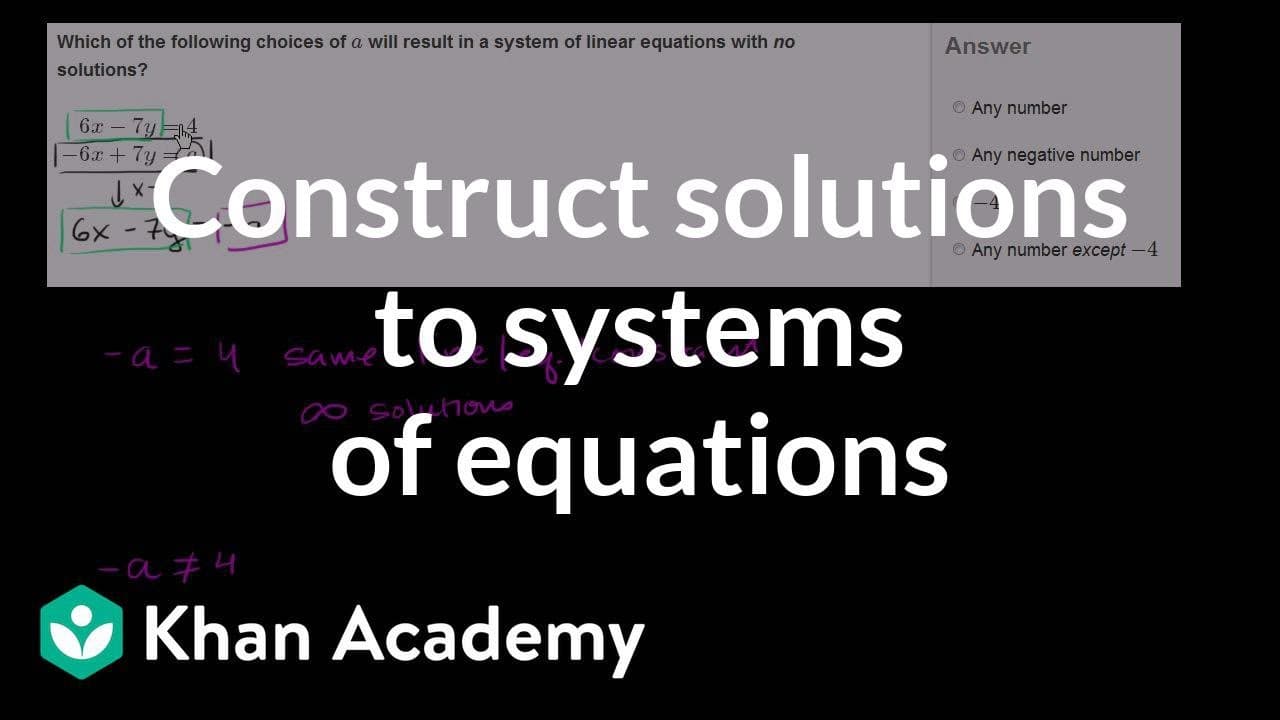
Fill in the blanks to form a system of linear equations in the variables x and y with infinitely many solutions. So you're going to have infinitely many solutions if essentially both of these equations are describing the same line. If they're both essentially the same equation, they are the same constraint. And we can graphically imagine that. Let'... Read More
Key Insights
- 🫥 Two linear equations representing the same line will have infinitely many solutions.
- 😀 For a system to have no solutions, the equations should have the same slope but different y-intercepts.
- ❓ By manipulating the equations algebraically, we can determine the conditions for infinite solutions or no solutions.
- #️⃣ The y-intercept of a linear equation affects the number of solutions in a system.
- 💁♂️ Slope-intercept form helps analyze the slope and y-intercept of linear equations.
- #️⃣ The value of a determines the y-intercept in one of the equations, affecting the system's number of solutions.
- ❣️ Infinitely many solutions occur when the same combination of x and y values satisfies both equations.
Install to Summarize YouTube Videos and Get Transcripts
Explore YouTube Video Summarizer or Get YouTube Transcript Extractor
Questions & Answers
Q: What conditions result in a system of linear equations with infinitely many solutions?
A system of linear equations will have infinitely many solutions if the equations describe the same line, meaning they have the same slope and y-intercept.
Q: How can we determine if a system has no solutions?
To have no solutions, the system should have the same slope but different y-intercepts. If we plot the equations, they will be parallel lines that do not intersect.
Q: How can we algebraically manipulate equations to determine the number of solutions?
By manipulating the equations to have the same left-hand side and different right-hand sides, we can determine if the system has infinite solutions or no solutions.
Q: What happens if the y-intercepts of two equations are equal?
If the y-intercepts of two equations are equal, then the system will have infinitely many solutions as the equations describe the same line.
Summary & Key Takeaways
-
Two linear equations that represent the same line have infinitely many solutions.
-
To create a system of linear equations with no solutions, the equations should have the same slope but different y-intercepts.
-
By algebraically manipulating the equations, we can determine the conditions for infinite solutions or no solutions.
Read in Other Languages (beta)
Share This Summary 📚
Summarize YouTube Videos and Get Video Transcripts with 1-Click
Try YouTube Summary with ChatGPT & Claude or YouTube Transcript Generator
Explore More Summaries from Khan Academy 📚



Summarize YouTube Videos and Get Video Transcripts with 1-Click
Try YouTube Summary with ChatGPT & Claude or YouTube Transcript Generator