Example: Analyzing distribution of sum of two normally distributed random variables | Khan Academy
TL;DR
Given the normal distribution of Shinji's fuel usage for his morning and evening commute, there is a 2.28% probability that Shinji will run out of fuel.
Transcript
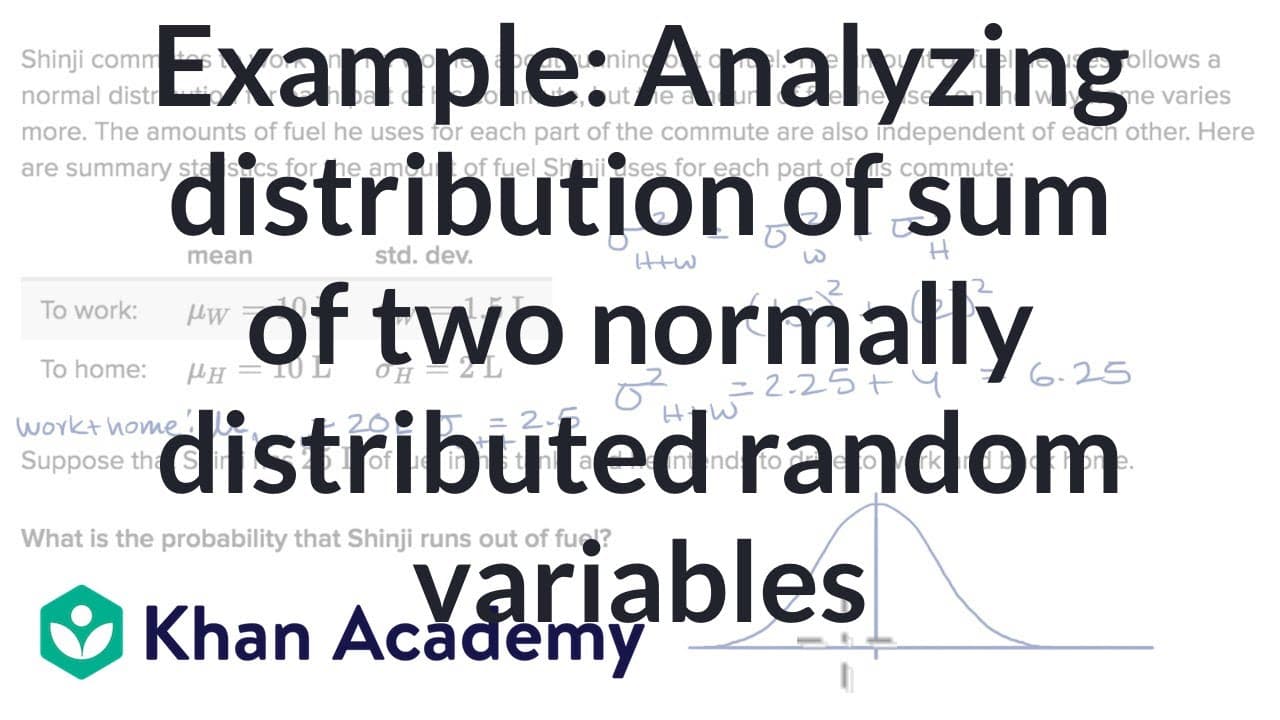
- [Instructor] Shinji commutes to work and he worries about running out of fuel. The amount of fuel he uses follows a normal distribution for each part of his commute, but the amount of fuel he uses on the way home varies more. The amounts of fuel he uses for each part of the commute are also independent of each other. Here are summary statistics f... Read More
Key Insights
- ⛽ Shinji's fuel usage for his morning and evening commute follows two separate normal distributions.
- 🛝 The total fuel usage for the round trip commute can be described by another normal distribution.
- 🏃 By calculating the probability using the normal distribution, it is found that there is a 2.28% chance Shinji will run out of fuel.
Install to Summarize YouTube Videos and Get Transcripts
Explore YouTube Video Summarizer or Get YouTube Transcript Extractor
Questions & Answers
Q: What are the mean and standard deviation for Shinji's fuel usage on his way home?
The mean fuel usage for Shinji's commute back home is 10 liters, just like his commute to work. However, the standard deviation is higher at 2 liters.
Q: How is the total fuel usage for the round trip commute calculated?
The mean of the total fuel usage is the sum of the means for the commute to work and back home, which is 20 liters. The standard deviation is the square root of the sum of the variances, 6.25, which is approximately 2.5 liters.
Q: Are the fuel usage for the commute to work and back home independent of each other?
Yes, it is stated that the fuel usage for each part of the commute is independent, which allows us to add the variances when calculating the variance of the total fuel usage.
Q: What is the probability that Shinji runs out of fuel?
The probability that Shinji runs out of fuel is 0.0228, which is equivalent to a 2.28% chance. This is calculated by finding the area under the normal distribution curve, above 25 liters.
Summary & Key Takeaways
-
Shinji's fuel usage for his commute to work follows a normal distribution with a mean of 10 liters and a standard deviation of 1.5 liters.
-
His fuel usage for his commute back home also follows a normal distribution, but with a higher standard deviation of 2 liters.
-
By calculating the total fuel usage for the round trip commute and using the normal distribution, it is found that there is a 2.28% probability that Shinji will run out of fuel.
Read in Other Languages (beta)
Share This Summary 📚
Summarize YouTube Videos and Get Video Transcripts with 1-Click
Try YouTube Summary with ChatGPT & Claude or YouTube Transcript Generator
Explore More Summaries from Khan Academy 📚



Summarize YouTube Videos and Get Video Transcripts with 1-Click
Try YouTube Summary with ChatGPT & Claude or YouTube Transcript Generator