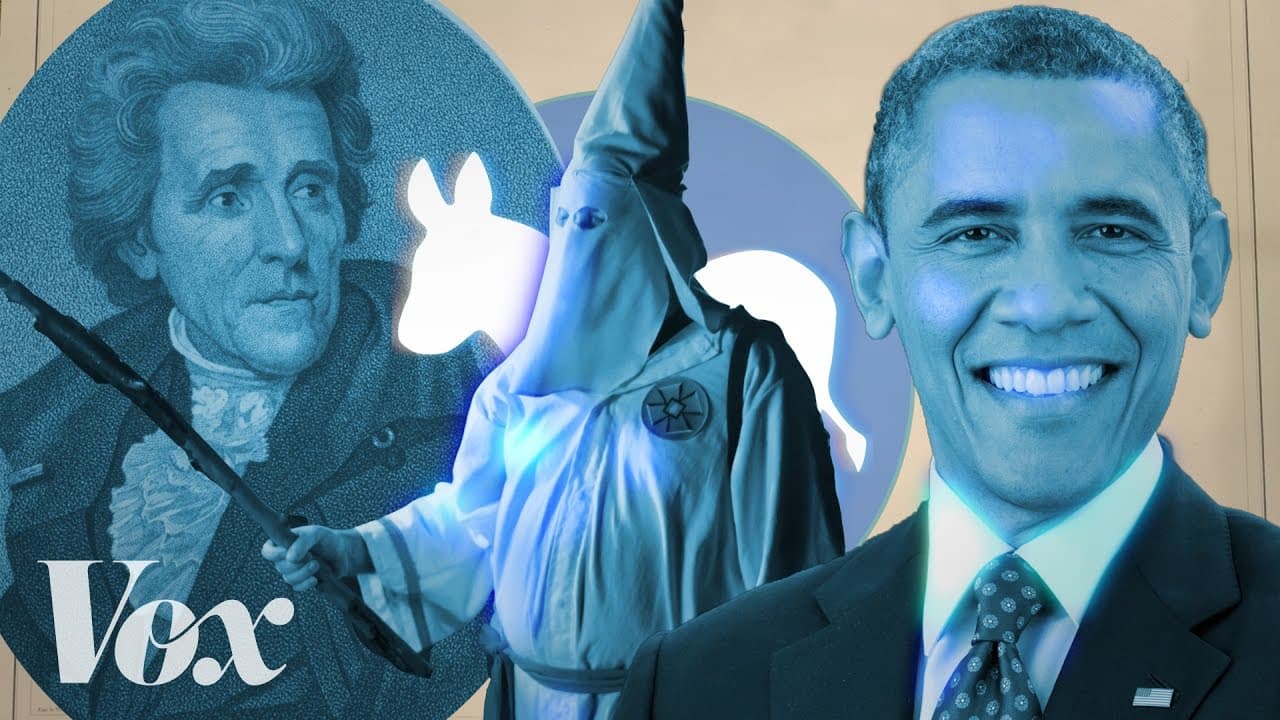
From white supremacy to Barack Obama: The history of the Democratic Party
TL;DR
The Democratic Party shifted from white supremacy to progressive policies.
Transcript
Today’s Democratic Party believes government has an important role to play in society. It fights against economic inequality. It advocates policies that battle racial and gender discrimination. But it wasn’t always this way. The Democratic Party was once the party of white supremacy, supporting slavery and the Ku Klux Klan. To understand how the pa... Read More
Key Insights
- The Democratic Party originally supported white supremacy and slavery, but has transformed into a party advocating for racial and gender equality.
- Andrew Jackson was a key figure in the party's early history, symbolizing determination and challenging political elites.
- The Indian Removal Act and Manifest Destiny were significant policies during the party's early years, reflecting expansionist and exclusionary ideologies.
- The Civil War era saw the Democratic Party align with Southern interests, opposing federal intervention for black citizens' rights.
- Progressivism gained traction in the early 20th century, with Woodrow Wilson advancing regulatory reforms, marking a shift in the party's focus.
- The Great Depression solidified the Democratic Party's identity as proponents of government activism, notably through Franklin Roosevelt's New Deal.
- The Civil Rights Movement of the 1960s catalyzed a shift in the party, moving away from segregationist policies and gaining minority support.
- Demographic changes, particularly Hispanic immigration, have strengthened the Democratic Party's appeal among minority voters, influencing its modern political strategy.
Install to Summarize YouTube Videos and Get Transcripts
Explore YouTube Video Summarizer or Get YouTube Transcript Extractor
Questions & Answers
Q: How did the Democratic Party's stance on racial issues evolve over time?
The Democratic Party originally supported slavery and white supremacy, aligning with Southern interests. However, throughout the 20th century, particularly during the Civil Rights Movement of the 1960s, the party shifted towards advocating for racial equality. This was marked by the passage of the Civil Rights Act, which saw progressive reformers within the party gain influence, leading to increased support from minority groups and a departure from its segregationist past.
Q: What role did Andrew Jackson play in the Democratic Party's formation?
Andrew Jackson was a pivotal figure in the Democratic Party's formation in the mid-1820s. He challenged the political establishment and was seen as a populist leader representing the common people's will. His critics derogatorily referred to him as a 'jackass,' a symbol he embraced, leading to the donkey becoming a representation of the Democratic Party. Jackson's presidency was marked by controversial policies like the Indian Removal Act, reflecting the party's early expansionist and exclusionary ideologies.
Q: What impact did the Great Depression have on the Democratic Party's identity?
The Great Depression significantly influenced the Democratic Party's identity, solidifying its reputation as the party of government activism. Under President Franklin Roosevelt, the party implemented the New Deal, a series of domestic government projects aimed at combating the economic crisis. This marked a dramatic expansion of government involvement in economic affairs and reinforced the party's commitment to progressive reforms, setting a precedent for future Democratic administrations.
Q: How did the Civil Rights Movement affect the Democratic Party's political alignment?
The Civil Rights Movement of the 1960s was a turning point for the Democratic Party, shifting its political alignment from supporting segregationist policies to advocating for racial equality. The passage of the Civil Rights Act demonstrated the party's commitment to progressive reforms, leading to increased support from minority groups, particularly African Americans. This shift caused many white Southerners to move away from the party, altering its traditional voter base and paving the way for a more diverse coalition.
Q: What is the significance of the Democratic Party's demographic shifts in recent years?
In recent years, demographic shifts have played a crucial role in reshaping the Democratic Party's base. The increasing diversity of the American population, particularly the growth of Hispanic and other minority groups, has strengthened the party's appeal among these voters. This demographic change has influenced the party's modern political strategy, focusing on issues that resonate with minority communities and urban areas, contrasting with its historical alignment with rural and Southern white interests.
Q: How did the Democratic Party's policies evolve from the 19th to the 20th century?
In the 19th century, the Democratic Party supported policies that favored expansionism and white supremacy, including the Indian Removal Act and the doctrine of Manifest Destiny. However, in the 20th century, the party began to embrace progressivism, advocating for government regulation of big businesses and social welfare programs. This evolution was marked by key figures such as Woodrow Wilson and Franklin Roosevelt, who advanced reforms that reshaped the party's identity and aligned it with progressive causes.
Q: What role did Woodrow Wilson play in the Democratic Party's shift towards progressivism?
Woodrow Wilson played a significant role in the Democratic Party's shift towards progressivism during the early 20th century. As president, he implemented a range of progressive reforms aimed at regulating big businesses and improving ordinary people's lives. Wilson's administration marked a departure from the party's previous focus on Southern interests, establishing the Democratic Party as a key proponent of progressive policies and government intervention in economic affairs.
Q: How did the Democratic Party's support base change following the Civil War?
Following the Civil War, the Democratic Party's support base was primarily located in the Southern United States, where it aligned with white Southerners' interests in maintaining racial supremacy and opposing federal intervention on behalf of black citizens. However, as the 20th century progressed, the party's support base began to shift towards urban areas and minority communities, particularly following the Civil Rights Movement of the 1960s. This change reflected the party's evolving stance on racial issues and its commitment to progressive reforms.
Summary & Key Takeaways
-
The Democratic Party has undergone significant ideological and geographical transformations, evolving from a supporter of slavery to a champion of equality and government intervention. This shift is marked by key historical events and figures, including Andrew Jackson, the Civil War, and the Civil Rights Movement.
-
The party's origins in the 1820s were rooted in populism and expansionism, with policies like the Indian Removal Act reflecting its exclusionary stance. However, the 20th century saw a pivot towards progressivism, as leaders like Woodrow Wilson and Franklin Roosevelt embraced regulatory reforms and social welfare programs.
-
Demographic shifts, especially the increase in minority populations, have played a crucial role in reshaping the Democratic Party's base. The party now draws significant support from urban areas and minority voters, a stark contrast to its historical alignment with Southern white interests.
Read in Other Languages (beta)
Share This Summary 📚
Summarize YouTube Videos and Get Video Transcripts with 1-Click
Try YouTube Summary with ChatGPT & Claude or YouTube Transcript Generator
Explore More Summaries from Vox 📚




Summarize YouTube Videos and Get Video Transcripts with 1-Click
Try YouTube Summary with ChatGPT & Claude or YouTube Transcript Generator