Slope and y intercept from equation
TL;DR
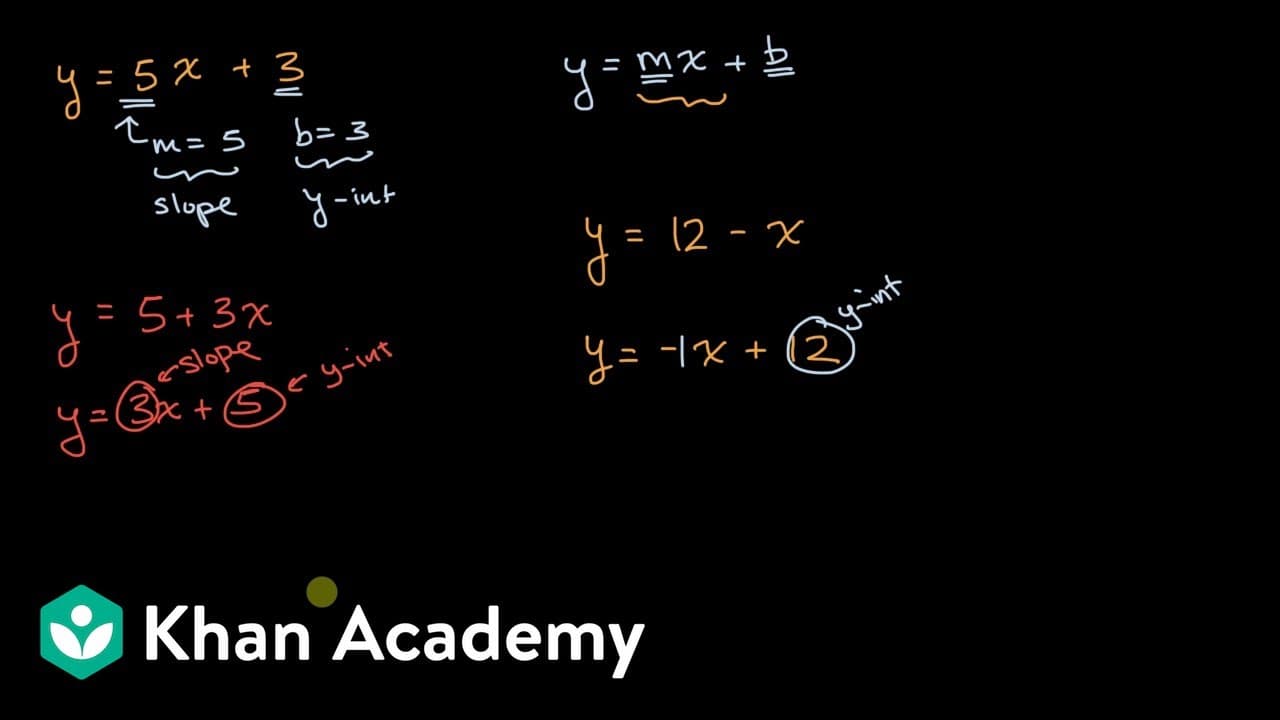
This video provides examples of recognizing the slope and y-intercept in different equations.
Transcript
- [Instructor] What I'd like to do in this video is a few more examples recognizing the slope and y-intercept given an equation. So, let's start with something that we might already recognize. Let's say we have something of the form y is equal to five x plus three. What is the slope and the y-intercept in this example here? Well, we've already talk... Read More
Key Insights
- ❣️ The slope and y-intercept can be recognized by identifying the coefficient on the x term and the constant term, respectively.
- 🆘 Rearranging the terms in the equation can help identify the slope and y-intercept.
- 🫵 Equations with only one term can be viewed as having a zero coefficient for x and a zero constant term.
Install to Summarize YouTube Videos and Get Transcripts
Explore YouTube Video Summarizer or Get YouTube Transcript Extractor
Questions & Answers
Q: How can the slope and y-intercept be determined in an equation?
The slope can be determined by identifying the coefficient on the x term, while the y-intercept is the constant term in the equation. In the form y = mx + b, m represents the slope and b represents the y-intercept.
Q: What should be done when the order of terms in an equation is different from the slope-intercept form?
To identify the slope and y-intercept, you can rearrange the terms so that the x term is before the constant term. By swapping the positions of the terms, the equation can be written in the slope-intercept form.
Q: How can the slope and y-intercept be recognized in an equation with only one term?
Even if an equation has only one term on the right-hand side, it can be viewed as having a coefficient of zero for the x term and a constant term of zero as well. Thus, the slope is zero, and the y-intercept is zero.
Q: How can the slope and y-intercept be determined when the equation does not resemble the slope-intercept form?
In such cases, the equation can be rewritten or viewed as having additional terms. By adding an x term of zero or multiplying by one, the slope and y-intercept can be identified using the same principles as in the slope-intercept form.
Summary & Key Takeaways
-
The slope and y-intercept can be identified in an equation of the form y = mx + b. The coefficient on x is the slope (m) and the constant term is the y-intercept (b).
-
In equations where the order of terms is different, rearranging them can help identify the slope and y-intercept.
-
The slope is the coefficient on the x term, and the y-intercept is the constant term in the equation.
-
By viewing the equation as having additional terms, it becomes easier to identify the slope and y-intercept.
Read in Other Languages (beta)
Share This Summary 📚
Summarize YouTube Videos and Get Video Transcripts with 1-Click
Try YouTube Summary with ChatGPT & Claude or YouTube Transcript Generator
Explore More Summaries from Khan Academy 📚



Summarize YouTube Videos and Get Video Transcripts with 1-Click
Try YouTube Summary with ChatGPT & Claude or YouTube Transcript Generator