How much of a pyramid is submerged | Basic trigonometry | Trigonometry | Khan Academy
TL;DR
The video teaches how to calculate the height of water above the ground using trigonometry and measurements of the Great Pyramid in Giza, Egypt.
Transcript
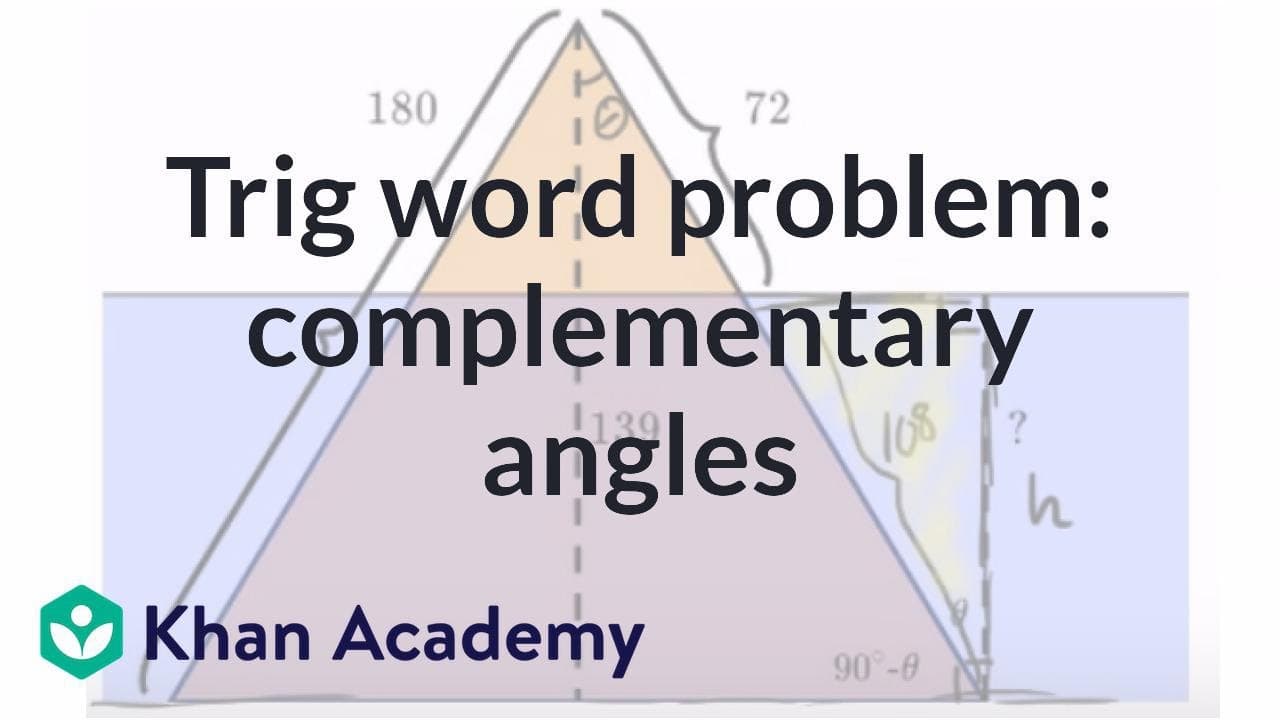
The Nile River has overflowed and covered its entire surroundings, except for the tip of the Great Pyramid in Giza, Egypt. An expedition was sent to find how high the water had risen. The people measured the edge of the pyramid that's above the water and found it was 72 meters long. So this distance right over here is 72 meters. They knew that the ... Read More
Key Insights
- 🤒 The expedition measured the length of the exposed edge of the pyramid (72 meters) and the total length of the edge (180 meters).
- 🥳 By using trigonometry and the cosine ratio, they established that the cosine of theta (the angle of the pyramid) is equal to both the height divided by 108 (the part of the edge below the water) and 139/180 (the adjacent side over the hypotenuse).
- 🤒 By solving the equation, they determined that the height of the water above the ground is 83.4 meters.
- 🛟 Trigonometry can be used in real-life scenarios to solve for unknown measurements.
- 🔺 The concept of complementary angles was utilized to determine the angle theta and its relationship to the triangle's other angles.
- 💦 The Nile River flooding had significant effects on the surrounding area, including submerging most of the Great Pyramid in water.
- 🙃 The Great Pyramid in Giza, Egypt, is an isosceles triangle with equal lengths on both sides.
Install to Summarize YouTube Videos and Get Transcripts
Explore YouTube Video Summarizer or Get YouTube Transcript Extractor
Questions & Answers
Q: How did the expedition measure the height of the water above the ground?
The expedition used trigonometry to calculate the height by measuring the exposed edge of the Great Pyramid and its total length.
Q: What measurements were used in the trigonometric calculations?
The expedition used the length of the exposed edge (72 meters) and the total length of the edge (180 meters) of the Great Pyramid.
Q: What trigonometric ratio did they use and why?
They used the cosine ratio because the length they wanted to calculate (the height of the water) was the adjacent side, and the hypotenuse (the total length of the edge of the pyramid) was known.
Q: What was the final calculation for the height of the water?
The height of the water was calculated to be 83.4 meters above the ground.
Summary & Key Takeaways
-
The Nile River has flooded the surroundings, leaving only the tip of the Great Pyramid visible.
-
An expedition measures the length of the exposed edge of the pyramid (72 meters) and the total length of the edge (180 meters) to find the height of the water.
-
By using trigonometry and the measurements, the expedition calculates that the water level is 83.4 meters above the ground.
Read in Other Languages (beta)
Share This Summary 📚
Summarize YouTube Videos and Get Video Transcripts with 1-Click
Try YouTube Summary with ChatGPT & Claude or YouTube Transcript Generator
Explore More Summaries from Khan Academy 📚



Summarize YouTube Videos and Get Video Transcripts with 1-Click
Try YouTube Summary with ChatGPT & Claude or YouTube Transcript Generator