How to Calculate Deflection in Simply Supported Beams
TL;DR
To calculate deflection in simply supported beams using Macaulay's method, first identify the loads and their positions, then apply the deflection formula. For a single load of 40 kN on a 6-meter beam, use the formula to find deflection under the load and maximum deflection, which turns out to be the same. For multiple loads, set up moment equations to determine deflection under each load and maximum deflection.
Transcript
so hello students uh so in this class we are going to solve a problem on uh for a simply supported beam on which a eccentric point load is acting so in our previous class we have seen the theory behind what is the how do we solve such problem using macular method okay so we have seen the theory now we will just use that application we we'll use the... Read More
Key Insights
- 😁 Macaulay's method is a useful technique for solving problems involving simply supported beams with point loads and calculating deflection.
- 😁 The deflection under the load and the maximum deflection in the first problem are determined using the same formula, as there is only one load acting on the beam.
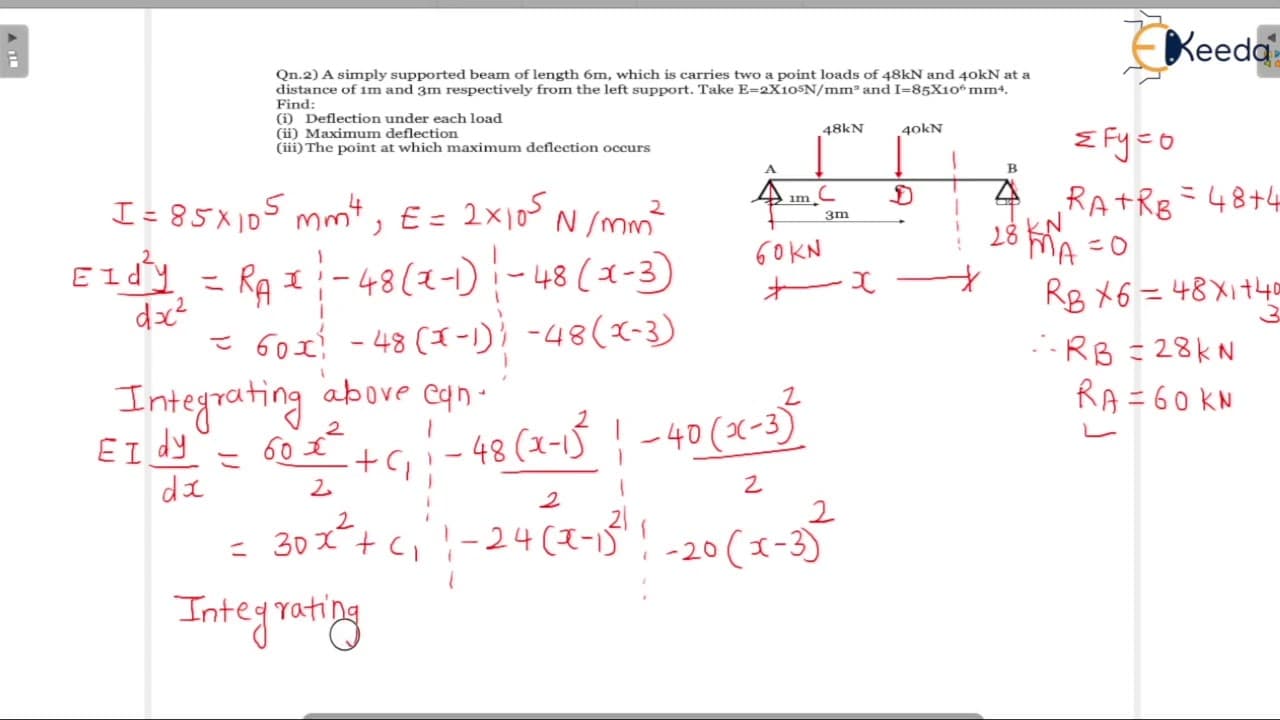
- 😁 The second problem discusses how to calculate the deflection under each load and the maximum deflection by setting up moment equations for different sections of the beam.
- 😥 Boundary conditions are essential in finding the constant of integration in the deflection equation and determining the deflection at specific points.
Install to Summarize YouTube Videos and Get Transcripts
Explore YouTube Video Summarizer or Get YouTube Transcript Extractor
Questions & Answers
Q: What is the objective of the first problem discussed in the video?
The objective is to calculate the deflection under the load and the maximum deflection of a simply supported beam with a point load of 40 kN at a distance of 4 meters from the left end.
Q: How is the deflection under the load and the maximum deflection calculated?
The deflection under the load and the maximum deflection are calculated using the formula yc = (-w * y^2 * b^2) / (3 * E * I * L), where yc represents the deflection under the load. Since there is only one load in the first problem, the maximum deflection is equal to the deflection under the load.
Q: What is the second problem discussed in the video?
The second problem involves a simply supported beam carrying two point loads of 48 kN and 40 kN at distances of 1 meter and 3 meters, respectively, from the left support. The objective is to calculate the deflection under each load, the maximum deflection, and the point at which the maximum deflection occurs.
Q: What method is used to solve these problems?
The problems are solved using Macaulay's method, which involves considering sections of the beam and setting up moment equations to solve for the deflection.
Summary & Key Takeaways
-
The video demonstrates the process of solving a problem on a simply supported beam with a point load of 40 kN at a distance of 4 meters from the left end. The goal is to calculate the deflection under the load and the maximum deflection.
-
Another problem is introduced, involving a beam carrying two point loads of 48 kN and 40 kN at distances of 1 meter and 3 meters, respectively, from the left support. The video explains how to calculate the deflection under each load, the maximum deflection, and the point at which the maximum deflection occurs.
-
The video utilizes the Macaulay's method to solve these problems, providing step-by-step explanations for the calculations involved.
Read in Other Languages (beta)
Share This Summary 📚
Summarize YouTube Videos and Get Video Transcripts with 1-Click
Try YouTube Summary with ChatGPT & Claude or YouTube Transcript Generator
Explore More Summaries from Ekeeda 📚






Summarize YouTube Videos and Get Video Transcripts with 1-Click
Try YouTube Summary with ChatGPT & Claude or YouTube Transcript Generator