Products
Features
YouTube Video Summarizer
Summarize YouTube videos
Web & PDF Highlighter
Highlight web pages & PDFs
Chat with PDF
Ask any PDF questions with AI
Ask AI Clone
Chat with your highlights & memories
Audio Transcriber
Transcribe audio files to text
Glasp Reader
Read and highlight articles
Kindle Highlight Export
Export your Kindle highlights
Idea Hatch
Hatch ideas from your highlights
Integrations
Obsidian Plugin
Notion Integration
Pocket Integration
Instapaper Integration
Medium Integration
Readwise Integration
Snipd Integration
Hypothesis Integration
Apps & Extensions
Chrome Extension
Safari Extension
Edge Add-ons
Firefox Add-ons
iOS App
Android App
Discover
Discover
Ideas
Discover new ideas and insights
Articles
Curated articles and insights
Books
Book recommendations by great minds
Posts
Essays and notes from readers
Quotes
Inspiring quotes collection
Videos
Curated videos and summaries
Explore Glasp
Glasp Newsletter
Weekly insights and updates
Glasp Talk
Interview series with great minds
Glasp Blog
Latest news and articles
Glasp Use Cases
Learn how others use Glasp
Build & Support
Glasp API
Access Glasp's API for developers
MCP Connector
Connect Glasp to Claude & ChatGPT
Community
Glasp Reddit Community
Students
Student discount and benefits
FAQs
Frequently Asked Questions
AboutPricing
DashboardLog inSign up

2011 Calculus AB free response #2 (a & b) | AP Calculus AB | Khan Academy
September 7, 2011
by
Khan Academy
YouTube video player
2011 Calculus AB free response #2 (a & b) | AP Calculus AB | Khan Academy

TL;DR

The content discusses how to approximate the rate of temperature change using a given table and how to estimate the average temperature over a specified period using trapezoidal sums.

Transcript

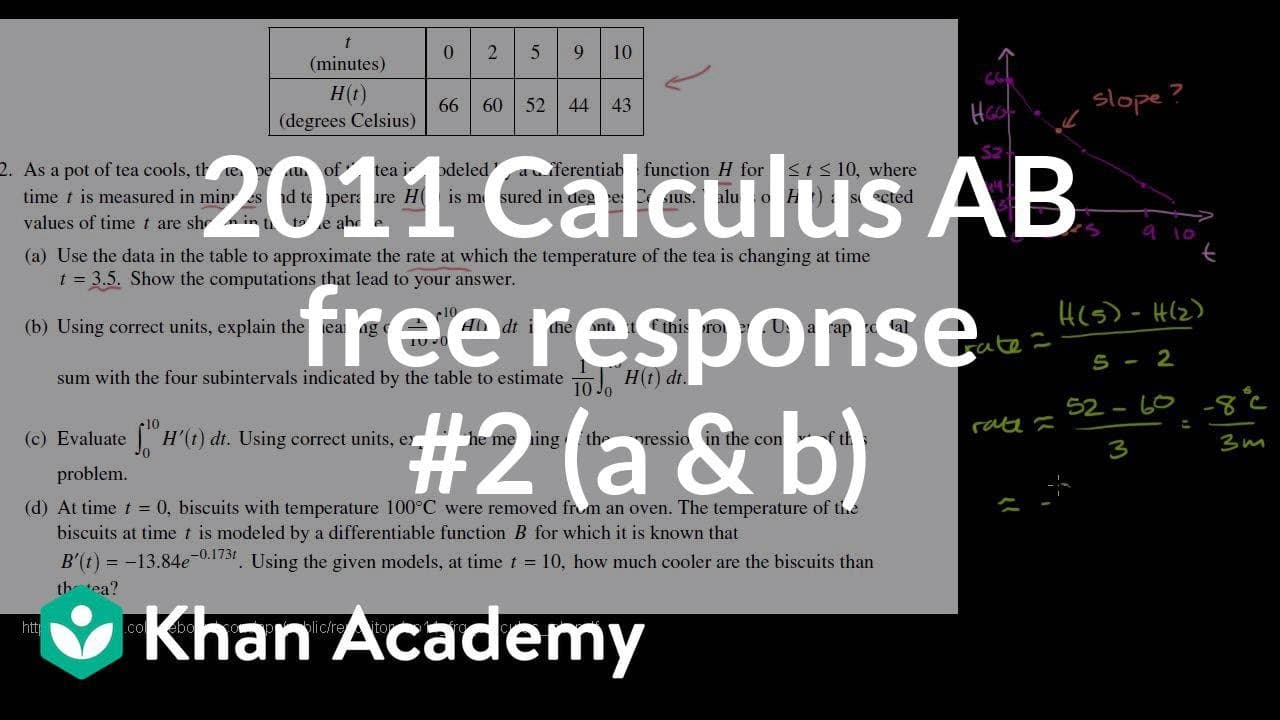
As a pot of tea cools, the temperature the tea is modeled by a differentiable function h. For 0 is less than or equal to, t is less than or equal to 10. Where time t is measured in minutes. And temperature h of t is measured in degrees Celsius. Values of h of t, at selected time, selected values of time t are shown in the table above, so that's rig... Read More

Key Insights

  • 🛀 The graph of temperature change over time shows a decreasing curve.
  • 😥 The rate of temperature change at a specific time can be approximated by finding the slope between neighboring points on the graph.
  • 🍹 The definite integral of the temperature function represents the area under the curve and can be estimated using trapezoidal sums.

Install to Summarize YouTube Videos and Get Transcripts

Explore YouTube Video Summarizer or Get YouTube Transcript Extractor

Questions & Answers

Q: How can the rate of temperature change of the tea be approximated at t = 3.5?

To approximate the rate of temperature change at t = 3.5, we find the slope between the temperatures at t = 5 and t = 2. The slope is calculated by finding the change in temperature over the change in time, resulting in approximately -8/3 degrees Celsius per minute.

Q: What does 1/10 times the definite integral from 0 to 10 of h(t) dt represent in this problem?

1/10 times the definite integral of h(t) from 0 to 10 represents the average temperature over the entire ten-minute period. It is found by dividing the area under the temperature curve by the total time elapsed.

Q: How can the definite integral be estimated using trapezoidal sums?

To estimate the definite integral using trapezoidal sums, divide the area under the curve into smaller trapezoids. Find the area of each trapezoid by multiplying the average height by the length of its base. Then, sum up the areas of all the trapezoids to obtain an approximation of the definite integral.

Q: What is the significance of dividing the estimated definite integral by 10?

Dividing the estimated definite integral by 10 represents finding the average temperature over the entire ten-minute period. This step ensures that the units of the result remain in degrees Celsius.

Summary & Key Takeaways

  • The content presents a table showing the temperature of a tea at different time intervals.

  • The rate of temperature change at a specific time is approximated by finding the slope between neighboring points on the graph.

  • The content explains how to estimate the average temperature over a given period using trapezoidal sums.


Read in Other Languages (beta)

English

Share This Summary 📚

Summarize YouTube Videos and Get Video Transcripts with 1-Click

Download browser extensions on:

Try YouTube Summary with ChatGPT & Claude or YouTube Transcript Generator

Explore More Summaries from Khan Academy 📚
Solving the matrix vector equation | Matrices | Precalculus | Khan Academy thumbnail
Solving the matrix vector equation | Matrices | Precalculus | Khan Academy
Khan Academy
Discriminant for types of solutions for a quadratic | Algebra II | Khan Academy thumbnail
Discriminant for types of solutions for a quadratic | Algebra II | Khan Academy
Khan Academy
Example: Intersection of sine and cosine | Graphs of trig functions | Trigonometry | Khan Academy thumbnail
Example: Intersection of sine and cosine | Graphs of trig functions | Trigonometry | Khan Academy
Khan Academy
Dividing rational expressions | Precalculus | Khan Academy thumbnail
Dividing rational expressions | Precalculus | Khan Academy
Khan Academy
Example: Correlation coefficient intuition | Mathematics I | High School Math | Khan Academy thumbnail
Example: Correlation coefficient intuition | Mathematics I | High School Math | Khan Academy
Khan Academy
Example: Graphing y=3⋅sin(½⋅x)-2 | Trigonometry | Algebra 2 | Khan Academy thumbnail
Example: Graphing y=3⋅sin(½⋅x)-2 | Trigonometry | Algebra 2 | Khan Academy
Khan Academy

Summarize YouTube Videos and Get Video Transcripts with 1-Click

Download browser extensions on:

Try YouTube Summary with ChatGPT & Claude or YouTube Transcript Generator

Apps & Extensions

  • Chrome Extension
  • Safari Extension
  • Edge Add-ons
  • Firefox Add-ons
  • iOS App
  • Android App

Key Features

  • YouTube Video Summarizer
  • Web & PDF Summarizer
  • Web & PDF Highlighter
  • Chat with PDF
  • Ask AI Clone
  • Audio Transcriber
  • Glasp Reader
  • Kindle Highlight Export
  • Idea Hatch

Integrations

  • Obsidian Plugin
  • Notion Integration
  • Pocket Integration
  • Instapaper Integration
  • Medium Integration
  • Readwise Integration
  • Snipd Integration
  • Hypothesis Integration

More Features

  • APIs
  • MCP Connector
  • Blog & Post
  • Embed Links
  • Image Highlight
  • Personality Test
  • Quote Shots

Company

  • About us
  • Blog
  • Community
  • FAQs
  • Job Board
  • Newsletter
  • Pricing
Terms

•

Privacy

•

Guidelines

© 2026 Glasp Inc. All rights reserved.