What Causes Gamma-Ray Bursts in Astronomy?
TL;DR
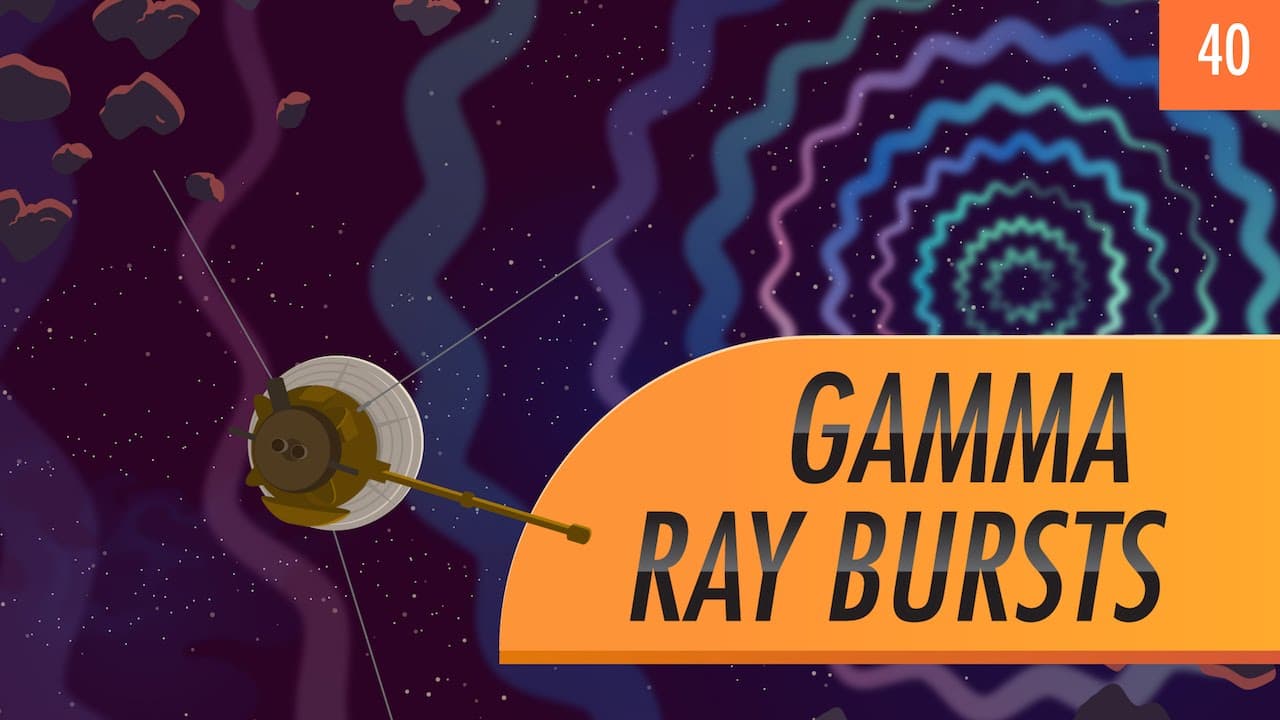
Gamma-ray bursts (GRBs) are the most violent events in the universe, originating from hypernovae or merging neutron stars. These bursts are so energetic that they are visible from billions of light years away and mark the birth of black holes. GRBs are divided into long and short types, with long bursts stemming from massive star explosions and short ones from neutron star collisions.
Transcript
Sometimes in science, the story of HOW we learned something is just as cool as what we learned. In the case of gamma-ray bursts, it’s kinda hard to beat the awesomeness of what they are. But of all the plotlines in astronomy, their origin story comes the closest. It begins, quite literally, in the grip of Cold War paranoia, and ends…well, it doesn... Read More
Key Insights
- Gamma-ray bursts are the most violent events in the universe, visible from billions of light years away.
- There are two types of GRBs: long bursts from hypernovae and short bursts from merging neutron stars.
- Hypernovae involve massive stars collapsing into black holes, emitting twin beams of energy.
- Short GRBs result from neutron stars colliding and forming a black hole, emitting a brief flash of gamma rays.
- GRBs were first detected during the Cold War by satellites monitoring nuclear tests.
- The discovery of GRBs challenged astronomers due to their rapid fade and random sky distribution.
- Modern satellites like Swift have improved GRB detection and localization, enhancing our understanding.
- GRBs are rare but pose a potential danger if one were to occur within 7,000 light years of Earth.
Install to Summarize YouTube Videos and Get Transcripts
Explore YouTube Video Summarizer or Get YouTube Transcript Extractor
Questions & Answers
Q: What causes gamma-ray bursts?
Gamma-ray bursts are caused by two main events: hypernovae and neutron star mergers. Hypernovae occur when a massive star's core collapses into a black hole, emitting twin beams of matter and energy. Neutron star mergers involve two neutron stars colliding, forming a black hole and emitting a brief, intense gamma-ray burst.
Q: How were gamma-ray bursts first discovered?
Gamma-ray bursts were first discovered during the Cold War by the Vela satellites, which were launched to monitor for nuclear tests in space. These satellites detected unexpected gamma-ray flashes, which were later identified as originating from deep space, not nuclear detonations, leading to the discovery of GRBs.
Q: What are the two types of gamma-ray bursts?
The two types of gamma-ray bursts are long and short bursts. Long GRBs are associated with hypernovae, where a massive star explodes and its core collapses into a black hole. Short GRBs result from the collision and merger of neutron stars, forming a black hole and emitting a brief gamma-ray flash.
Q: Why are gamma-ray bursts so energetic?
Gamma-ray bursts are extremely energetic because they involve the collapse of massive stars or the merger of neutron stars, both of which release enormous amounts of energy. In hypernovae, energy is focused into beams, making GRBs visible across billions of light years. Neutron star mergers also release intense energy during the formation of a black hole.
Q: How do modern satellites detect gamma-ray bursts?
Modern satellites like NASA's Swift are equipped with instruments to detect gamma-ray flashes from GRBs. Upon detection, Swift quickly locates the burst's position and directs its telescopes to gather data. It then communicates the coordinates to Earth-based telescopes for further observation, improving our understanding of these phenomena.
Q: What is the significance of gamma-ray bursts in astronomy?
Gamma-ray bursts are significant in astronomy as they represent the most energetic events in the universe and mark the formation of black holes. Their study provides insights into the life cycles of massive stars, the behavior of neutron stars, and the conditions of the early universe. GRBs also challenge and refine our understanding of astrophysics.
Q: Can a gamma-ray burst affect Earth?
A gamma-ray burst could affect Earth if it occurred within 7,000 light years, as the energy beams could cause significant damage to our atmosphere and biosphere. However, the likelihood is low due to the rarity of GRBs and the specific alignment needed for the beams to hit Earth. Known potential sources, like Eta Carinae, are not aimed at us.
Q: How often do gamma-ray bursts occur in the universe?
Gamma-ray bursts occur frequently in the universe, with estimates suggesting hundreds may happen daily. However, we only detect those whose energy beams are directed towards Earth. Satellites like Swift detect approximately one GRB per day, but the actual rate is much higher, indicating the vast scale and frequency of these cosmic events.
Summary & Key Takeaways
-
Gamma-ray bursts (GRBs) are the universe's most energetic explosions, visible from billions of light years away. They originate from hypernovae, where massive stars explode, or from the collision of neutron stars. The discovery of GRBs during the Cold War led to significant advancements in astronomy, revealing the birth of black holes.
-
Long GRBs result from hypernovae, where a massive star's core collapses into a black hole, emitting focused energy beams. Short GRBs occur when neutron stars merge, forming a black hole and emitting a brief gamma-ray flash. These events are rare but can be detected daily by modern satellites.
-
The Cold War era Vela satellites first detected GRBs while monitoring for nuclear tests. Today, observatories like Swift rapidly detect and locate GRBs, allowing ground-based telescopes to study them. Despite their distance, GRBs are a potential threat if they occur within 7,000 light years of Earth.
Read in Other Languages (beta)
Share This Summary 📚
Summarize YouTube Videos and Get Video Transcripts with 1-Click
Try YouTube Summary with ChatGPT & Claude or YouTube Transcript Generator
Explore More Summaries from CrashCourse 📚




Summarize YouTube Videos and Get Video Transcripts with 1-Click
Try YouTube Summary with ChatGPT & Claude or YouTube Transcript Generator