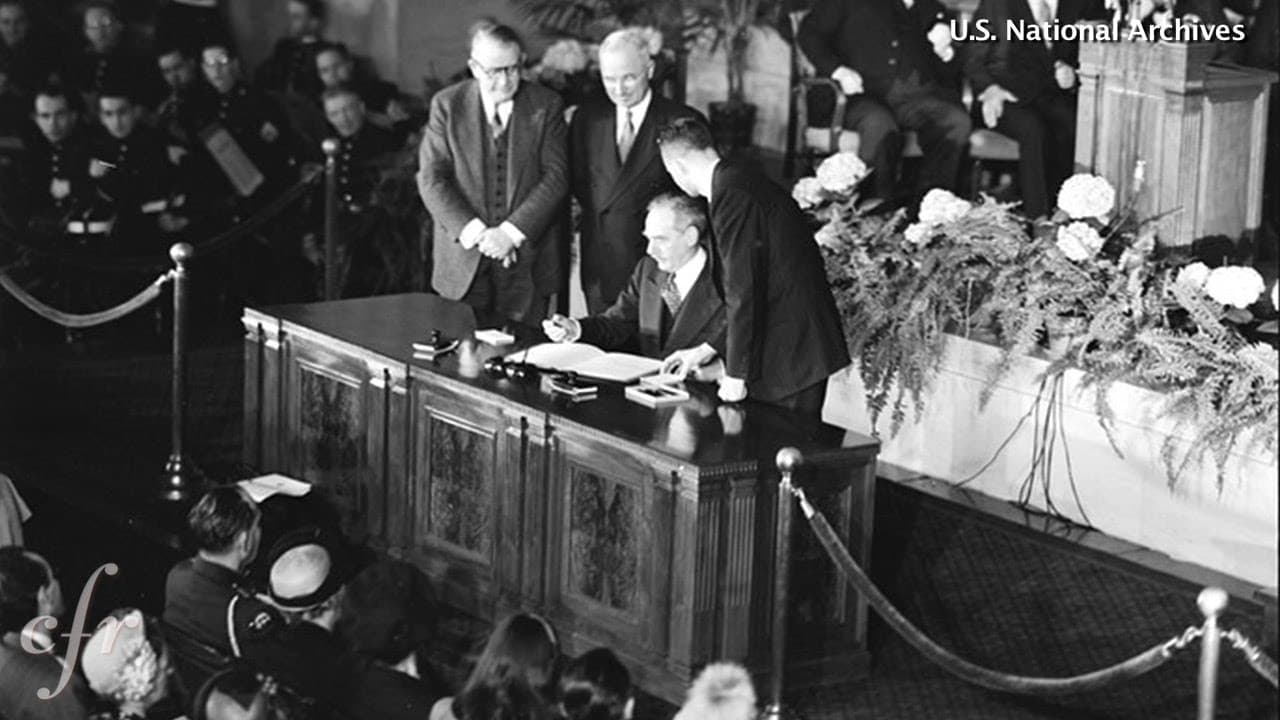
Lessons Learned: North Atlantic Treaty Signing
TL;DR
NATO's creation marked a major U.S. foreign policy shift.
Transcript
Jim Lindsay: World politics is in constant flux. Power ebbs and flows across the globe. But how quick are countries to change the direction of their foreign policy in response to a shifting global landscape? I’m Jim Lindsay, and this is Lessons Learned. Our topic today is the signing of the North Atlantic Treaty in Washington, DC, on April 4, 19... Read More
Key Insights
- The North Atlantic Treaty was signed on April 4, 1949, marking a pivotal shift in U.S. foreign policy by committing to European defense during peacetime.
- Historically, the U.S. avoided entangling alliances, as advised by leaders like Washington and Jefferson, but global events necessitated a change in approach.
- The Soviet Union's aggressive actions, such as the Czechoslovakia coup, catalyzed the U.S. decision to join NATO to counter Soviet expansion.
- Article V of the treaty was crucial, stipulating that an attack on one NATO member is considered an attack on all, ensuring collective defense.
- President Truman emphasized that the treaty symbolized a commitment to freedom and peace, rejecting the notion of inevitable war.
- The U.S. foreign policy shift was not immediate but occurred after significant global events like World War I and II, highlighting the inertia in policy change.
- Contemporary debates continue on whether emerging global powers like China and India necessitate another reevaluation of U.S. foreign policy.
- The formation of NATO demonstrated the U.S.'s willingness to engage internationally, moving away from isolationist tendencies post-World War I and II.
Install to Summarize YouTube Videos and Get Transcripts
Explore YouTube Video Summarizer or Get YouTube Transcript Extractor
Questions & Answers
Q: Why was the signing of the North Atlantic Treaty significant?
The signing of the North Atlantic Treaty was significant because it marked the first time in U.S. history that the country made a peacetime military commitment to Europe. This decision represented a major shift from the U.S.'s traditional stance of avoiding entangling alliances, as advised by early leaders like Washington and Jefferson. The treaty established NATO, a collective defense organization, in response to Soviet expansionism, particularly after the Czechoslovakia coup.
Q: What historical advice did the U.S. initially follow regarding foreign alliances?
Initially, the U.S. followed the advice of early leaders such as George Washington and Thomas Jefferson, who recommended avoiding entangling alliances, especially with Europe. Washington's Farewell Address and Jefferson's inaugural address both emphasized minimizing political connections abroad, reflecting a pragmatic approach given the U.S.'s relative weakness and isolation from European conflicts in the early 1800s.
Q: How did Soviet actions influence the U.S. decision to join NATO?
Soviet actions, particularly the orchestration of the Czechoslovakia coup in March 1948, alarmed U.S. policymakers and influenced the decision to join NATO. The aggressive expansion of Soviet influence in Europe was perceived as a direct threat, prompting the U.S. to abandon its isolationist tendencies and commit to a military alliance with European countries to counter Soviet encroachment and ensure regional stability.
Q: What is the significance of Article V in the North Atlantic Treaty?
Article V of the North Atlantic Treaty is significant because it establishes the principle of collective defense, stating that an attack on one NATO member is considered an attack on all. This provision was crucial in ensuring mutual protection among member states and served as a deterrent against potential aggressors, particularly the Soviet Union, by guaranteeing that any aggression would be met with a unified military response from all NATO countries.
Q: How did the U.S. foreign policy change after World War II?
After World War II, the U.S. foreign policy shifted from isolationism to active international engagement. The devastation of the war and the threat of Soviet expansion prompted the U.S. to abandon its previous stance of avoiding European affairs. This change was epitomized by the signing of the North Atlantic Treaty, which committed the U.S. to a peacetime military alliance with Europe, marking a new era of collective security and international cooperation.
Q: What role did President Truman play in the signing of the treaty?
President Truman played a pivotal role in the signing of the North Atlantic Treaty by advocating for a collective defense strategy and emphasizing the treaty's significance as a commitment to peace and freedom. He rejected the idea of inevitable war and highlighted the ability of courageous and visionary leaders to shape their destiny. Truman's support was instrumental in securing U.S. participation in NATO and reinforcing the country's commitment to international security.
Q: Why is the North Atlantic Treaty still relevant today?
The North Atlantic Treaty remains relevant today as it continues to provide a framework for collective defense and international security among its member states. With emerging global challenges and rising powers like China and India, the treaty's principles of mutual protection and cooperation are crucial in addressing contemporary threats. The ongoing debates about U.S. foreign policy highlight the treaty's enduring importance in adapting to a changing global landscape.
Q: What contemporary debates exist regarding U.S. foreign policy?
Contemporary debates regarding U.S. foreign policy revolve around whether the emergence of new global powers, such as China, India, and Brazil, necessitates a fundamental rethinking of America's international strategy. Various intellectual camps propose different approaches, from returning to isolationist policies to advocating for more assertive or multilateral strategies. These discussions reflect the ongoing challenge of adapting U.S. foreign policy to a world that has evolved significantly since the signing of the North Atlantic Treaty.
Summary & Key Takeaways
-
The signing of the North Atlantic Treaty on April 4, 1949, marked a significant shift in U.S. foreign policy, as it committed to a peacetime military alliance with Europe, countering Soviet threats. This decision was influenced by Soviet actions, such as the Czechoslovakia coup, which alarmed U.S. policymakers.
-
Historically, the U.S. avoided European entanglements, but global events like World War II necessitated a change. Article V of the treaty ensured collective defense, marking the first time the U.S. committed to European defense during peacetime, symbolizing a new era in international relations.
-
President Truman highlighted the treaty as a commitment to peace and freedom, rejecting inevitable war. Current discussions question whether rising powers like China and India require another U.S. foreign policy reevaluation, as the world continues to evolve and present new challenges.
Read in Other Languages (beta)
Share This Summary 📚
Summarize YouTube Videos and Get Video Transcripts with 1-Click
Try YouTube Summary with ChatGPT & Claude or YouTube Transcript Generator
Explore More Summaries from Council on Foreign Relations 📚


Summarize YouTube Videos and Get Video Transcripts with 1-Click
Try YouTube Summary with ChatGPT & Claude or YouTube Transcript Generator