What Is First Order Logic and Its Syntax?
TL;DR
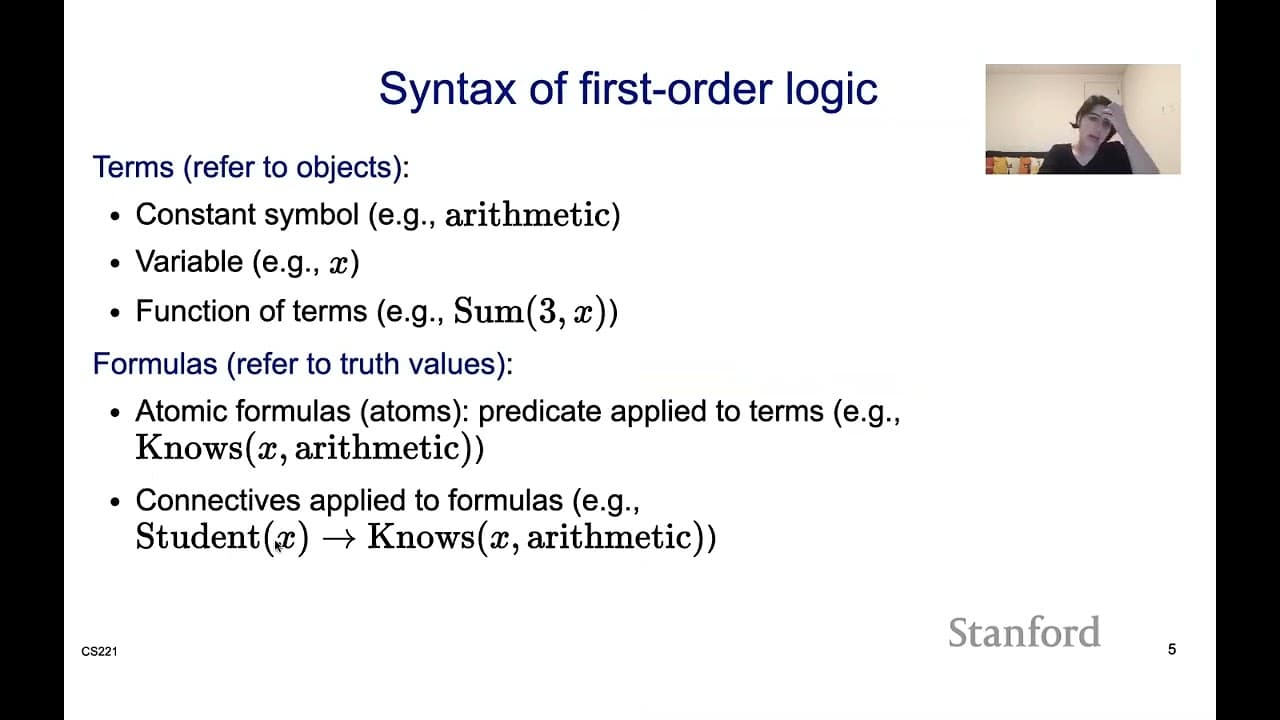
First order logic enhances propositional logic by introducing objects and predicates, enabling greater expressiveness and scalability. It consists of terms, formulas, and atomic formulas, which are essential for representing complex logical statements. By applying unique names and domain closure assumptions, it establishes a clear relationship between constant symbols and objects.
Transcript
okay so in this module we would like to talk about first order logic so far we've been talking about propositional logic you've talked about the syntax of propositional logic it's semantics and we've also talked about a few different inference rules so we've talked about modus ponens and and resolution okay and now we want to extend our logic and m... Read More
Key Insights
- 👻 First order logic is an extension of propositional logic that allows for the representation of objects and predicates.
- 🖤 The limitations of propositional logic, such as lack of expressiveness and scalability, are overcome by the structure and syntax of first order logic.
- 🫀 Terms, formulas, and atomic formulas form the basic elements of first order logic's syntax.
- 🦔 Models in first order logic can be represented using graphs, with nodes representing objects and edges representing predicates.
- 🤬 Unique names and domain closure assumptions ensure a one-to-one mapping between constant symbols and objects.
Install to Summarize YouTube Videos and Get Transcripts
Explore YouTube Video Summarizer or Get YouTube Transcript Extractor
Questions & Answers
Q: Why is first order logic necessary when propositional logic seems powerful enough?
While propositional logic is powerful, it lacks expressiveness and scalability when dealing with complex statements involving objects and relationships. First order logic's structure of objects and predicates allows for more nuanced representations.
Q: How does first order logic address the limitations of propositional logic?
First order logic introduces terms, allowing for the representation of objects. Additionally, it includes predicates that express relationships between objects, enabling more complex statements. Quantifiers and variables are used to represent universal and existential statements.
Q: What is the syntax of first order logic?
First order logic includes terms, which can be constant symbols, variables, or functions operating on terms. Formulas include atomic formulas (predicates applied to terms), logical connectives, and quantifiers.
Q: How are quantifiers represented in first order logic?
Quantifiers, such as "for all" and "there exists," are represented using variables. They are used to express statements that hold for all or some instances of a specific term. For example, "for all x, p(x)" implies that statement p holds for every x.
Summary & Key Takeaways
-
First order logic extends propositional logic to include objects and predicates, allowing for more expressiveness and scalability.
-
In propositional logic, writing statements with numerous symbols and propositions becomes impractical and does not scale well.
-
First order logic introduces terms, formulas, and atomic formulas as the basic elements of its syntax, allowing for the representation of objects, predicates, and quantifiers.
Read in Other Languages (beta)
Share This Summary 📚
Summarize YouTube Videos and Get Video Transcripts with 1-Click
Try YouTube Summary with ChatGPT & Claude or YouTube Transcript Generator
Explore More Summaries from Stanford Online 📚


Summarize YouTube Videos and Get Video Transcripts with 1-Click
Try YouTube Summary with ChatGPT & Claude or YouTube Transcript Generator