Can You Actually See a Neutrino Flash in Your Eye?
TL;DR
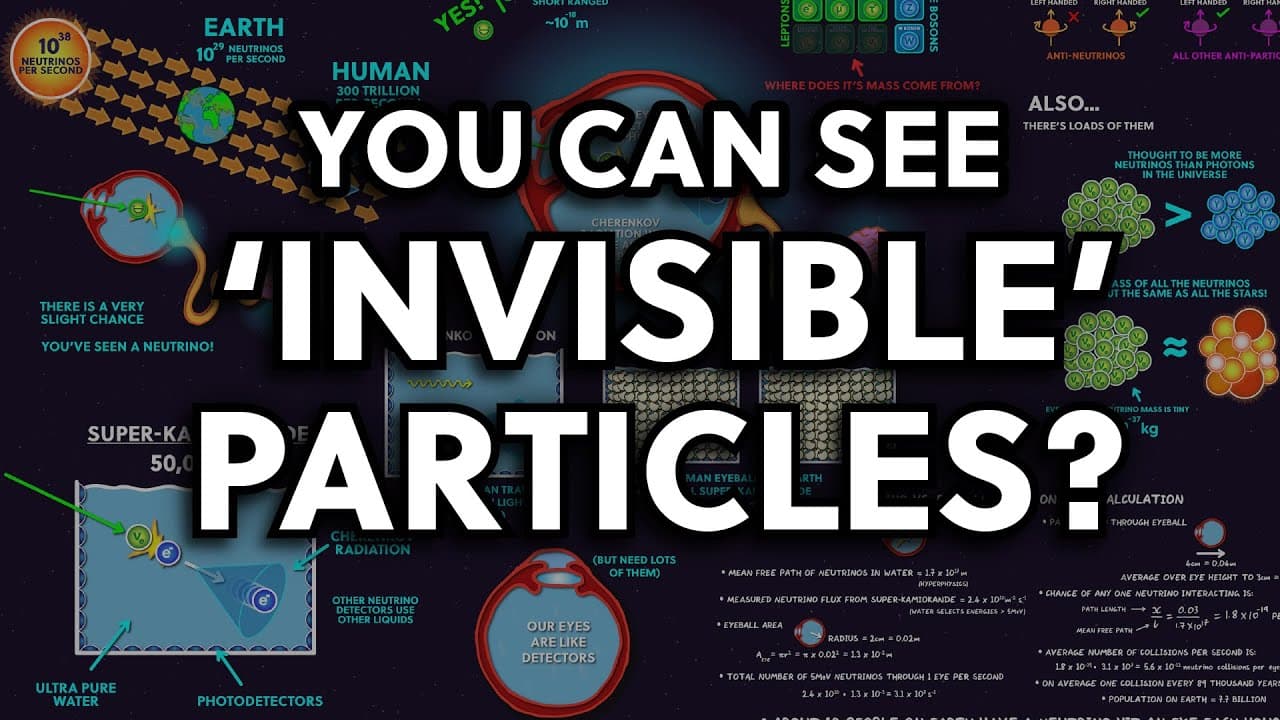
There's a very small chance that a neutrino can collide with your eye and create a visible flash of light, approximately once every 89,000 years per person. With billions of people on Earth, this means around ten people per hour might experience this phenomenon, although the flashes are only noticeable in the dark.
Transcript
Today I want to talk about neutrinos. They’re fundamental particles, here they are on the standard model of particle physics, and they are created in the fusion reactions in the Sun which gives out a colossal 10^38 neutrinos every second, then a massive 10^29 pass right through the Earth every second as if it is not there and 300 trillion... Read More
Key Insights
- 🧑🔬 Neutrinos, abundant and mysterious, interact uniquely via the weak force, posing challenges to scientists.
- 💆 Neutrinos' elusive mass origins and morphing abilities make them distinct and intriguing particles.
- 🦻 Neutrino detectors, like Super-Kamiokande, aid in unveiling neutrino mysteries by detecting rare interactions.
- 💥 Cherenkov radiation, emitted in neutrino collisions, assists in detecting and studying neutrinos underground.
- 🔦 Neutrinos have the potential to cause visible flashes of light in human eyes, offering a rare glimpse into their elusive nature.
- ❓ Studying neutrinos provides insights into fundamental physics concepts and the universe's mysteries.
- ❓ Platforms like Brilliant offer opportunities to delve into physics problem-solving and expand understanding of complex topics.
Install to Summarize YouTube Videos and Get Transcripts
Explore YouTube Video Summarizer or Get YouTube Transcript Extractor
Questions & Answers
Q: What makes neutrinos unique among particles in the standard model of particle physics?
Neutrinos stand out by interacting solely via the weak force, having mysterious mass origins, morphing into different types, and showing handedness quirks in left-handed neutrinos and right-handed anti-neutrinos.
Q: How do neutrino detectors like Super-Kamiokande work, and what do they help researchers uncover?
Neutrino detectors, like Super-Kamiokande, use liquid mediums to detect rare neutrino collisions, emitting Cherenkov radiation, aiding scientists in unraveling the mysteries surrounding neutrinos.
Q: Can neutrinos cause visible flashes of light in human eyes, and how often does this occur?
Yes, neutrinos can collide with the eye, creating Cherenkov radiation flashes, statistically occurring once every 89 thousand years per person, equivalent to around ten people per hour globally.
Q: How does Cherenkov radiation work, and why is it significant in detecting neutrino collisions in detectors?
Cherenkov radiation is a form of light resulting from particles moving faster than light in a medium. Neutrino interactions create this radiation, aiding in the detection of neutrino collisions in detectors.
Summary & Key Takeaways
-
Neutrinos, fundamental particles, abundant and elusive, barely interact with matter, pass through bodies unnoticed.
-
Neutrinos uniquely interact via the weak force, possess elusive mass sources, morph types, and exhibit left-handed quirks.
-
Neutrino detectors like Super-Kamiokande uncover neutrino mysteries, emit Cherenkov radiation in rare eye collisions.
Read in Other Languages (beta)
Share This Summary 📚
Summarize YouTube Videos and Get Video Transcripts with 1-Click
Try YouTube Summary with ChatGPT & Claude or YouTube Transcript Generator
Explore More Summaries from Domain of Science 📚




Summarize YouTube Videos and Get Video Transcripts with 1-Click
Try YouTube Summary with ChatGPT & Claude or YouTube Transcript Generator