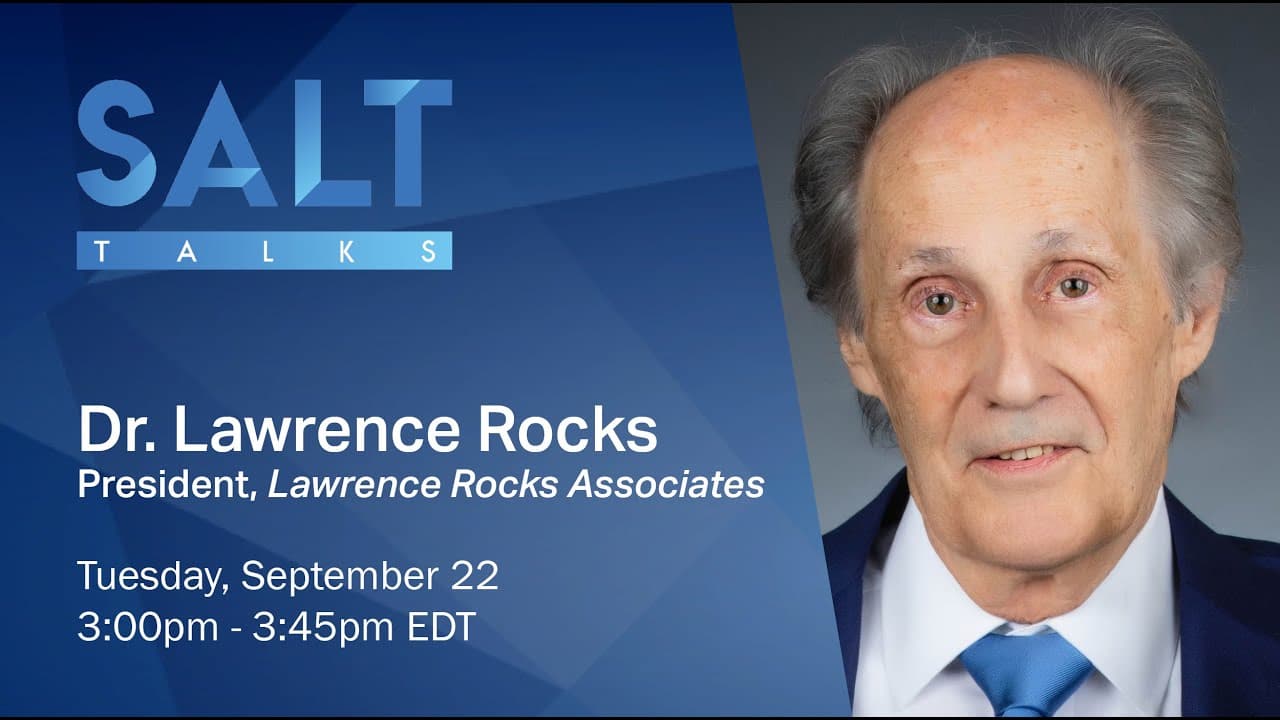
Lawrence Rocks: The Green Revolution & Robotics | SALT Talks #63
TL;DR
Dr. Lawrence Rox discusses his experience as a chemist, the importance of energy policy, and the challenges of transitioning to more sustainable energy sources.
Transcript
hello everyone welcome back to salt talks my name is john darcy i'm the managing director of salt which is a global thought leadership forum at the intersection of finance technology and public policy assault talks is a digital interview series that we started during this work from home period with the world's leading and most foremost investors cr... Read More
Key Insights
- ⚾ Dr. Rox emphasizes the importance of finding a balance between strength and flexibility, not only in sports like baseball but also in the human body's tendons and ligaments.
- 🌱 He proposes the use of small nuclear power plants as backup energy sources, as they are less prone to overheating and have fewer risks compared to large plants.
- 🍹 Dr. Rox suggests that solar architecture, which involves designing buildings to absorb sunlight in winter and shield from it in summer, is a more practical approach to harnessing solar energy compared to solar electricity.
- 🤢 He advocates for the burial of nuclear waste at sea in nickel steel containers, as it would be safer and more secure than on-land storage.
- 😘 Dr. Rox believes that monitoring low-level air pollution and ensuring proper ventilation can have a significant impact on athletes' performance.
Install to Summarize YouTube Videos and Get Transcripts
Explore YouTube Video Summarizer or Get YouTube Transcript Extractor
Questions & Answers
Q: Why did Dr. Lawrence Rox decide to become a chemist?
Dr. Rox became interested in science and astronomy at a young age, which sparked his passion for chemistry and its applications in various fields.
Q: How did Dr. Rox's book, "The Energy Crisis," impact energy policy?
The book highlighted the looming shortage of gasoline and oil and called for a unified national energy policy, which influenced the creation of the Department of Energy under the Carter administration.
Q: Is oil still a national security issue?
Yes, according to Dr. Rox, oil is still a national security issue. However, he believes that instead of ending the fossil fuel era entirely, the focus should be on reducing dependence on oil and using it more wisely.
Q: What are the challenges of transitioning to renewable energy sources?
Dr. Rox believes that wind power, especially offshore wind, is a promising source of renewable energy. However, there are challenges such as real estate limitations, the impact on bird migration, and the disposal of wind turbine blades.
Summary & Key Takeaways
-
Dr. Lawrence Rox grew up in New York City and developed an interest in astronomy and science at a young age, which eventually led him to a career in chemistry.
-
In 1973, he published a book called "The Energy Crisis," which explored the looming shortage of gasoline and oil and influenced the creation of the Department of Energy under the Carter administration.
-
Dr. Rox believes that while oil is still a national security issue, the focus should be on reducing and using oil more wisely and exploring alternative energy sources like wind and solar power.
Read in Other Languages (beta)
Share This Summary 📚
Summarize YouTube Videos and Get Video Transcripts with 1-Click
Try YouTube Summary with ChatGPT & Claude or YouTube Transcript Generator
Explore More Summaries from SALT 📚

Summarize YouTube Videos and Get Video Transcripts with 1-Click
Try YouTube Summary with ChatGPT & Claude or YouTube Transcript Generator