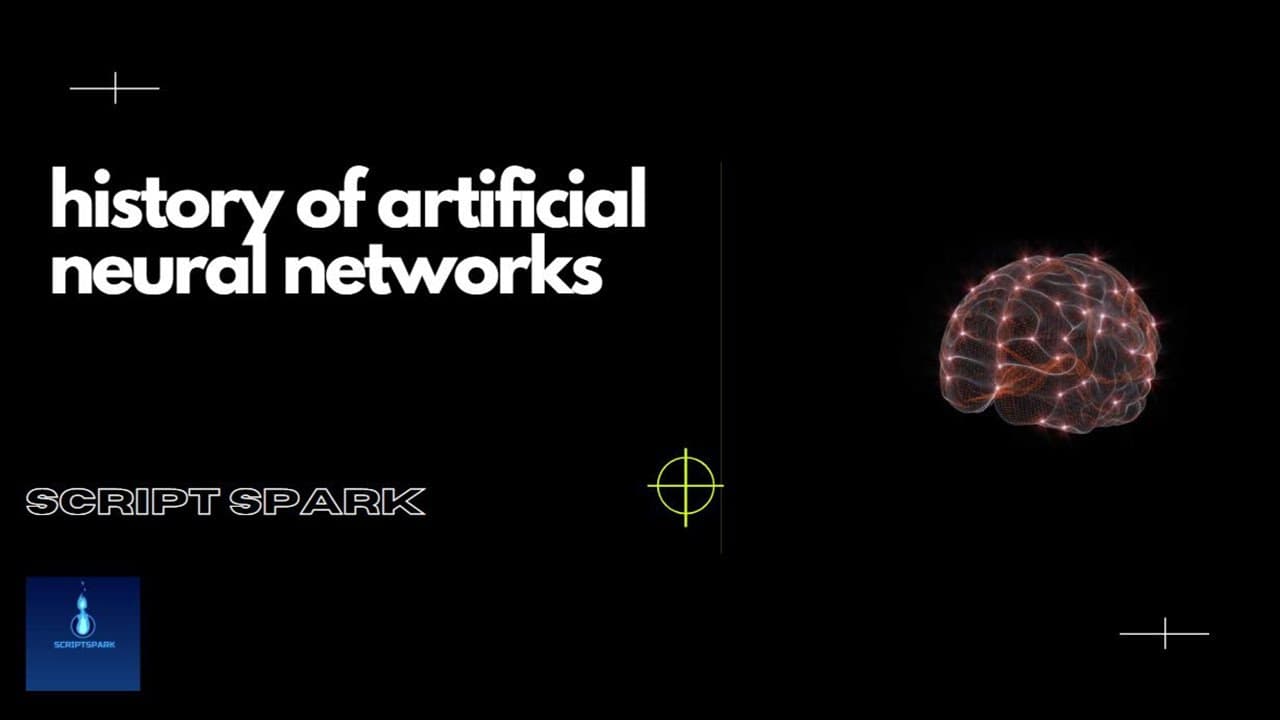
The history of artificial neural networks
TL;DR
The video reviews the history and evolution of artificial neural networks from inception to present advancements.
Transcript
thanks for click this video in this channel i will discuss programming robotics mashing learning related topics if anyone interest to understand these topics please subscribe our channel this video i will talk about history of artificial neural networks let's start warren mccullich and walter pitts 1943 opened the subject by creating a computationa... Read More
Key Insights
- 🖐️ The concept of artificial neural networks originated in the 1940s, laying a crucial foundation for modern AI.
- ❓ Hebbian learning introduced by D.O. Hebb was instrumental in explaining patterns of neural connectivity and adaptation.
- 👻 The backpropagation algorithm allowed multi-layer networks to be effectively trained, becoming a pivotal development in neural network research.
- 🈸 The introduction of CMOS technology in the 1980s significantly improved processing capability for neural network applications.
- ✊ Deep learning emerged as a powerful technique due to the combination of increased computing power and advanced training methods like unsupervised learning.
- 💝 Competitions in the late 2000s showcased neural networks achieving near-human performance levels in tasks such as handwriting recognition.
- 🍉 Multi-dimensional long short-term memory (LSTM) networks revolutionized sequential data handling in tasks without prior language knowledge.
Install to Summarize YouTube Videos and Get Transcripts
Explore YouTube Video Summarizer or Get YouTube Transcript Extractor
Questions & Answers
Q: What were the initial contributions to the field of artificial neural networks?
The initial contributions were made by Warren McCulloch and Walter Pitts in 1943, who developed a computational model for neural networks. This foundational work set the stage for future research, leading to significant theories on learning mechanisms, such as Hebbian learning proposed by D.O. Hebb in the late 1940s.
Q: How did the multilayer perceptron evolve over time?
The multilayer perceptron, initially conceptualized in the 1950s, underwent significant evolution as research progressed. The introduction of the backpropagation algorithm by Werbos in the 1970s enabled practical training of these networks, allowing for multilayer architectures to process complex tasks effectively and efficiently.
Q: What role did GPU technology play in advancing neural networks?
GPU technology played a crucial role in advancing neural networks by providing the necessary processing power to handle larger, more complex models. This enhancement enabled the application of deep learning techniques, allowing networks to learn intricate patterns and achieve state-of-the-art performance on various tasks like image and speech recognition.
Q: Can you explain the challenges faced by neural networks in the early years?
Early neural networks faced several challenges, including limited computational power and significant theoretical limitations. Minsky and Papert's 1969 critique highlighted that basic perceptrons could not solve problems like XOR, illustrating the need for more advanced architectures and learning methods to address complex logical functions.
Summary & Key Takeaways
-
The video traces the origins of artificial neural networks back to 1943 with McCulloch and Pitts, who introduced a foundational computational model. Their work sparked further exploration into neural learning and adaptation.
-
Significant milestones are highlighted, including Hebbian learning, the creation of the perceptron by Rosenblatt in 1958, and the emergence of the backpropagation algorithm in the 1970s, which enabled effective training of multi-layer neural networks.
-
The emergence of deep learning became a turning point due to advancements in GPU technology and unsupervised learning techniques, allowing networks to achieve remarkable performance in tasks like image recognition and language modeling.
Read in Other Languages (beta)
Share This Summary 📚
Summarize YouTube Videos and Get Video Transcripts with 1-Click
Try YouTube Summary with ChatGPT & Claude or YouTube Transcript Generator
Explore More Summaries from script spark 📚




Summarize YouTube Videos and Get Video Transcripts with 1-Click
Try YouTube Summary with ChatGPT & Claude or YouTube Transcript Generator