What Is Entropy in Data Science and Its Applications?
TL;DR
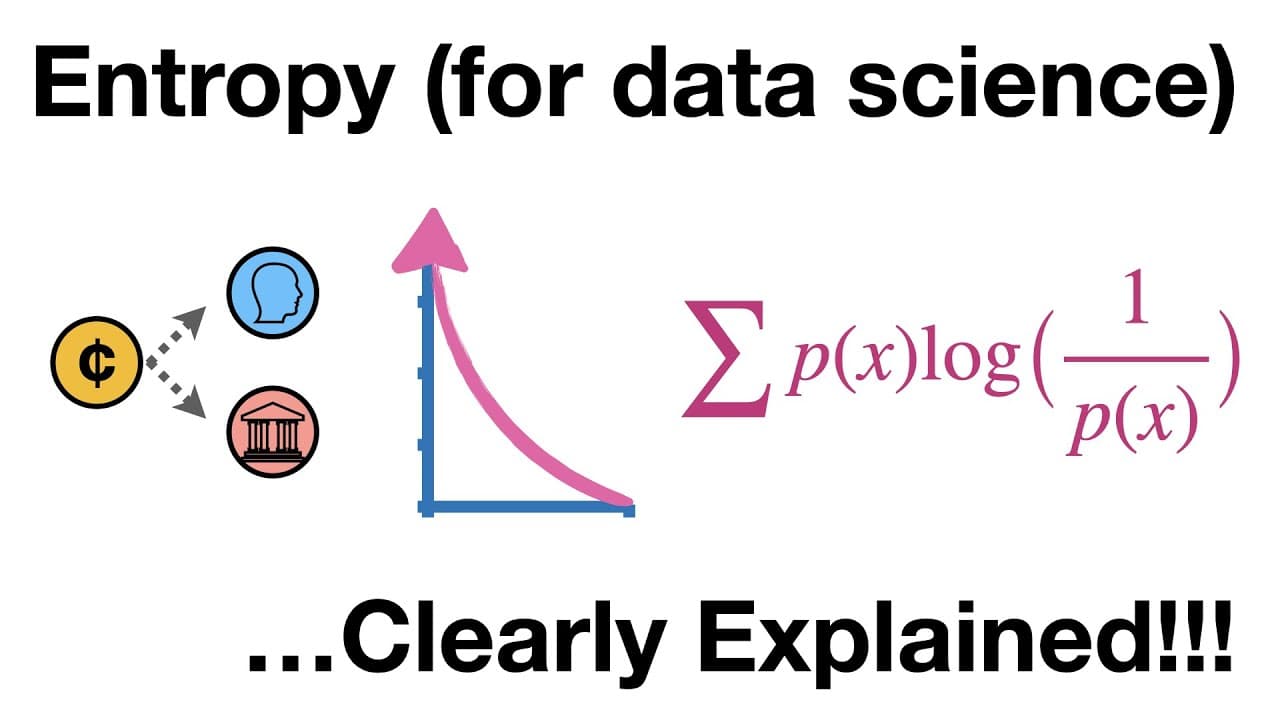
Entropy measures the average surprise in data science, used for classification trees, mutual information, and dimension reduction. It quantifies the uncertainty or diversity of outcomes based on probabilities, with higher entropy indicating greater unpredictability in a dataset. Understanding entropy helps in evaluating similarities and differences among categories effectively.
Transcript
yes you can understand entropy hooray steadquest hello i'm josh starmer and welcome to statquest today we're going to talk about entropy for data science and it's going to be clearly explained note this stat quest assumes that you are already familiar with the main ideas of expected values if not check out the quest entropy is used for a lot of thi... Read More
Key Insights
- 💁 Entropy is used in various data science applications such as classification trees, mutual information, and dimension reduction algorithms.
- 😮 Surprise is inversely related to probability, and entropy quantifies the average surprise per event.
- 😮 The equation for entropy can be derived from the equation for surprise, making it easier to understand and interpret.
- 😮 Entropy can be used to measure the similarity or difference between categories based on their probabilities and associated surprises.
- ✋ Higher entropy indicates higher uncertainty or diversity in outcomes.
- ❓ The entropy value is affected by the probabilities assigned to different outcomes.
- 💁 Entropy helps in understanding and quantifying the information content or uncertainty in a dataset.
Install to Summarize YouTube Videos and Get Transcripts
Explore YouTube Video Summarizer or Get YouTube Transcript Extractor
Questions & Answers
Q: How is entropy used in data science?
Entropy is used in data science for building classification trees, measuring the relationship between two variables with mutual information, and quantifying similarities and differences in dimension reduction algorithms.
Q: How is surprise related to probability?
Surprise is inversely related to probability. When the probability of an event is low, the surprise associated with it is high, and vice versa.
Q: How is entropy calculated?
Entropy is calculated using the equation: entropy = -p1log(p1) - p2log(p2) - ... - pnlog(pn), where p1, p2, ..., pn are the probabilities of different outcomes.
Q: What does the entropy value indicate?
The entropy value indicates the average surprise per event. Higher entropy suggests a higher degree of uncertainty or diversity in the outcomes.
Key Insights:
- Entropy is used in various data science applications such as classification trees, mutual information, and dimension reduction algorithms.
- Surprise is inversely related to probability, and entropy quantifies the average surprise per event.
- The equation for entropy can be derived from the equation for surprise, making it easier to understand and interpret.
- Entropy can be used to measure the similarity or difference between categories based on their probabilities and associated surprises.
- Higher entropy indicates higher uncertainty or diversity in outcomes.
- The entropy value is affected by the probabilities assigned to different outcomes.
- Entropy helps in understanding and quantifying the information content or uncertainty in a dataset.
- Entropy can be derived using the properties of logs and the surprise equation, allowing for a better understanding of its calculation and interpretation.
Summary & Key Takeaways
-
Entropy is used in various data science applications such as classification trees, mutual information, and dimension reduction algorithms.
-
Surprise is inversely related to probability, and entropy quantifies the average surprise per event.
-
The equation for entropy can be derived from the equation for surprise, and it can be used to measure similarity or difference between categories.
Read in Other Languages (beta)
Share This Summary 📚
Summarize YouTube Videos and Get Video Transcripts with 1-Click
Try YouTube Summary with ChatGPT & Claude or YouTube Transcript Generator
Explore More Summaries from StatQuest with Josh Starmer 📚
Summarize YouTube Videos and Get Video Transcripts with 1-Click
Try YouTube Summary with ChatGPT & Claude or YouTube Transcript Generator