Normative and positive statements | Basic economics concepts | AP Macroeconomics | Khan Academy
TL;DR
Normative statements are a matter of opinion or ethics, while positive statements can be tested.
Transcript
- [Instructor] What we're going to do in this video is discuss the difference between normative statements and positive statements, and you'll see these words used usually in an economic context, sometimes a philosophical one. A normative statement is one that really is a matter of opinion, maybe a matter of ethics, something that someone thinks is... Read More
Key Insights
- 👍 Normative statements are based on opinion or ethics, while positive statements can be tested and proven true or false.
- ❓ Normative statements cannot be objectively evaluated or measured.
- ❓ Positive statements can be analyzed through data and empirical evidence.
- 🧚 The presence of words like "should" or "fair" indicates a normative statement.
- ❓ Positive statements can be studied through simulations, comparisons, and surveys.
- 🏆 Positive statements in economics often involve testing the impact of policies or economic theories.
- ❓ Normative statements can be influenced by personal beliefs or values.
Install to Summarize YouTube Videos and Get Transcripts
Explore YouTube Video Summarizer or Get YouTube Transcript Extractor
Questions & Answers
Q: What is the difference between normative statements and positive statements?
A normative statement is a subjective opinion or ethical view that cannot be tested, while a positive statement can be evaluated and proven true or false through testing or data analysis.
Q: Can normative statements be proven right or wrong?
No, normative statements cannot be proven right or wrong as they are based on personal beliefs or opinions rather than verifiable facts.
Q: How can positive statements be tested?
Positive statements can be tested through various methods such as running simulations, comparing data from different scenarios, and conducting surveys or experiments.
Q: Is the statement "Raising taxes on the wealthy slows economic growth" a normative or positive statement?
This statement is a positive statement because it can be tested by comparing countries or conducting simulations to analyze the impact of raising taxes on the wealthy on economic growth.
Summary & Key Takeaways
-
Normative statements are subjective opinions and cannot be tested, while positive statements can be evaluated and proven true or false.
-
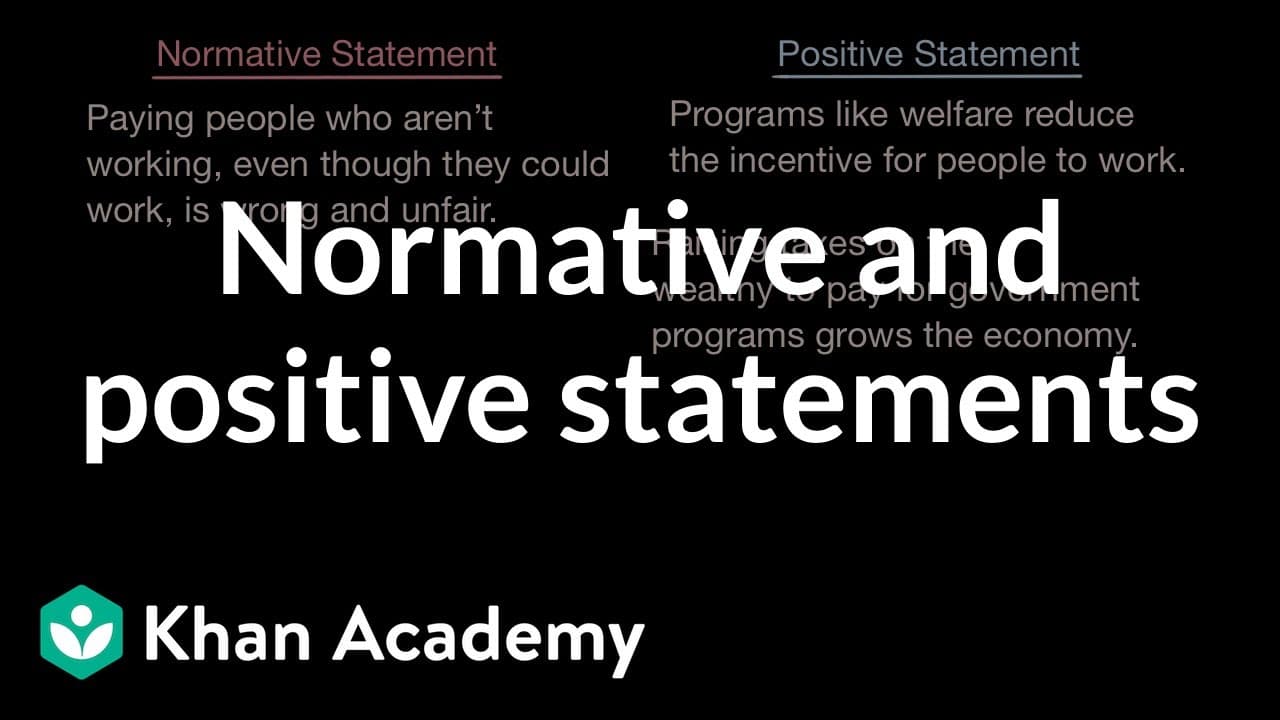
Examples of normative statements include "Paying people who aren't working, even though they could work, is wrong and unfair."
-
Examples of positive statements include "Programs like welfare reduce the incentive for people to work" and "Raising taxes on the wealthy to pay for government programs grows the economy."
Read in Other Languages (beta)
Share This Summary 📚
Summarize YouTube Videos and Get Video Transcripts with 1-Click
Try YouTube Summary with ChatGPT & Claude or YouTube Transcript Generator
Explore More Summaries from Khan Academy 📚



Summarize YouTube Videos and Get Video Transcripts with 1-Click
Try YouTube Summary with ChatGPT & Claude or YouTube Transcript Generator