Converting Metric Units of Volume
TL;DR
This content explains how to convert between different metric units of volume using conversion factors, focusing on the two categories based on length and liquids.
Transcript
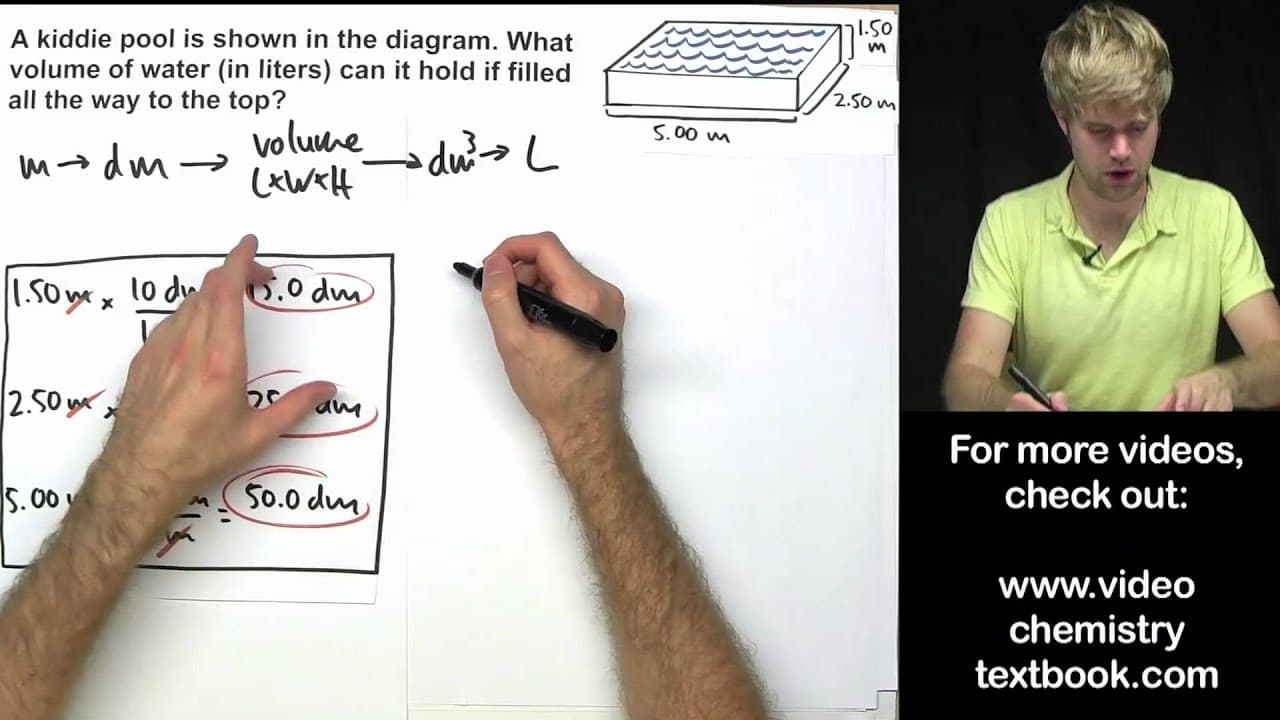
here we're going to look at how to convert between metric units of volume there are kind of two categories of metric units that you can use to measure volume one of these categories is based on units of length so we have things like cubic millimet cubic centimet in cubic meters the other category contains units that you're probably most used to dea... Read More
Key Insights
- ⚾ There are two categories of metric units for volume: length-based and liquid-based.
- 🟰 1 milliliter is equal to 1 cubic centimeter, and 1 liter is equal to 1 cubic decimeter.
- 🧑🏭 Conversion factors can be used to convert between different units of volume.
- 🔇 The volume of rectangular objects can be calculated by multiplying the length, width, and height.
- 🔇 Equations are provided for calculating the volume of cylinders and spheres.
- 👻 Conversion factors allow for easy conversion between different categories of metric units.
Install to Summarize YouTube Videos and Get Transcripts
Explore YouTube Video Summarizer or Get YouTube Transcript Extractor
Questions & Answers
Q: What are the two categories of metric units used to measure volume?
The two categories are based on length and liquids. Length-based units include cubic millimeters, cubic centimeters, and cubic meters. Liquid-based units include milliliters and liters.
Q: How can 1 milliliter be converted to cubic centimeters?
1 milliliter is exactly the same as 1 cubic centimeter. This means that they have a 1:1 conversion ratio, so they are interchangeable.
Q: How can 1 liter be converted to cubic decimeters?
1 liter is equivalent to 1 cubic decimeter. This means that they have a 1:1 conversion ratio, so they are the same.
Q: How can conversion factors be used to convert between different categories of metric units?
Conversion factors can be used by setting up a ratio between the two units being converted. For example, to convert cubic centimeters to milliliters, you can use the conversion factor: 1 ml/1 cubic cm. Multiply the given value in cubic centimeters by this conversion factor to get the equivalent value in milliliters.
Summary & Key Takeaways
-
The content discusses two categories of metric units for volume measurement: one based on length (cubic millimeters, cubic centimeters, cubic meters) and the other based on liquids (milliliters, liters).
-
There are straightforward ways to convert between these categories. For example, 1 milliliter is equal to 1 cubic centimeter, and 1 liter is equal to 1 cubic decimeter.
-
Conversion factors can be used to convert between different units of volume.
Read in Other Languages (beta)
Share This Summary 📚
Summarize YouTube Videos and Get Video Transcripts with 1-Click
Try YouTube Summary with ChatGPT & Claude or YouTube Transcript Generator
Explore More Summaries from Tyler DeWitt 📚


Summarize YouTube Videos and Get Video Transcripts with 1-Click
Try YouTube Summary with ChatGPT & Claude or YouTube Transcript Generator