How to Calculate the Diameter of a Parachute
TL;DR
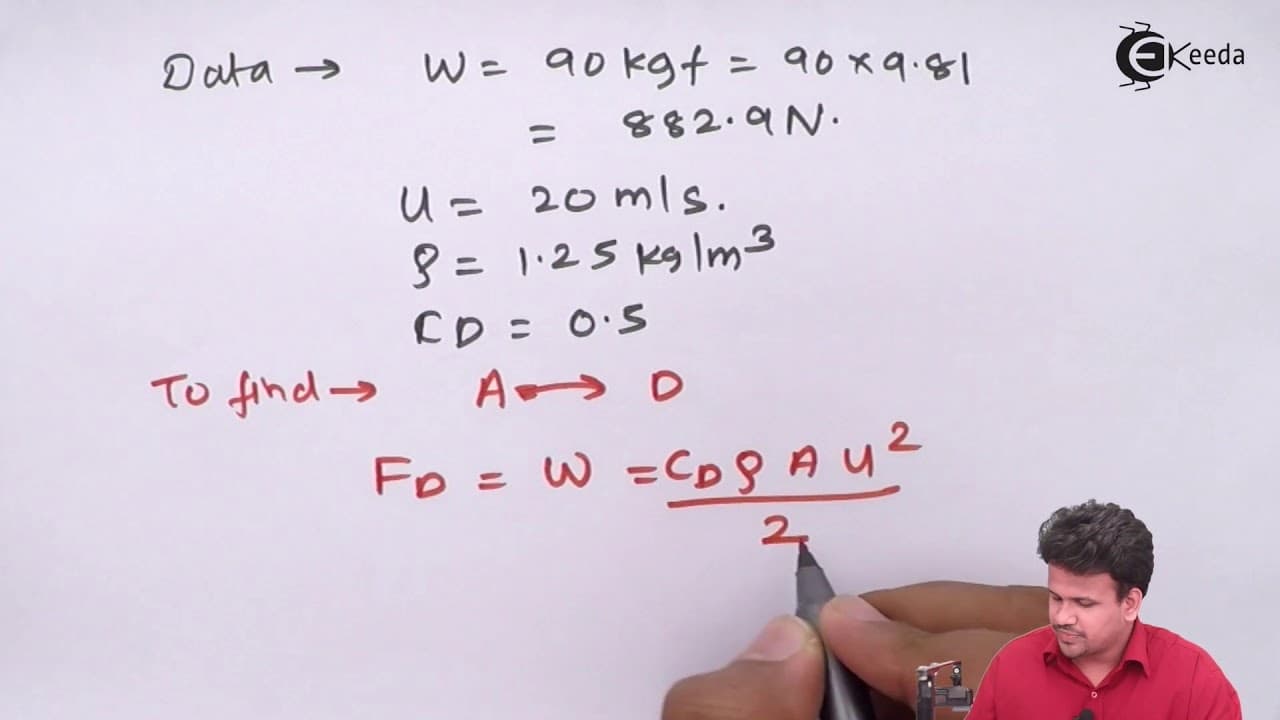
To calculate the diameter of a parachute, use the equilibrium of forces where the drag force equals the weight of the descending object. Given a weight of 90 kg, a descent velocity of 20 m/s, a drag coefficient of 0.5, and air density of 1.25 kg/m³, the diameter computes to approximately 2.999 meters.
Transcript
hello students in the previous section we have seen what is the lift force and the drive force and method to derive how lift force and drag force comes into existence now we are going to apply those formulas and concept to solve real life problems on left and right so we have a problem over here that is a man weighing 90 kg f descends down to a gro... Read More
Key Insights
- 🏋️ Lift force and drag force formulas and concepts can be applied to real-life problems involving parachutes.
- 🏋️♂️ In the problem, the drag force on the parachute is equal to the weight of the man, resulting in equilibrium during descent.
- 🐲 The coefficient of drag and density play essential roles in calculating the drag force.
- 😵 The equation Fd = ρAcd(u^2)/2 is used to determine the drag force, where A is the cross-sectional area of the parachute.
- 🪂 By solving the equation and substituting known values, the diameter of the parachute can be calculated.
- 🐢 The diameter of the parachute is critical for determining its effectiveness in slowing down the descent of the attached individual.
- 🐲 Understanding drag forces is crucial for designing safe and efficient parachutes.
Install to Summarize YouTube Videos and Get Transcripts
Explore YouTube Video Summarizer or Get YouTube Transcript Extractor
Questions & Answers
Q: How does the drag force on the parachute affect its descent?
The drag force, which opposes the motion, counteracts the weight of the man, resulting in equilibrium during descent. The drag force is crucial in determining the parachute's diameter.
Q: How is the drag force calculated in this problem?
The drag force formula is Fd = ρAcd(u^2)/2, where ρ is density, A is the cross-sectional area, cd is the coefficient of drag, and u is the velocity. By substituting known values into this equation, the drag force is determined.
Q: Why is the coefficient of drag important in the calculation?
The coefficient of drag quantifies the aerodynamic properties of the parachute. It affects the magnitude of the drag force, which influences the parachute's ability to slow down and descend safely.
Q: What is the significance of finding the diameter of the parachute?
The diameter of the parachute is derived from the calculated drag force. This information is crucial for ensuring that the parachute provides enough drag to slow down the descent of the man attached to it.
Summary & Key Takeaways
-
A man weighing 90 kg descends with a parachute in the shape of a hemisphere against the air with a velocity of 20 m/s.
-
The drag force on the parachute will be in the upward direction and equal to the weight of the man, leading to equilibrium.
-
By calculating the drag force using the given data, the diameter of the parachute can be determined.
Read in Other Languages (beta)
Share This Summary 📚
Summarize YouTube Videos and Get Video Transcripts with 1-Click
Try YouTube Summary with ChatGPT & Claude or YouTube Transcript Generator
Explore More Summaries from Ekeeda 📚

Summarize YouTube Videos and Get Video Transcripts with 1-Click
Try YouTube Summary with ChatGPT & Claude or YouTube Transcript Generator