What Is the Integrated Rate Law for Second-Order Reactions?
TL;DR
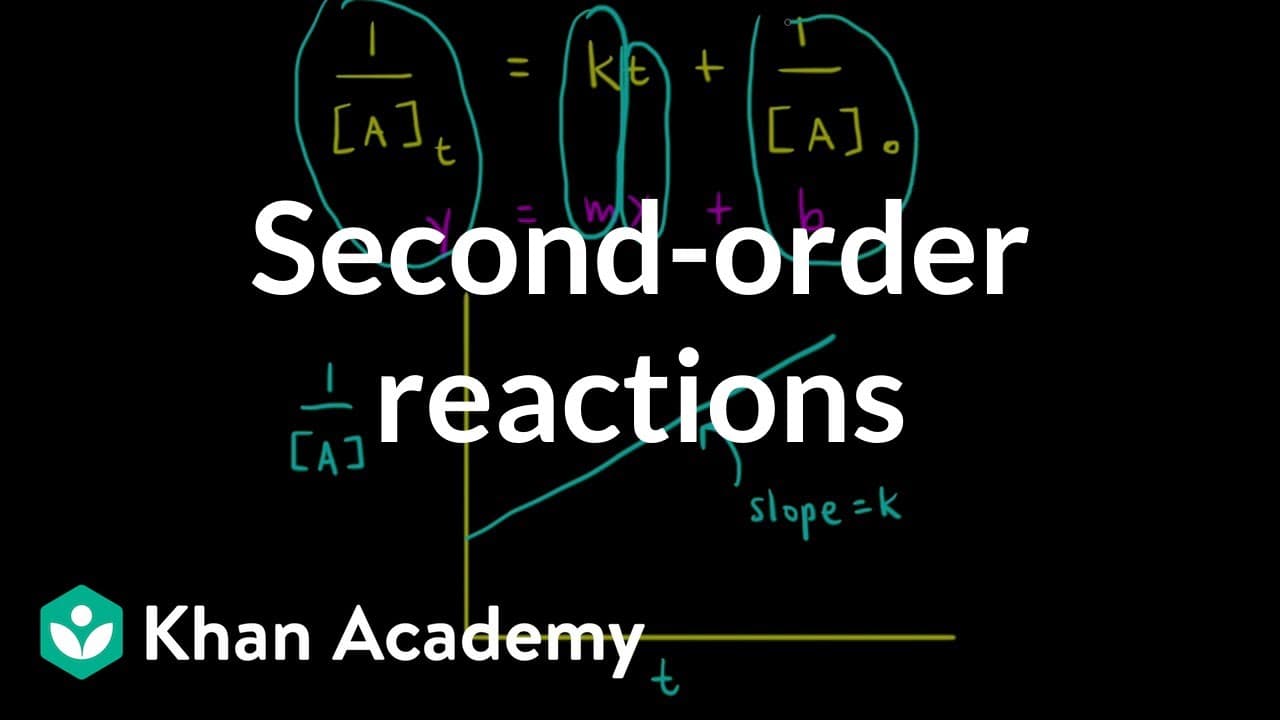
The integrated rate law for second-order reactions is given by 1/[A]t = kt + 1/[A]0, where [A]t is the concentration at time t and [A]0 is the initial concentration. This equation has a linear form where the slope equals the rate constant (k), and incorporates stoichiometric coefficients, which can affect the calculation of k.
Transcript
- [Instructor] Let's say we have a hypothetical reaction where reactant A turns into products. And let's say the reaction is second order with respect to A. If the reaction is second order with respect to A, then we can write the rate of the reaction is equal to the rate constant k times the concentration of A to the second power since this is a se... Read More
Key Insights
- ☠️ The rate of a second order reaction can be expressed using the rate constant and the concentration of reactant A squared.
- ☠️ The integrated rate law for a second order reaction is derived by setting the two ways of expressing the rate of reaction equal to each other and using calculus.
- ☠️ The integrated rate law resembles the equation for a straight line, with the slope representing the rate constant and the y-intercept representing the reciprocal of the initial concentration.
- ☠️ The stoichiometric coefficient in a balanced chemical equation affects the math and can change the value of the rate constant.
- 🫥 Plotting 1/[A]t against time results in a straight line, with the slope equal to 2k.
- 🇦🇪 The rate constant has units of 1/(molar * seconds) due to the units of concentration and time in the integrated rate law.
- ☠️ Textbooks may sometimes provide an incorrect rate constant value for second order reactions, as they often overlook the stoichiometric coefficient's influence.
Install to Summarize YouTube Videos and Get Transcripts
Explore YouTube Video Summarizer or Get YouTube Transcript Extractor
Questions & Answers
Q: How is the rate of a second order reaction determined?
The rate of a second order reaction can be determined by multiplying the rate constant (k) by the concentration of reactant A squared.
Q: What is the integrated rate law for a second order reaction?
The integrated rate law for a second order reaction is given by 1/[A]t = kt + 1/[A]0, where [A]t is the concentration at time t and [A]0 is the initial concentration.
Q: How is the integrated rate law derived?
The integrated rate law is derived by setting the two ways of expressing the rate of reaction equal to each other, using calculus and integration.
Q: How can the rate constant (k) be determined?
The rate constant (k) can be determined by finding the slope of the graph when plotting 1/[A]t on the y-axis and time on the x-axis. The slope of the line is equal to 2k.
Summary & Key Takeaways
-
The rate of a second order reaction can be expressed as the rate constant (k) multiplied by the concentration of reactant A squared.
-
The integrated rate law for a second order reaction can be derived using calculus and is expressed as 1/[A]t = kt + 1/[A]0, where [A]t is the concentration at time t and [A]0 is the initial concentration.
-
The integrated rate law resembles the equation for a straight line, with the slope representing the rate constant (k) and the y-intercept representing 1/[A]0.
Read in Other Languages (beta)
Share This Summary 📚
Summarize YouTube Videos and Get Video Transcripts with 1-Click
Try YouTube Summary with ChatGPT & Claude or YouTube Transcript Generator
Explore More Summaries from Khan Academy 📚



Summarize YouTube Videos and Get Video Transcripts with 1-Click
Try YouTube Summary with ChatGPT & Claude or YouTube Transcript Generator