Problem 09 Non Determinstic PDA
TL;DR
This video discusses the construction of a non-deterministic pushdown automaton (NPDA) that accepts strings of the form a^i v^j series^k d^l such that i is equal to k or j is equal to l.
Transcript
click the Bell icon to get latest videos from ekeeda Hello friends let us solve one more question on design of npda it is accepting the set of all strings of the form a raised to i v raised to J series to K and D raised to l such that I is equal to K or J is equal to l here we are using the power of non-deterministic PDA one comparison will do comp... Read More
Key Insights
- 🏗️ The construction of the NPDA involves creating two branches, one for comparing A's and C's and the other for comparing B's and D's.
- 🔣 The NPDA uses the top of the stack to keep track of zeros and symbols encountered in the input string.
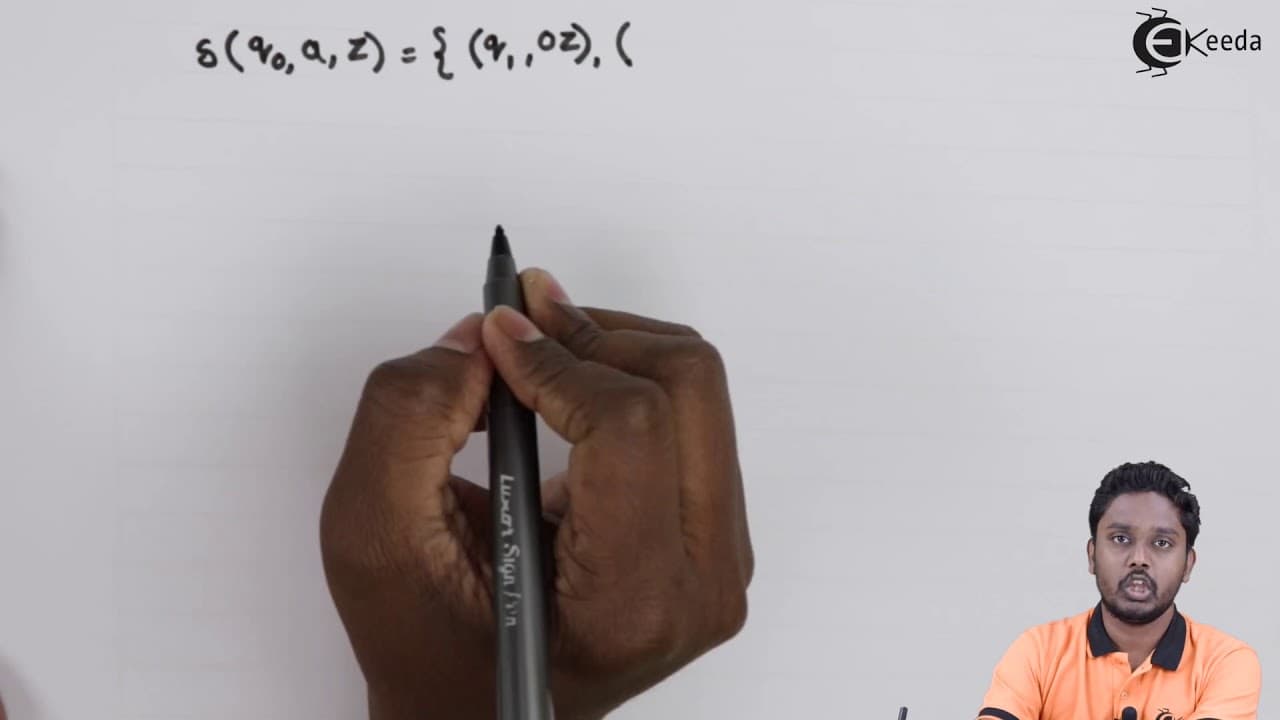
- 0️⃣ Transition definitions in the NPDA involve pushing zeros onto the stack, popping zeros off the stack, and skipping symbols based on the encountered input.
- 🉑 The final states of the NPDA determine whether the string is accepted or rejected.
Install to Summarize YouTube Videos and Get Transcripts
Explore YouTube Video Summarizer or Get YouTube Transcript Extractor
Questions & Answers
Q: What is the purpose of the NPDA constructed in this video?
The NPDA is designed to accept strings of the form a^i v^j series^k d^l such that i is equal to k or j is equal to l.
Q: How does the NPDA compare the number of A's and C's?
The NPDA uses a branch to compare the number of A's and C's. For each encountered A, a zero is pushed onto the stack, and for each encountered C, a zero is popped off the stack while skipping B and D symbols.
Q: What happens when the NPDA encounters the symbol B?
When the NPDA encounters the symbol B, it keeps the zero on the top of the stack unchanged, effectively ignoring the B symbol.
Q: How does the NPDA count the number of D's?
The NPDA uses a loop and a separate state to continuously pop off zeros from the stack for each encountered D symbol, ensuring that the number of A's and C's previously counted is matched.
Summary & Key Takeaways
-
The video demonstrates the construction of an NPDA that compares the number of A's and C's in a string and counts the number of B's and D's separately.
-
Two branches are created in the NPDA, one for the comparison of A's and C's and the other for the comparison of B's and D's.
-
Transitions are defined based on the encountered symbols, pushing zeros onto the stack, and popping zeros off the stack.
Read in Other Languages (beta)
Share This Summary 📚
Summarize YouTube Videos and Get Video Transcripts with 1-Click
Try YouTube Summary with ChatGPT & Claude or YouTube Transcript Generator
Explore More Summaries from Ekeeda 📚






Summarize YouTube Videos and Get Video Transcripts with 1-Click
Try YouTube Summary with ChatGPT & Claude or YouTube Transcript Generator