Divergence intuition, part 2
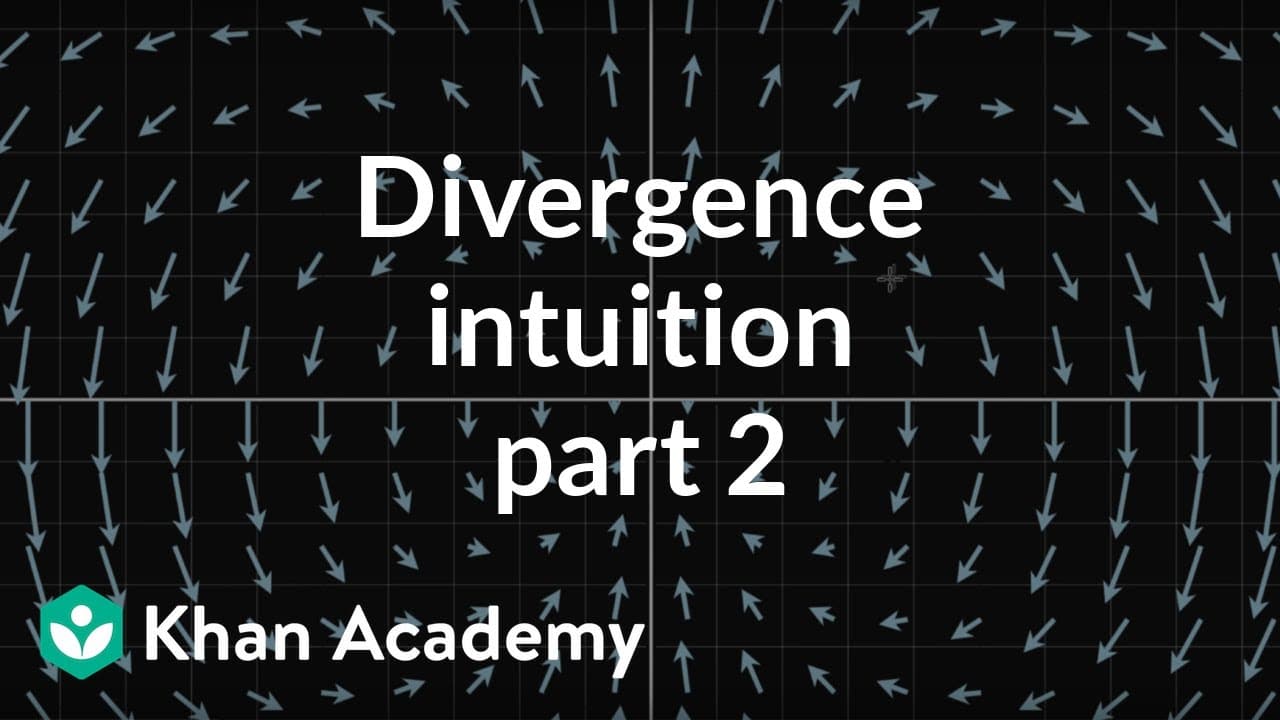
TL;DR
This video explores the concept of divergence, explaining how it can be understood intuitively and the formula that represents it.
Transcript
- [Voiceover] Hey everyone. So, in the last video I was talking about divergence and kind of laying down the intuition that we need for it. Where you're imagining a vector field as representing some kind of fluid flow where particles move according to the vector that they're attached to in that point in time and as they move to a different point th... Read More
Key Insights
- 😥 Divergence measures the tendency of fluid flow to either move away from, towards, or remain balanced at a given point.
- 😥 Positive divergence signifies fluid movement away from the point, negative divergence indicates flow towards the point, and zero divergence represents a balance of inflow and outflow.
- 🏑 Divergence is represented by a formula using functions P and Q, which are scalar value functions representing the components of the vector field's output.
- 😥 The intuition of divergence involves considering the behavior of fluid particles around a point, whether they diverge, converge, or remain balanced.
- 😥 Even in cases of non-zero divergence, there can be movement towards the point, but it is counterbalanced by more rapid outflow.
Install to Summarize YouTube Videos and Get Transcripts
Explore YouTube Video Summarizer or Get YouTube Transcript Extractor
Questions & Answers
Q: How is divergence related to the movement of fluid particles in a vector field?
Divergence in a vector field determines whether fluid particles tend to flow towards or away from a specific point in space. Positive divergence indicates movement away from the point, while negative divergence indicates movement towards it.
Q: Can divergence be zero at a point? What does it mean?
Yes, divergence can be zero at a point. It means that the fluid flowing towards the point is perfectly balanced by the fluid flowing away from it. In other words, the net flow of fluid is neither towards nor away from the point.
Q: Are there any other examples of positive divergence besides the extreme case shown in the video?
Yes, positive divergence can occur even when there is some movement towards the point. However, this movement is heavily counterbalanced by fluid particles rapidly moving away from the point, resulting in an overall divergence away from the point.
Q: How is negative divergence different from positive divergence?
Negative divergence occurs when fluid particles converge towards a point. While the extreme example shown in the video features all vectors flowing towards the point, it can also include scenarios where some fluid particles move away from the point, but are heavily counterbalanced by particles flowing towards it.
Summary & Key Takeaways
-
The video introduces the concept of divergence, which explores whether fluid flows tend to move towards or away from a specific point in space.
-
It discusses the intuitive understanding of positive divergence, where fluid particles move away from a point, and negative divergence, where particles converge towards a point. It also explains zero divergence.
-
The video hints at exploring the formula for divergence in the upcoming videos, using functions P and Q and their partial derivative properties.
Read in Other Languages (beta)
Share This Summary 📚
Summarize YouTube Videos and Get Video Transcripts with 1-Click
Try YouTube Summary with ChatGPT & Claude or YouTube Transcript Generator
Explore More Summaries from Khan Academy 📚



Summarize YouTube Videos and Get Video Transcripts with 1-Click
Try YouTube Summary with ChatGPT & Claude or YouTube Transcript Generator