How Does the Quantity Theory of Money Work?
TL;DR
The quantity theory of money connects the money supply, real GDP, and price level, expressed through the equation of exchange. It posits that inflation is influenced by changes in money supply, assuming the velocity of money remains constant, though real-world scenarios, like quantitative easing, challenge its simplicity.
Transcript
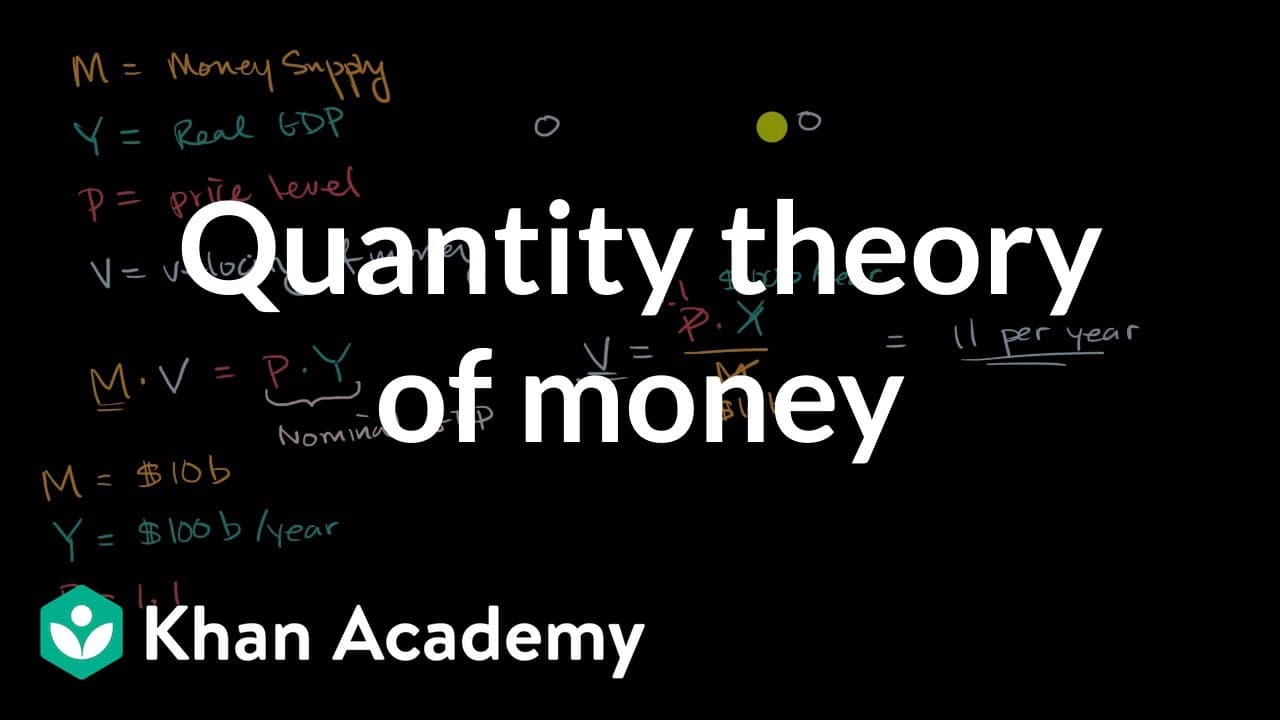
- [Instructor] In this video, we're going to talk about the quantity theory of money which is based on what is known as the equation of exchange and it tries to relate the money supply, M, so this is some measure of the money supply, with the real GDP, Y, so that is real GDP, and the price level, P, so this is price level, and we'll try to make thi... Read More
Key Insights
- 🤑 The quantity theory of money suggests a relationship between money supply, real GDP, and price level.
- 🤑 Velocity of money influences how frequently money is exchanged, impacting the economy.
- 🤑 Monetarists consider inflation a result of changes in the money supply.
- 🖤 Quantitative easing and the lack of dramatic inflation challenge the simplicity of the theory.
- 🤑 Technology advancements and shifts in people's mindset could affect velocity of money.
- 🤑 The equation of exchange provides a framework for analyzing the relationship between money, price level, and real GDP.
- 🤑 The quantity theory of money offers a simplified perspective on inflation in terms of monetary factors.
Install to Summarize YouTube Videos and Get Transcripts
Explore YouTube Video Summarizer or Get YouTube Transcript Extractor
Questions & Answers
Q: What does the quantity theory of money aim to relate?
The quantity theory of money aims to relate the money supply, real GDP, and price level in an economy.
Q: How is the velocity of money defined?
Velocity of money is a measure of how quickly money circulates in the economy, indicating how many times a dollar changes hands in a year.
Q: How can the equation of exchange be used to calculate nominal GDP?
The equation of exchange, which states that money supply times velocity equals price level times real GDP, can be used to calculate nominal GDP by multiplying the price level and real GDP.
Q: What assumptions do monetarists make?
Monetarists assume that velocity is constant and that changes in the money supply do not affect real output in the long run.
Summary & Key Takeaways
-
The quantity theory of money relates the money supply (M) to real GDP (Y) and the price level (P) using the equation of exchange.
-
The velocity of money measures how quickly money circulates in the economy.
-
Monetarists believe that changes in the money supply directly affect inflation, assuming velocity is constant.
Read in Other Languages (beta)
Share This Summary 📚
Summarize YouTube Videos and Get Video Transcripts with 1-Click
Try YouTube Summary with ChatGPT & Claude or YouTube Transcript Generator
Explore More Summaries from Khan Academy 📚



Summarize YouTube Videos and Get Video Transcripts with 1-Click
Try YouTube Summary with ChatGPT & Claude or YouTube Transcript Generator